
Disclaimer, immediately
The brewing of alcohol at home requires no licence in the UK for personal consumption. The brewing of alcohol in prison is, however, against prison rules, and this article is not a recommendation to do either, particularly the second. It is a piece of food history. Read on accordingly.
What happened in Wolverhampton
In the early 2000s, the staff at Wolverhampton prison noticed something odd. Quite a few of the inmates had started ordering jars of Marmite, the standard 250g, on the regular canteen list. The Marmite was disappearing faster than would be expected for normal toast-spreading purposes. The fruit ration was also disappearing faster than expected. Plastic containers, traditionally treated as low-risk items in cell inspections, were suddenly receiving more attention.
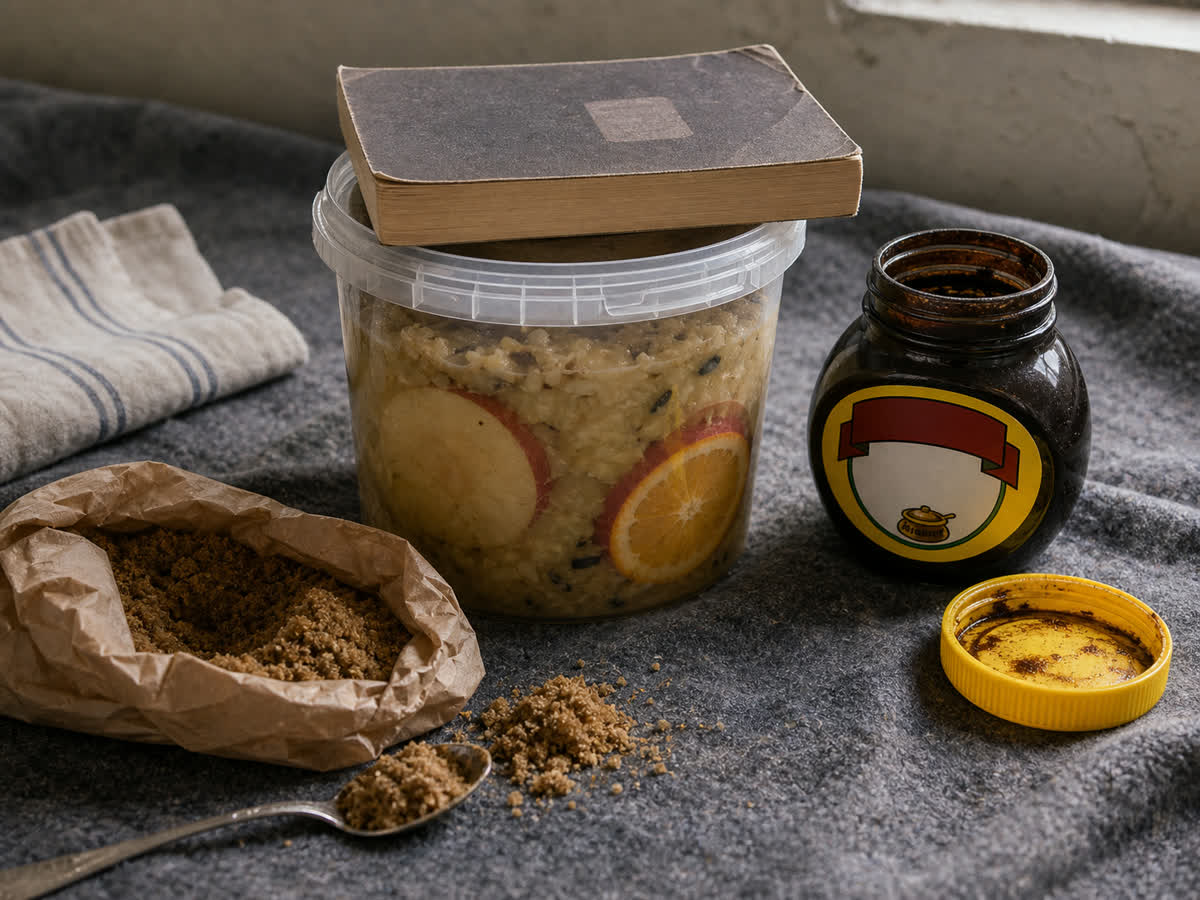
The penny dropped. Inmates were using the yeast in Marmite (which, although autolysed and not freely active, still contains enough live or revivable cells to do basic fermentation) combined with orange or apple pulp and a smuggled cup of sugar, sealed in a plastic container with a small hole for gas to escape, kept warm under the bedclothes, to brew small batches of basic prison hooch.
The story made the papers. Marmite, demurely, declined to comment on the off-label use. The prison cracked down on Marmite orders. The inmates, presumably, moved on to a different yeast source.
The principle, briefly
Brewing alcohol requires three things: a sugar source, a yeast culture, and a warm place to let the two react. Conventional brewing uses malted barley or grapes (or, indeed, fruit) for the sugar, and dedicated brewer’s or wine-yeast cultures for the yeast.
The Wolverhampton inmates used fruit pulp for the sugar, and Marmite for the yeast. It is, by all accounts and reports, a slow and inefficient ferment compared to using proper brewing yeast. The yield is low. The alcohol content is modest, probably four to six per cent at best. The resulting liquid is cloudy, off-smelling, and very strongly flavoured of Marmite. It is not pleasant.
But it is, in a strict sense, alcohol made from a jar of yeast extract. The chemistry works.
The “recipe”, with strong caveats
Should you choose, in a non-prison setting, to demonstrate the chemistry to yourself, the principle is:
- Two teaspoons of Marmite dissolved in warm water
- A cup of sugar
- The pulp of several oranges (or apples, or any sugary fruit)
- A sealed container with a pinhole or simple airlock so the carbon dioxide can escape
- A warm dark place, three to five days
Mix everything, seal it loosely, wait. The Marmite yeast will, eventually, start to ferment the fruit sugars. You will know it is working because the container will bubble and the smell will become powerfully yeasty.
What you will not produce is anything you would want to drink. The flavour is unequivocally awful. The brew is cloudy. The alcohol yield is unimpressive. As a piece of garden-shed chemistry it is interesting. As a beverage it is a curiosity.
If you want home-brewed alcohol that you would actually enjoy drinking, buy proper brewing yeast (a sachet of dried Champagne yeast costs about a pound), use proper malt or fruit juice, and follow a real recipe from a real home-brew book. The Marmite hooch story is a piece of newspaper folklore. Do not actually try to live on the resulting product.
What the story was really about
The Wolverhampton episode was, in a small way, a flattering one for Marmite. The jar’s yeast content turned out to be biologically active enough, even after processing, to support a fermentation. That is a quiet testament to the underlying ingredient quality. Marmite is, after all the seasoning and the salt and the concentration, still recognisably a yeast product.
It is also a small reminder that human ingenuity, applied to limited resources, will find a way. Including, if necessary, by way of a smuggled cup of sugar and a jar of Marmite.
The Hate Party would not have known what to do with the situation. The Love Party, of course, immediately spotted the trick.
Source: contemporary press coverage; HM Prison Service public statements at the time.