
What is Marmite?
Marmite is Britain’s most divisive spread - a dark brown, sticky paste made from concentrated yeast extract, a by-product of brewing beer. First produced in 1902, Marmite has become a British cultural icon, packaged in its distinctive squat glass jar with a yellow lid. The spread has an intensely savoury, salty flavour with umami notes that famously divides opinion, spawning the iconic slogan “Love it or hate it” — a divide that, it turns out, is partly written in your DNA.
Health Benefits
Marmite is remarkably nutritious, packed with B-vitamins including B1 (thiamine), B2 (riboflavin), B3 (niacin), and folic acid. It’s naturally low in calories (just 11 calories per serving) and virtually fat-free. The high B-vitamin content supports energy production, nervous system function, and mental wellbeing, which is part of why vegans keep Marmite in the cupboard for its B12. Some studies even suggest regular Marmite consumption may reduce anxiety.
Storage and Shelf Life
Thanks to its high salt content (around 8.5% salt), Marmite has an impressively long shelf life. Once opened, it should be stored in a cool, dry place - not the fridge - where it will keep for months. The spread doesn’t truly go off, though it may develop a slightly stronger flavour over time.
What Do I Do With It?
The Classic: Marmite on Toast
The traditional way to eat Marmite is thinly spread on hot buttered toast. The heat melts the butter, creating a golden layer over which you apply a thin scraping of Marmite - the key word being “thin.” First-timers often make the mistake of spreading it like jam or peanut butter, which results in an overwhelming, overly salty experience.
Cooking with Marmite
Beyond toast, Marmite is a secret weapon in British kitchens:
- Stews and casseroles: A teaspoon adds incredible depth and umami
- Gravy and sauces: Enhances savoury flavours and adds richness
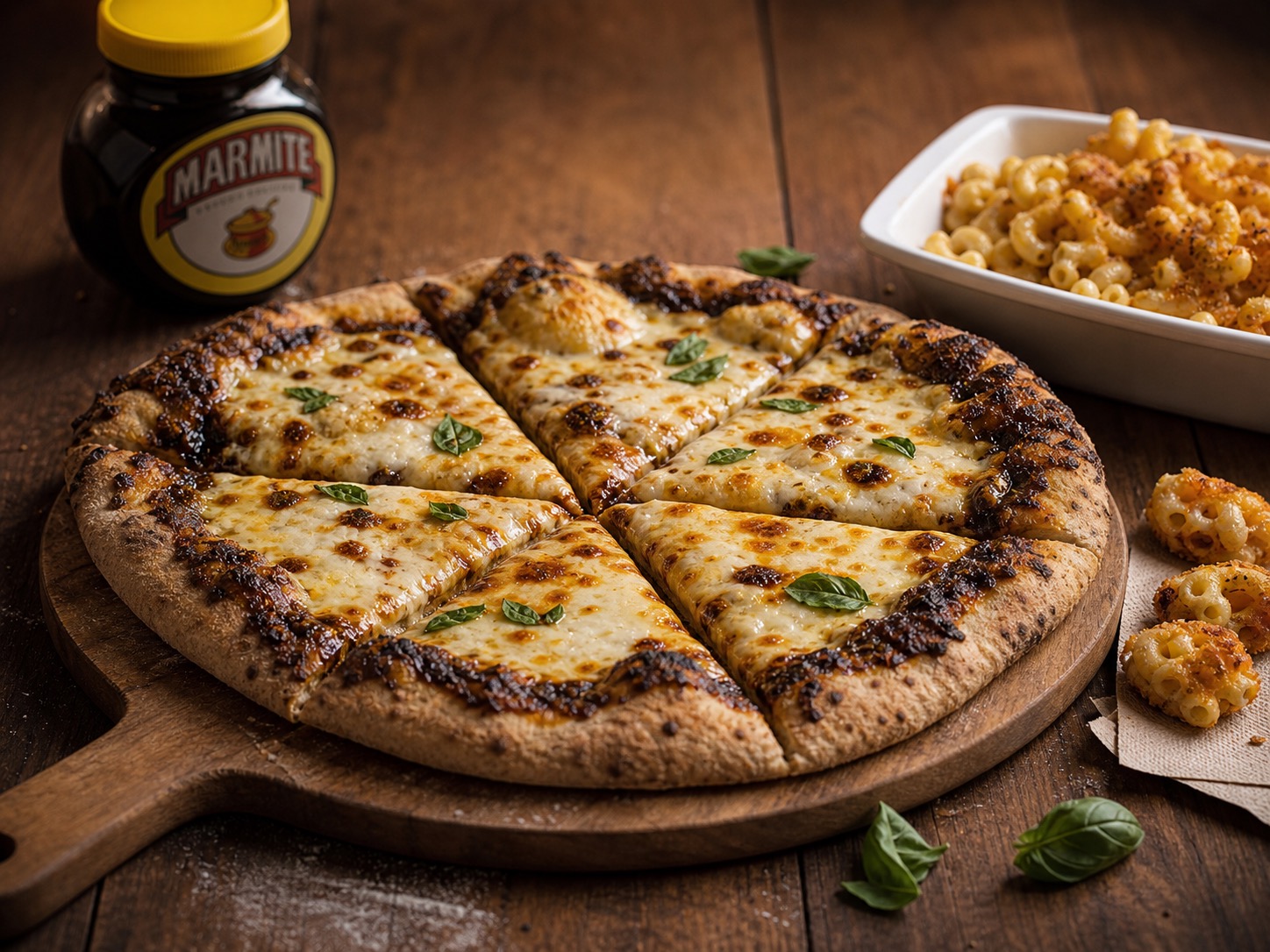
- Cheese dishes: Pairs brilliantly with cheddar in cheese on toast or macaroni cheese
- Mashed potatoes: A small amount creates extraordinarily flavourful mash
- Roast potatoes: Brush on before roasting for extra crispy, savoury spuds
- Bolognese and chilli: Adds complexity and depth
- Spaghetti: Try it with just butter and Marmite for a simple, satisfying meal — see Nigella’s Marmite spaghetti, the right way
Alternative Uses
Marmite can be dissolved in hot water to make a savoury drink (particularly popular in winter), used as a sandwich filling with cheese or cucumber, or even added to scrambled eggs.
What Are Its Ingredients?
UK Marmite ingredients, as printed on a 2026 jar: Yeast extract (contains barley, wheat, oats, rye), salt, vegetable juice concentrate, vitamins (thiamin, riboflavin, niacin, vitamin B12 and folic acid), natural flavouring (contains celery)
The recipe has remained remarkably consistent over the decades, with only minor adjustments. The New Zealand version, produced by Sanitarium, uses a slightly different formulation that locals claim tastes subtly different from the British original.
Who Makes It?
Marmite is currently owned by Unilever, the Anglo-Dutch consumer-goods conglomerate that bought the brand when it acquired Bestfoods in 2000. As of March 2026 that is changing: McCormick has agreed to combine with Unilever’s foods business in a roughly $45 billion deal, and Marmite is included in the package. The transaction is expected to close mid-2027, after which Marmite will sit inside the American spice company alongside Knorr, Hellmann’s, Bovril, Colman’s and Pot Noodle.
Day-to-day production has not changed: jars are still made in Burton-on-Trent, still in the same bulbous glass jar with the same yellow-and-black label, still concentrated brewers’ yeast with the same secret seasoning blend the original Marmite Food Company developed in 1902. The corporate parent on the holding-company papers is the bit that is moving.
Before Unilever, the brand had been in Bovril Limited’s hands from 1934, then briefly with the American consumer-goods group CPC International (later Bestfoods) from 1990 to 2000. Unilever’s 27-year tenure has been the longest-marketing-investment, most-product-innovation, most-culturally-prominent period in Marmite’s history. Whether that continues under McCormick is the question.
Different Versions Worldwide
Confusingly, several different products worldwide carry the Marmite name:
- UK Marmite: The original, made in Burton-on-Trent by Unilever (and from mid-2027, by McCormick). The recipe nearly every reference to “Marmite” on this site means.
- New Zealand Marmite: Made by Sanitarium in Christchurch under a separate licence. A genuinely different recipe — sweeter, slightly caramelised, with a different mouthfeel. New Zealanders are fiercely loyal to it and the 2011-13 Marmageddon shortage when the Christchurch factory was damaged by earthquake reached prime-ministerial press-conference level there.
- South African Marmite: Made under licence in South Africa (historically by Pioneer Foods, now part of PepsiCo South Africa). A milder, slightly less salty recipe than the UK version but recognisably the same product — closer to the UK original than the NZ version is. Often labelled simply “Marmite” with no country qualifier.
- Marmite Guinness (UK, 2007): A discontinued UK limited edition where Unilever swapped the standard Burton brewers’ yeast for spent yeast from Guinness’s St James’s Gate brewery in Dublin. Black-and-gold label, deeper and slightly more bitter than standard. Not a separate national variant — a one-off collaboration. See Guinness Marmite, the limited edition with the Irish stout yeast.
These products are not interchangeable and taste distinctly different, leading to fierce loyalty among devotees of each version.
How Is It Made?
Marmite is produced at the iconic factory in Burton-on-Trent, Staffordshire, England’s historic brewing capital. The town’s brewing heritage makes it the perfect location, as Marmite is made from brewer’s yeast.
The Production Process
- Yeast extraction: Spent brewer’s yeast from beer production is collected
- Autolysis: The yeast cells are broken down, releasing their contents
- Concentration: The yeast extract is concentrated through heating
- Blending: Vegetable extracts, spices, and vitamins are added
- Maturation: The mixture is matured to develop its distinctive flavour
- Packaging: The spread is jarred in those iconic squat glass pots
Standard Marmite is ready relatively quickly, but premium variants like Marmite XO are matured for 28 days - four times longer than regular Marmite - creating a more intense, complex flavour.
Is It Vegetarian?
Yes. Marmite is suitable for vegetarians and has been approved by the Vegetarian Society. Although it’s made from yeast (which is technically a living organism), yeast is not classified as an animal product. The vegetable extracts and spices used are all plant-based.
Marmite is also vegan-friendly, containing no animal products whatsoever. This makes it popular among plant-based eaters seeking umami flavour and B-vitamins, particularly B12, which can be challenging to obtain in vegan diets.
Is It Natural?
Yes, Marmite is a natural product. The B-vitamins it contains are naturally present in brewer’s yeast, though some additional vitamins (particularly B12 and folic acid) are fortified during production. The spread contains no artificial colours, flavours, or preservatives - its long shelf life is entirely due to its high salt content.
Is It Kosher?
The kosher status of Marmite is complex. While the ingredients themselves are vegetarian and contain nothing explicitly non-kosher, the manufacturing process involves equipment that may also process non-kosher products. Additionally, different batches might be produced on different lines.
Some Jewish communities accept Marmite as kosher (particularly if it’s not being consumed with meat), while others prefer products with specific kosher certification. If keeping strictly kosher, check with your rabbi or look for batches with kosher certification markings.
Where Can I Buy It Outside Britain?
United States
Marmite is widely available in the US through: - Amazon: The most reliable source, offering various sizes including 250g and 500g jars - World Market: Often stocks British foods including Marmite - British import shops: Specialty stores in major cities - Major supermarkets: Increasingly stocked in international aisles
Expect to pay premium prices - typically $8-15 for a 250g jar compared to £3-4 in the UK.
International Versions
Many countries have their own yeast extract spreads: - Australia: Vegemite (and the related Promite) - Switzerland: Cenovis - Germany: Vitam-R - South Africa: Marmite (Guinness-based version) - New Zealand: Marmite (Sanitarium version)
Online Shopping
UK-based online retailers like Ocado, Tesco, and Sainsbury’s ship internationally, though shipping costs can be substantial. British expatriate communities often organize bulk orders to share shipping costs.
Where Does the Name Come From?
The name “Marmite” comes from the French word for a lidded earthenware or metal cooking pot (technically a stockpot). The Marmite jar’s distinctive shape was designed to resemble this French cooking pot, reflected in the stylised marmite depicted on every label.
This naming was quite sophisticated for 1902, lending the product continental sophistication while also being descriptive - the jar literally looks like a tiny marmite pot.
What About Marmite’s Advertising Campaigns?
Marmite’s advertising history is legendary, evolving from straightforward product promotion to some of Britain’s most talked-about marketing campaigns.
Early Days: “My Mate Marmite” (Pre-1996)
Early campaigns focused on health benefits and versatility, positioning Marmite as a nutritious everyday staple.
The Game-Changer: “Love It or Hate It” (1996-Present)
In 1996, Marmite embraced its divisive nature with the “Love it or hate it” campaign, one of the most successful repositionings in British advertising history. Rather than trying to convince everyone to love Marmite, the campaign celebrated the divide, making the brand’s polarising nature its greatest strength.
“End Marmite Neglect” (2013, 2015)
This controversial campaign parodied animal rescue programmes, showing rescue teams liberating neglected Marmite jars from the backs of cupboards and rehoming them with loving Marmite fans. Despite receiving over 500 complaints for “trivialising” animal cruelty, the campaign drove a 14-15% sales increase and wasn’t investigated by the ASA.
The campaign’s success led to a revival in 2015, complete with a “Marmageddon helpline” for neglected jars.
“The Gene Project” (2016-2017)
In an audacious campaign, Marmite partnered with DNAFit to conduct actual genetic research into whether love or hatred of Marmite is encoded in our DNA. The study recruited 260+ participants who tasted Marmite and provided DNA samples.
Researchers identified 15 candidate genetic markers (SNPs) associated with Marmite preference. Consumers could order gene testing kits to discover if they were genetically predisposed to love or hate Marmite. The campaign generated massive media attention and drove a 33% sales uplift, including a 60% increase in Tesco.
Brexit and “Marmitegate” (October 2016)
Marmite inadvertently became the symbol of Brexit’s economic impact when Tesco and Unilever clashed over Brexit-induced price increases. After the pound’s 17% post-referendum fall, Unilever demanded a 10% price increase. Tesco refused, pulling Marmite and other Unilever products from its online store.
“Marmitegate” dominated British headlines and trended worldwide on Twitter. The dispute was resolved within days, but Marmite had become an unexpected political symbol, demonstrating Brexit’s tangible impact on everyday life.
Recent Campaigns (2020-2025)
“Marmite Dynamite” (February 2021): Launched the chilli-flavoured variant with “exploding” billboards showing a Marmite jar lid blown through a car windscreen. The campaign generated 194 million impressions and sold five times more than previous limited editions.
“Marmite Ultrasound/Baby” (April 2023): Played on research suggesting babies in the womb experience their mother’s tastes, showing expecting mothers introducing babies to Marmite before birth.
“First Timers” (October 2023): Targeted 18-24 year-olds, 43% of whom had never tried Marmite. Featuring puppet demonstrations and provocative “tips for first-timers” messaging, supported by TikTok challenges and a Tinder quiz called “Sticky Situations.”
“Marmite Smugglers” (April 2024): A recruitment campaign inviting Londoners flying to New York to become “Marmite Smugglers,” addressing Americans’ difficulty obtaining the spread. Over 500 people applied within 48 hours.
All these campaigns were created by adam&eveDDB, maintaining remarkable creative consistency while keeping Marmite culturally relevant.
What About Marmageddon? (The 2012 New Zealand Crisis)
In March 2012, New Zealand experienced a genuine Marmite crisis dubbed “Marmageddon.” The February 2011 Christchurch earthquake severely damaged the Sanitarium factory - New Zealand’s only Marmite production facility. Production halted in November 2011 and wasn’t expected to resume until July 2012.
Public Panic
New Zealanders panicked. Supermarkets sold out within days. On auction site TradeMe, used jars sold for up to NZ$800 - 185 times the normal retail price of $4.25. Even Prime Minister John Key advised the nation to “spread it thinner” and admitted he might have to switch to Australian rival Vegemite.
The hashtag #Marmageddon trended globally. International media including CNN, The Guardian, and NPR covered the crisis, bemused by a nation’s devotion to yeast extract.
Resolution
Production gradually resumed through 2012, with full availability returning by late 2012. The crisis demonstrated Marmite’s extraordinary cultural significance in New Zealand, where it’s even more beloved than in Britain.
The COVID-19 Pandemic and Marmite Shortages (2020-2021)
The coronavirus pandemic created unexpected Marmite shortages in both the UK and globally. With pubs closed during lockdowns, beer production plummeted, creating a shortage of brewer’s yeast - Marmite’s key ingredient.
Production Challenges
From March 2020, Marmite production was dramatically affected. For several months, only 250g jars could be produced. Supermarket shelves frequently sold out as lockdown cooking drove demand skyward while supply contracted.
Unilever reported “continued high demand for Marmite with more people making meals at home” combined with “reduced supply of yeast from the breweries.”
Global Impact
South Africa experienced particularly severe shortages in both 2020 and 2021, exacerbated by alcohol bans that completely halted beer production and thus yeast availability.
Recovery
As pubs reopened and breweries resumed full production through late 2020 and 2021, Marmite production normalised. The full range of jar sizes returned to shelves by summer 2021.
What New Products Have Been Launched Since 2011?
Marmite XO (2010, Relaunched 2019)
Marmite XO (standing for “extra old,” borrowing brandy terminology) was first launched in March 2010. Selected by superfan group “Marmarati,” XO is matured for 28 days - four times longer than standard Marmite - creating a stronger, more complex flavour.
After being discontinued, intense fan demand led to a July 2019 relaunch, initially exclusive to Tesco. The 2019 version features an off-white cap instead of the original black, priced around £3.99 for 250g.
Squeezy Bottles (2006, Recently Relaunched)
Originally launched in 2006 after five years of development, the squeezy bottle addressed consumer feedback about the difficulty of spreading Marmite. Innovation Generation designed the structural pack while The Core created the visual identity.
The technical challenge was creating a non-drip silicone valve that could handle Marmite’s viscous consistency. Discontinued in 2020, the squeezy format returned in the late 2020s with a new, less viscous formula and is available in 400g bottles.
Marmite Peanut Butter (2019-2024)
Launched in March 2019, Marmite Peanut Butter was the brand’s first permanent product innovation since 1902. The spread blended approximately 90% peanut butter with 10% yeast extract, addressing the fact that many consumers were already mixing the two.
Marmite Crunchy Peanut Butter launched in 2019, followed by a smooth version in 2020. The product generated enormous publicity and 60% of buyers purchased it alongside regular Marmite rather than as a replacement.
However, after five years, Unilever discontinued Marmite Peanut Butter in 2024 to “focus on new innovations,” disappointing dedicated fans.
Marmite Dynamite (February 2021)
Marmite Dynamite combined yeast extract with chilli heat, initially available exclusively at Sainsbury’s for six months. The formulation deliberately builds heat gradually rather than overwhelming immediately.
The marketing campaign featured “exploding” billboards with giant jar lids blown through car windscreens and the tagline “Love it, hate it, be careful with it.” The campaign generated 194 million impressions and £650k in earned media, making Dynamite Marmite’s most successful limited edition to date - selling five times more than previous launches.
Ma’amite Special Editions (2012, 2022)
Marmite celebrated both Queen Elizabeth II’s Diamond Jubilee (2012) and Platinum Jubilee (2022) with special “Ma’amite” jars featuring Union Jack designs. The 2012 edition coincided with Marmite’s 110th anniversary.
The 2022 Platinum Jubilee campaign by adam&eveDDB featured the Queen’s corgi reacting to Marmite with the tagline “One either loves it or one hates it” - a regal twist on the famous slogan.
Other Limited Editions
Additional limited editions have included Marmite Truffle (featuring truffle flavouring) and various collaborative merchandise and special packaging.
The Elton John Partnership (2022-2024)
From 2022-2024, Marmite partnered with Sir Elton John for a series of limited edition jars supporting the Elton John AIDS Foundation. Each jar celebrated different eras of Elton’s career:
- 2022: “Rocketman” themed jar
- 2023: Celebrating the 50th anniversary of “Goodbye Yellow Brick Road”
- 2024: Inspired by Elton’s legendary 1975 Dodger Stadium concert, featuring metallic foiling
- Future: A fourth and final jar was planned to complete the collection
Over the three-year partnership, Marmite donated $1 million to the Elton John AIDS Foundation, combining celebrity collaboration with charitable fundraising.
What About Sustainability?
Since 2020, Marmite has made significant environmental strides:
Packaging Innovations
- 100% recycled plastic (rPET) jars that can be recycled repeatedly
- Reduced plastic in jar lids
- Eliminated virtually all plastic from secondary packaging
- Cardboard and paper packaging sourced from recycled materials
- Developing cardboard pallets to replace traditional pallets
Environmental Impact
These changes have reduced Marmite’s carbon emissions by 8,300 tons of CO2 per year. Production efficiency improvements minimise waste through accurate raw material dosage and mould loading systems.
Verification
Independent comparative life cycle analysis conducted by PwC France (August 2023) confirmed Marmite’s environmental performance improvements.
What Are Vegemite, Promite, Bovril, and Other Yeast Extracts?
Vegemite (Australia)
Australia’s answer to Marmite, launched in 1922. Slightly saltier and more bitter than Marmite, Vegemite has become an Australian cultural icon even more dominant in Australia than Marmite is in Britain. Owned by Bega Cheese since 2017.
Promite (Australia)
Another Australian yeast extract, sweeter and milder than Vegemite, launched in the 1950s. Less popular than Vegemite but with devoted fans who prefer its gentler flavour.
Bovril
While Bovril resembles Marmite, it’s fundamentally different - traditionally a beef extract rather than yeast extract. Launched in 1886, Bovril has a meatier, richer flavour.
Recipe History: In 2004, Unilever reformulated Bovril as vegetarian using yeast extract during the BSE crisis and beef export bans. However, after sales declined and prolonged customer complaints, Unilever restored beef extract in 2006. Bovril has remained beef-based since, with a chicken variant also available.
International Alternatives
- Cenovis (Switzerland): Similar to Marmite but with a slightly different flavour profile
- Vitam-R (Germany): German yeast extract spread
- Various: Many countries produce their own yeast extract spreads, particularly in Europe
Marmite Merchandise and Collaborations
Beyond the spread itself, Marmite has expanded into various merchandise:
Food Products
- Marmite-flavoured crisps (Walkers)
- Marmite cashews
- Marmite rice cakes
- Marmite breadsticks
- Various limited-edition snack collaborations
Cookbooks
Multiple Marmite cookbooks have been published, featuring recipes showcasing the spread’s versatility in cooking.
Novelty Items
- Marmite-themed clothing and accessories
- Collectible tins and special edition jars
- Kitchen accessories
- Historical: Marmite cycling shirts, toy trucks, and biscuits from earlier decades
Modern Collaborations
The most significant recent collaboration was the 2022-2024 Elton John partnership, featuring limited edition jars that became collector’s items.
Is Marmite’s Ownership Changing?
Yes — set to. Marmite is still owned by Unilever today. In March 2026 the American spice company McCormick agreed to combine with Unilever’s foods business in a roughly $45 billion deal, with Marmite included in the package, but the transaction has not closed yet. Close is expected mid-2027, subject to McCormick shareholder approval and regulatory clearances. Until then, Marmite remains a Unilever brand and nothing operational changes.
The deal was preceded by Unilever quietly opening a formal sale process for its “Historic British Brands” portfolio in November 2025, and by the Magnum ice-cream spin-off that served as the corporate rehearsal for the larger food-business sale. The earliest public hint came in the Unilever portfolio-focus signal in early 2025.
After close, Marmite will sit alongside McCormick’s existing brands in a combined company headquartered in Hunt Valley, Maryland, with an international HQ in the Netherlands. McCormick has talked publicly about respecting heritage brands but the official press release named only Knorr and Hellmann’s by name — Marmite, Bovril, Colman’s and Pot Noodle are bundled into “a wide array of local brands”. Whether the new owners run a serious 125th-anniversary campaign in 2027 is the open question.
What Does the McCormick Deal Mean for Burton-on-Trent?
The immediate practical question for Marmite is the Burton-on-Trent factory and its roughly 240 manufacturing jobs. McCormick’s public language has been about long-term manufacturing agreements and respecting heritage brands, which sounds reassuring but is roughly what Mondelez said about Cadbury’s Bournville plant before substantially scaling it back.
The press release itself does not mention Burton, or any UK manufacturing commitment, by name. The historical pattern is worth knowing: what happened to Schwartz after McCormick acquired it in 1984, and the wider pattern across five McCormick acquisitions of European heritage brands, both offer a clearer picture than the press release does. Burton is watching closely.
How Has Britain Reacted to the Sale?
Loudly. The phrase “you can’t sell Marmite to the Americans” travelled through the press for a fortnight after the announcement. Britain has sold off cars, banks, energy, water, ports, telecoms and football clubs without much fuss, but drew the line at the yeast extract — itself a small piece of national psychology worth a sociologist’s attention.
American audiences encountered Marmite back in their own way: the #MarMeet TikTok wave saw a generation of Americans discover the jar, pronounce it wrong, and post their reactions. And the thought experiment of could Vegemite buy Marmite instead is one of the more entertaining alternative-history pieces of the cluster.
The Cultural Significance of Marmite
Over 120 years since its creation, Marmite has transcended being merely a food product to become a British cultural icon and metaphor. “Like Marmite” or “the Marmite effect” describes anything that sharply divides opinion, appearing in political commentary, business analysis, and everyday conversation.
The brand’s genius lies in embracing rather than fighting its divisive nature. While most brands desperately seek universal appeal, Marmite celebrates polarity. This authenticity has created remarkable loyalty among lovers and given haters permission to hate loudly - free marketing as both groups discuss, debate, and share their Marmite opinions.
From Marmageddon to Marmitegate, Brexit symbol to pandemic shortage, the spread has weathered controversies and crises, each time reinforcing its cultural significance. Whether you love it or hate it, Marmite endures as one of Britain’s most distinctive contributions to global food culture.
Related Reading on I Love Marmite
The McCormick deal and the sale
- McCormick buys Marmite, and the rest of Unilever’s pantry — the deal anatomy
- The British press has the Burton-Marmite story wrong — what the official release actually named
- What the McCormick deal means for Burton-on-Trent — the factory question
- What happened to Schwartz: the 42-year case study — McCormick’s track record with European brands
- Five spice acquisitions, one pattern — the wider McCormick playbook
- “You can’t sell Marmite to the Americans” — the British reaction
- Could Vegemite buy Marmite? — the alternative buyer thought experiment
- Marmite at 125, with a new American owner in the room — what 2027 might look like
- Unilever quietly puts Marmite up for sale — the November 2025 trigger
- Unilever spins off its ice cream — the corporate rehearsal
- Is Marmite about to be sold? — the early signal
- “Mar-meet” returns — the American TikTok response
History and origins
- The complete history of Marmite, 1902 to 2026 — the full long read
- How Marmite was invented, by a German chemist and a Burton brewery
- Burton-on-Trent, where the Marmite actually comes from
- Marmite is a French word, and the jar used to be a pot
- Marmite was a piece of the British war effort, twice
- Lucy Wills, Marmite, and the discovery of folic acid
- 1984: the year Marmite changed the lid and the nation panicked
Crises and shortages
- Remember when Marmite vanished from Tesco? — Marmitegate 2016
- When M&S was hacked, Tesco started delivering them Marmite — 2025 cyber-attack
- The countries where Marmite has been, briefly, illegal
Limited editions, collaborations and oddities
- Squeezy Marmite is back on Sainsbury’s shelves
- Marmite Peanut Butter is back, nine months after Unilever killed it
- The Marmarati, the fake secret society Marmite invented
- Guinness Marmite, the limited edition with the Irish stout yeast
- Elton’s last Marmite jar, and a million quid for the AIDS Foundation
- The time Paddington tried Marmite and Michael Bond was not pleased
- Someone made Rodin’s The Kiss out of 420 jars of Marmite
- Marmite-flavoured Vaseline, the April Fool that nearly worked
Recipes and cooking
- Nigella’s Marmite spaghetti, the right way
- Creamy Marmite chicken, the weeknight recipe
- A teaspoon of Marmite belongs in your soup
- Marmite in sauces and dressings, properly
- Marmite sandwich combinations worth bothering with
- Marmite in puddings, which is less unhinged than it sounds
- Marmite in the comfort-food repertoire, properly
Science, nutrition and culture
- Whether you love or hate Marmite is, partly, in your DNA
- Why vegans keep Marmite in the cupboard
- The B vitamins in the jar, briefly
- Marmite does not, sadly, repel mosquitoes
- A man called Saire Marmite, by his own request
Sources and Further Reading
- https://www.marmite.co.uk/ - Official Marmite website
- https://www.marketingweek.com/marmite-the-marketing-story-even-the-haters-love/ - Marketing case study
- https://www.npr.org/2012/03/19/148939382/marmite-shortage-shakes-new-zealand - Marmageddon coverage
- https://www.campaignlive.co.uk/article/marmite-gene-testing-prove-whether-youre-born-love-hate-it/1443927 - Gene Project campaign
- https://fortune.com/2016/10/14/unilever-tesco-settle-brexit-price-dispute/ - Marmitegate coverage
- https://www.npr.org/2020/06/17/879041017/u-k-suffers-marmite-shortage-during-covid-19-pandemic - COVID shortages
- https://www.thegrocer.co.uk/news/marmite-launches-limited-edition-dynamite-with-chilli/652853.article - Dynamite launch
- https://www.thegrocer.co.uk/news/unilever-axes-marmite-peanut-butter-to-focus-on-new-innovations/695699.article - Peanut Butter discontinuation
- https://www.huffingtonpost.co.uk/entry/we-asked-marmite-lovers-to-try-the-new-extra-old-marmite-heres-the-verdict_uk_5d25c5d7e4b0cfb595fe6dd7 - XO relaunch
- https://www.eltonjohnaidsfoundation.org/announcing-marmites-latest-elton-john-inspired-jar/ - Elton John partnership
- https://marmite.co.nz/packaging/ - Sustainability initiatives
- https://www.creativeboom.com/inspiration/marmite-first-timers/ - First Timers campaign
- https://www.adsoftheworld.com/campaigns/marmite-smugglers - Smugglers campaign
- https://en.wikipedia.org/wiki/Marmite - Comprehensive Marmite history
- https://en.wikipedia.org/wiki/Bovril - Bovril history and recipe changes