
The “discovery”
Last week, the internet collectively discovered that the Marmite jar has flat sides, and you can lay it on its side, and this makes it easier to scrape out the last bits. Greg James called it life-changing on Radio 1. The clip went around TikTok. The Marmite press office got a small flurry of calls.
This is fine. The trick works. Lay the jar on its side, gravity pools the residual Marmite at the bottom (which is now the flat side), and you can get a clean scrape with a butter knife at an angle you cannot achieve when the jar is upright.
The thing the internet has not quite registered is that this is not why the jar has flat sides.
Why the jar has flat sides
Glass jars on pallets stack better when they are square or have flat sides. They do not roll. They take up less wasted air in the case. They break less during shipping. They sit on the shelf without rolling forward.
This is not Marmite-specific. Look in your kitchen cupboard. Jack Daniel’s, square. Hendrick’s, square. HP Sauce, flat-sided. Gordon’s, square shoulder. Cointreau, square. Most spice jars, square or hexagonal. The reason is always the same: getting through the supply chain in one piece.
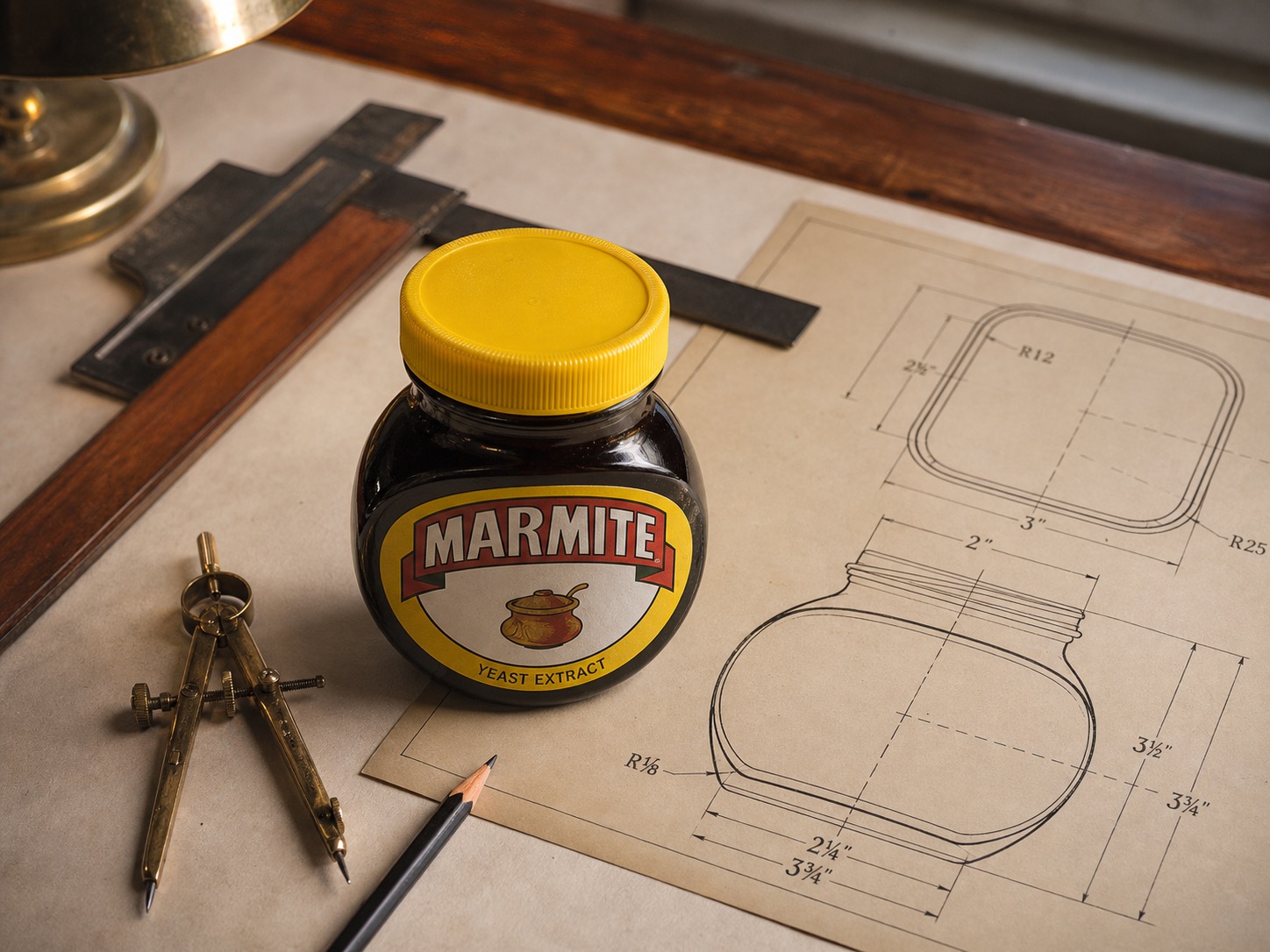
Marmite has had flat sides since the modern jar was introduced. It is not a recent design innovation. It is not a secret feature wired in by clever Burton engineers thinking about your breakfast. It is bog-standard industrial design.
So why has it gone viral now
Honest answer: TikTok needed a thing to be amazed about, and “lay your Marmite jar on its side” is exactly the kind of mid-difficulty domestic tip that produces good engagement. It is satisfying to watch, it makes the viewer feel slightly cleverer than they were a minute ago, and it costs them nothing to share.
None of that means it is not a useful tip. It is. Just stop calling it a “revelation”.
The actually useful tips for an almost-empty jar
While we are here, the things that genuinely help with the bottom of a Marmite jar:
A wider butter knife reaches more surface area. Use the proper one, not a thin steak knife.
A few minutes in a basin of warm water (lid off) softens the residue and makes it spreadable rather than scrapable.
If you are about to make gravy, soup or a stew, splash a tablespoon of hot water into the jar, seal it, shake it for a few seconds, and pour the resulting Marmite-water straight into the pan. You will get every last molecule out and the dish will be the better for it.
Or just buy the squeezy bottle, which Marmite already makes specifically to solve the extraction problem. Three pound fifty. The jar is for keeping in the cupboard and looking right.
Marmite’s response, if you missed it
The Marmite press office gave a polite “yes, you can do that, the jars were also designed for sensible packaging” reply, and reminded everyone the squeezy version exists. The right answer. They did not pretend the flat sides were a deliberate end-user feature, but they also did not stop anyone enjoying the moment.
There is a thing brands do where a piece of internet enthusiasm lands in their lap and they wreck it by trying to “engage” with it. Marmite chose not to. Credit.
Anyway
If you didn’t know about the flat-side trick, now you do, and it does work. If you did know about it, you have spent the last week being mildly smug. Both are valid uses of a Wednesday.
Pass the toast.