
Four dark, salty, intensely savoury things sit on the same stretch of supermarket shelf, and people muddle them up constantly. Marmite, Bovril, Vegemite and Oxo look like variations on a theme, and all four have their devoted defenders. But they are not interchangeable, and the difference matters a great deal if you happen to be vegetarian, vegan, or just trying to make a decent gravy.
I have written about the one-to-one Marmite versus Bovril question and the long-running Marmite versus Vegemite rivalry before. This is the four-way version: what each one actually is, where it came from, and which jar you want for the job in hand.
The one difference that settles most arguments
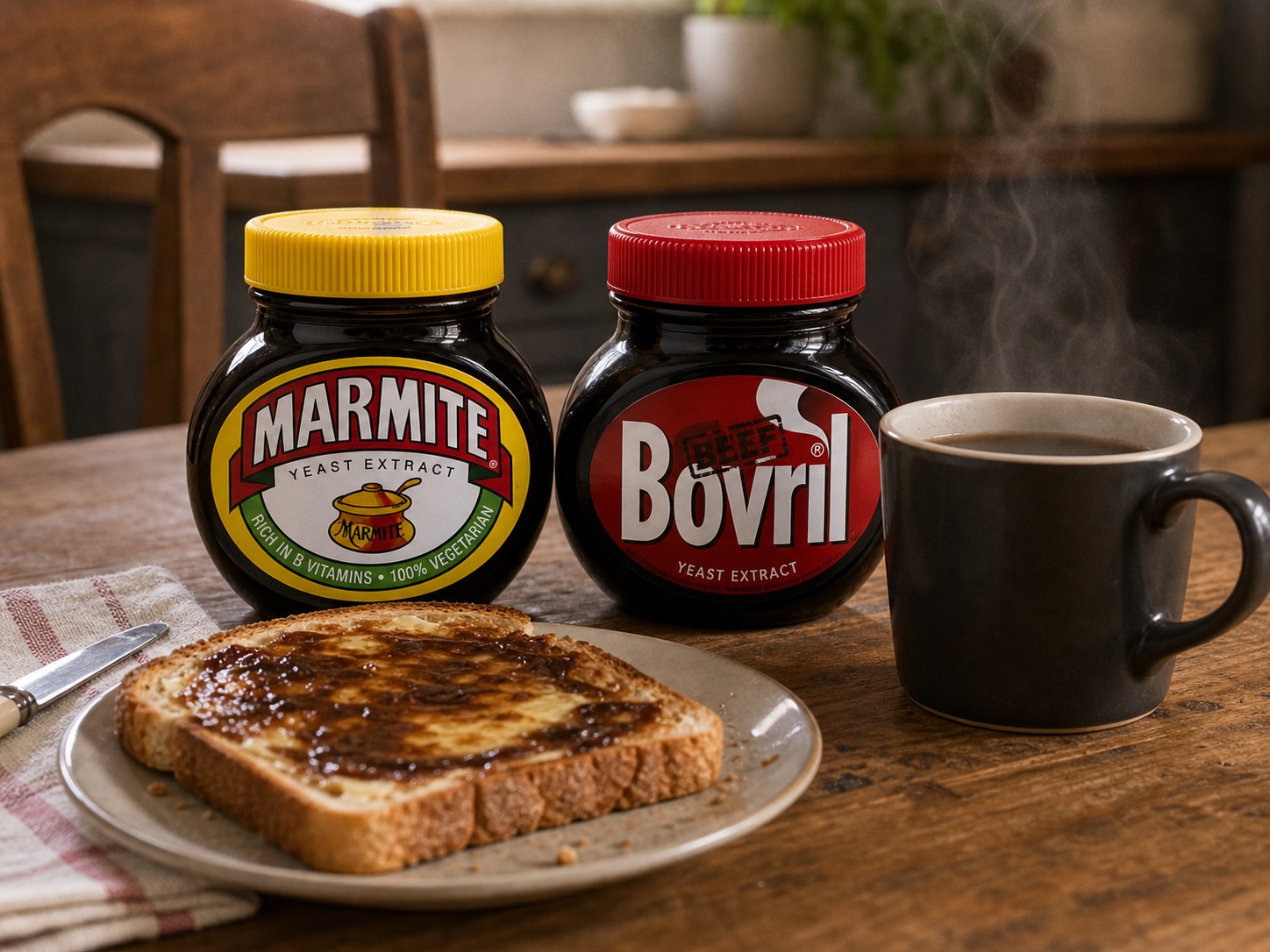
If you remember nothing else, remember this. Marmite and Vegemite are made from yeast extract and contain no meat, so they are suitable for vegetarians and vegans. Bovril and Oxo are built on beef, so they are not. That single fact resolves the overwhelming majority of “can I use this instead of that” questions in one line.
Everything else, the texture, the saltiness, whether you spread it or dissolve it, is detail on top of that core split.
Marmite
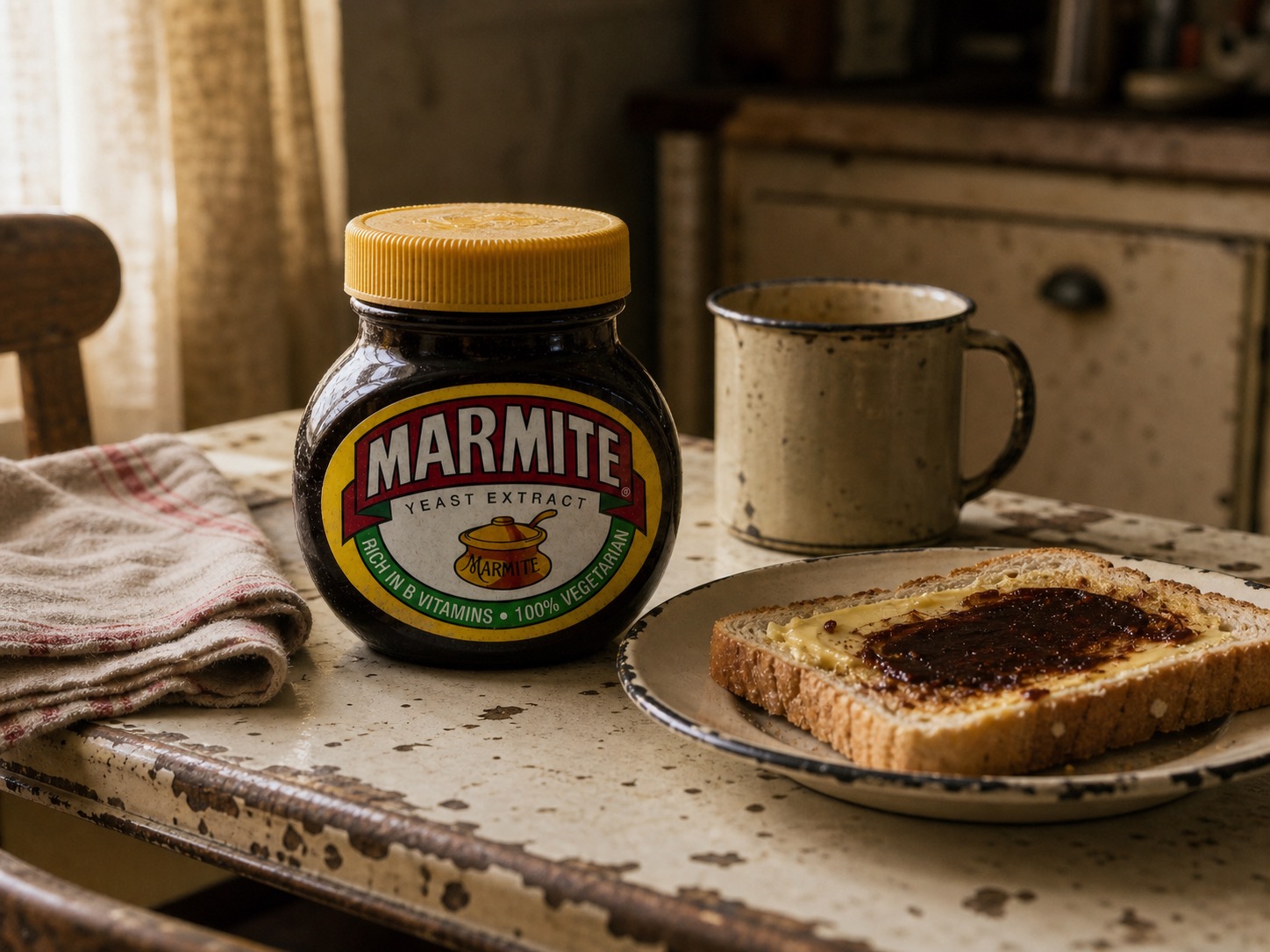
The original of the type, at least in Britain. The Marmite Food Company was formed in 1902 in Burton-on-Trent, where there was a ready supply of spent brewer’s yeast from the town’s enormous brewing trade. The idea, borrowed from the work of the German chemist Justus von Liebig, was that this leftover yeast could be concentrated into something rich and edible rather than thrown away. The result is a sticky, glossy, near-black paste that you spread thinly on buttered toast.
Marmite is vegetarian and vegan, rich in B vitamins, and has been owned by Unilever since 2000. Its whole identity is built around being divisive, which the brand has leaned into for decades.
Bovril
Bovril is the beef one, and the oldest of the four. It was developed in the 1870s by a Scot, John Lawson Johnston, originally to feed the French army, and the name stuck as a byword for a warming beef drink. Modern Bovril is a thick, dark beef extract paste, blended these days with some yeast extract, salt and spices. Like Marmite, it is now a Unilever product.
The key practical difference is how you use it. Bovril is made to be dissolved in hot water as a drink or stirred into stews and gravies, rather than spread on toast. And because it is built on beef, it is not suitable for vegetarians or vegans. There was a vegetarian version on sale for a few years in the 2000s, but the standard product is a meat extract.
Vegemite
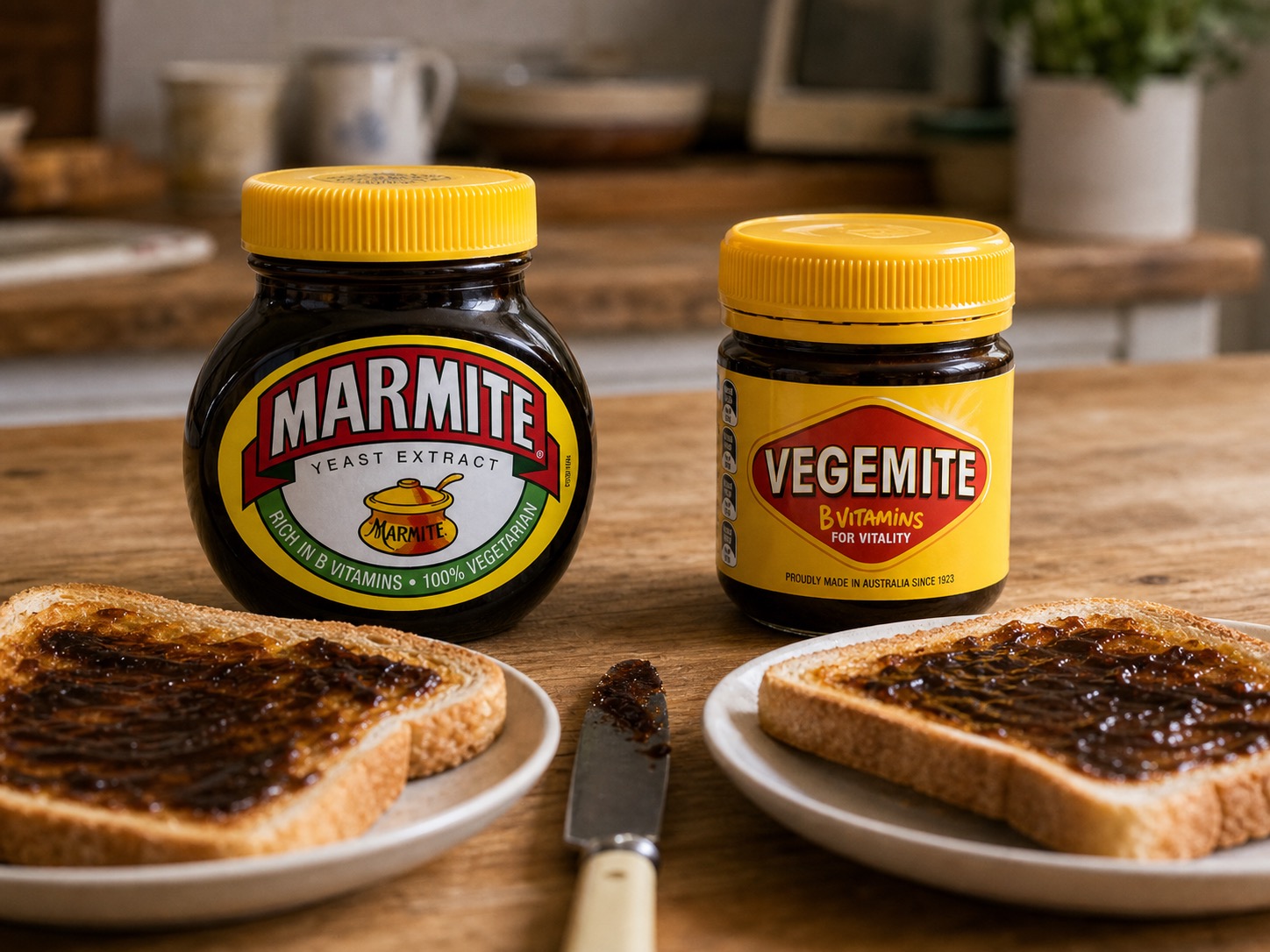
Vegemite is the Australian answer to Marmite, and it has a clear origin story. It was developed in Melbourne in 1922 by the food chemist Cyril Callister, after the disruption of Marmite imports during the First World War left a gap in the market. Like Marmite, it is a yeast-extract spread, vegetarian and vegan, and very high in B vitamins.
Australians will tell you, at length, that Vegemite and Marmite are nothing alike. The short version is that Vegemite tends to be thicker, less sweet and saltier on the tongue, while British Marmite has a slightly more caramelised, almost malty edge. They are cousins, not twins, and national loyalty runs deep on both sides.
Oxo
Oxo is the odd one out, because it is not really a spread or a paste at all in its famous form. It is the beef stock cube, the little foil-wrapped block you crumble into a pan. Its lineage traces back to the same nineteenth-century beef-extract science as Bovril, by way of Liebig’s Extract of Meat Company, with the compressed Oxo cube arriving in 1910 to make the product cheap and convenient.
Standard Oxo cubes are beef-based and used for stock, gravy and braising, though the range now includes chicken, vegetable and other varieties, some of which are suitable for vegetarians. If a recipe asks for Oxo, it usually wants a savoury stock base, not a spreadable extract.
Which one do you actually want?
- For toast: Marmite or Vegemite. Spread thinly over butter. Bovril can be spread in a pinch but it was not really designed for it, and Oxo cannot.
- For a hot savoury drink: Bovril, dissolved in boiling water. This is its natural home, especially on a cold day at the football.
- For gravy, stews and stock: Oxo cubes, or a spoonful of Bovril, or a small amount of Marmite for a vegetarian depth-charge of umami.
- For vegetarians and vegans: Marmite or Vegemite, full stop. Bovril and standard Oxo are off the menu.
- For B vitamins: Marmite and Vegemite are the standouts, both fortified with the B-complex including B12.
A quick reference table
- Marmite: yeast extract, vegetarian and vegan, spread, British (1902), Unilever.
- Vegemite: yeast extract, vegetarian and vegan, spread, Australian (1922).
- Bovril: beef extract, not vegetarian, hot drink and cooking paste, British (1870s), Unilever.
- Oxo: beef-based stock cube (with some veggie varieties), cooking, British (cube from 1910).
Is Bovril the same as Marmite?
No. Marmite is a yeast-extract spread suitable for vegetarians and vegans, while Bovril is a beef-extract product that is not. They look similar in the jar and both taste intensely savoury, but Marmite is made for spreading on toast and Bovril is made mainly for dissolving into a hot drink or stirring into cooking.
Is Vegemite just Australian Marmite?
Not exactly. Vegemite was created in Australia in 1922 as a local alternative after Marmite imports were disrupted, and it is also a yeast-extract spread, but the recipes differ. Vegemite is generally thicker, saltier and less sweet, while British Marmite has a more caramelised, malty character. Fans of each insist the difference is obvious.
Is Oxo the same as Bovril?
They share a common ancestry in nineteenth-century beef-extract science, but they are different products. Bovril is a thick extract paste you dissolve into a drink or cooking, while Oxo is best known as a compressed stock cube you crumble into stews, gravies and stocks. Both are primarily beef-based in their standard forms.
Which of these is suitable for vegans?
Marmite and Vegemite are both suitable for vegans, as they are made from yeast extract and contain no animal products. Standard Bovril and standard Oxo are beef-based and are not vegan, although Oxo does sell separate vegetable stock cubes that are.
Sources and further reading
- Bovril, Wikipedia
- Marmite, Wikipedia
- The history of Marmite, Marmite Museum
- Bovril vs Marmite, Let’s Foodie