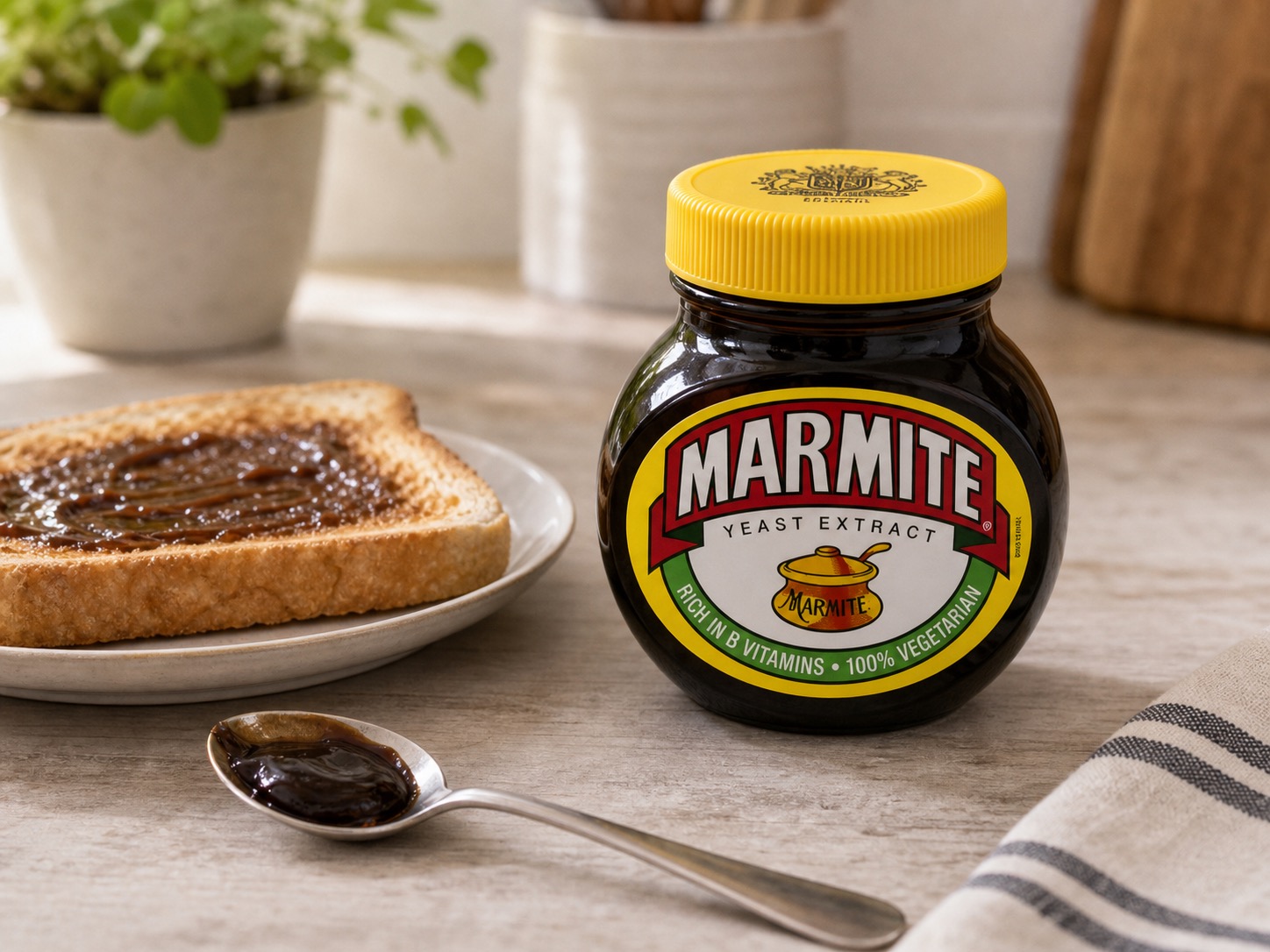

The full ingredients list on a jar of Marmite has five things on it. Ask most people what is in the jar and they will name one or two, then guess. That is not a criticism. The list is unusually short for a modern food product, and most of the items on it are doing more than one job. The easiest way to understand what Marmite actually is is to walk through them in order.
The list, in order
The label reads:
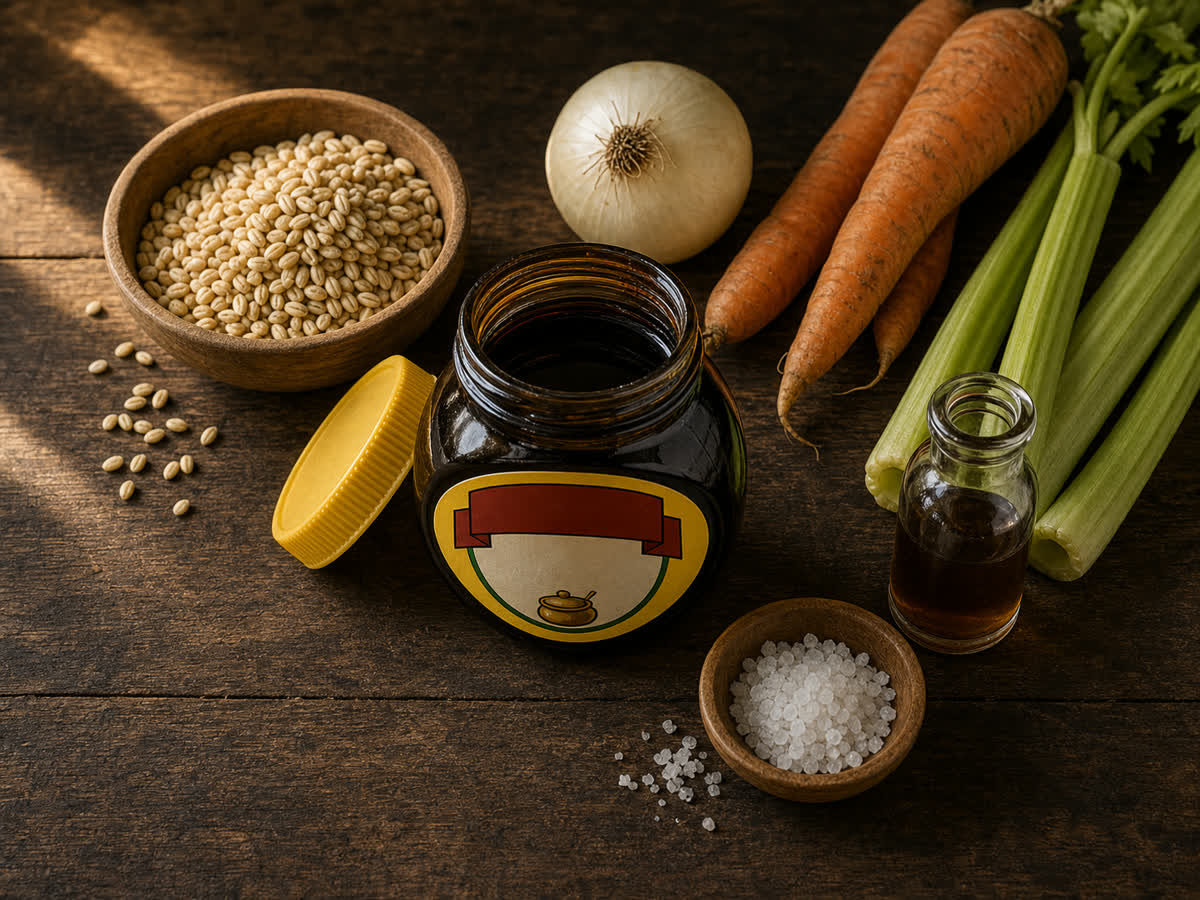
yeast extract (contains BARLEY, WHEAT, OATS, RYE), salt, vegetable juice concentrate, vitamins (thiamin, riboflavin, niacin, vitamin B12 and folic acid), natural flavouring (contains CELERY).
Five entries, and one of them is a bracket containing five vitamins, which are added rather than naturally present in any quantity worth declaring. Each item earns its place. None is filler.
The list used to be longer. A post on this site from March 2006 records “Spice Extracts” as a separate line on the jar of the day, with the celery declaration sitting next to it. The current label has no spice extracts on it at all, and the celery is declared against the natural flavouring instead. Whether that is a recipe change or only a change in how the same blend is described, the label does not say.
Yeast extract: the body of the product
Yeast extract is, by far, the largest single ingredient by weight. It is what Marmite essentially is. The “extract” is the concentrated soluble fraction of yeast cells that have been broken open and their cell walls discarded.
The original Marmite story is well known in outline. In the 1880s the German chemist Justus von Liebig discovered that brewer’s yeast, the spent yeast left over after beer fermentation, could be broken down into a concentrated, dark, salty paste. Marmite was the British commercial application of that discovery, founded in 1902 in Burton-on-Trent, next door to Bass Brewery and its enormous surplus of yeast. The brewery threw the spent yeast away. The Marmite Food Extract Company bought it.
That arrangement, more or less, continues. Modern Marmite is made from yeast cultivated specifically for the purpose at the Burton factory (the brewery connection ended in the 1990s), but the chemistry is the same. The yeast is encouraged to break itself down, a process called autolysis, and the resulting paste is filtered, concentrated, and combined with the other ingredients.
The parenthetical “(contains barley, wheat, oats, rye)” tells you that the yeast was grown on cereal-based media. Trace gluten remains. This is why Marmite is not certified gluten-free, although the actual gluten content per teaspoon is very low.
Salt: about 10% of the jar by weight
Marmite is salty. People notice. The salt is partly doing flavour work, since it amplifies the umami of the yeast extract in the same way it would amplify any other savoury ingredient, and partly doing preservation work. Salt at that concentration is what makes Marmite biologically inert. Almost no microorganism can colonise it.
The salt content is also why nutritionists give Marmite an ambiguous report card. Per teaspoon, the actual sodium intake is modest. Per 100g, the figure looks alarming and turns up in headlines. The way most people eat Marmite, a scrape on toast, falls firmly into the first category.
Vegetable juice concentrate: carrot and onion
This is the ingredient most people are surprised to find on the list, and the jar will not tell you what is in it. The label says only “vegetable juice concentrate”.
The breakdown turns up on other packs. When a manufacturer uses Marmite as an ingredient in something else, UK labelling rules make them print Marmite’s own ingredient list in brackets after it, and those sub-lists are more specific than the jar. Nairn’s Marmite and Cheese Oatcakes spell it out as “Vegetable Juice Concentrate (Carrot, Onion)”, inside a five-part Marmite sub-list that otherwise matches the jar entry for entry. Marmite’s own rice cakes drop the collective noun altogether and declare “carrot juice concentrate, onion juice concentrate” as two separate ingredients.
So it is carrot and onion. Ingredients are declared in descending order by weight. This one sits below the salt, and the salt is about a tenth of the jar, so there is not much of it. Both vegetables are ordinary plant material, which is one reason the jar is vegan.
Natural flavouring (contains celery): the unspecified rest
The last entry is the one the label will not expand on. “Natural flavouring” is a legal category rather than a description, the recipe is proprietary, and the exact composition is one of the things Unilever chooses not to disclose.
The allergen is the part they have no choice about. The “contains CELERY” warning is mandatory under UK rules, because celery is one of the fourteen allergens that must be declared, and on the current jar it sits against the natural flavouring rather than anywhere else on the list. That single word is the only component of the blend anyone outside Burton can name with confidence.
In practice the contribution is small. Marmite’s flavour is yeast extract and salt doing nearly all the work. The flavouring fills in the rounded background notes without being individually identifiable, which is exactly what it is there for.
The vitamins: a 1930s decision that has stuck
The vitamin fortification is the only part of the ingredient list that is not, strictly, traditional. It was added during the 1930s, when public-health concerns about B-vitamin deficiencies in the British diet pushed Marmite into a quietly important role as a fortified food.
Modern Marmite contains thiamin (B1), riboflavin (B2), niacin (B3), folic acid (B9), and B12. The first three were already present in significant quantities in unfortified yeast extract, because yeast is naturally rich in B vitamins, and the recipe was tuned to make those quantities reliable and consistent across batches. Folic acid and B12 were added as fortification.
The B12 question is worth a paragraph on its own. B12 is a vitamin that humans need and that does not occur in any plant in significant quantities. Vegans and vegetarians, in particular, rely on fortified foods or supplements to get enough. Marmite is one of the most widely consumed sources of dietary B12 in British vegan and vegetarian diets. A teaspoon a day contributes a meaningful fraction of the recommended intake. This has been a quiet selling point for the brand for decades.
Natural flavourings: the legal box at the end
This is the standard food-industry term for additional flavour compounds that have been derived from natural sources rather than synthesised. In Marmite’s case the natural flavourings are a small additional set of yeast-derived molecules that the manufacturer uses to tune batch consistency. The contribution is small. The legal requirement to declare it is what puts it on the label.
What is not in Marmite?
Things people sometimes assume are in Marmite, but are not:
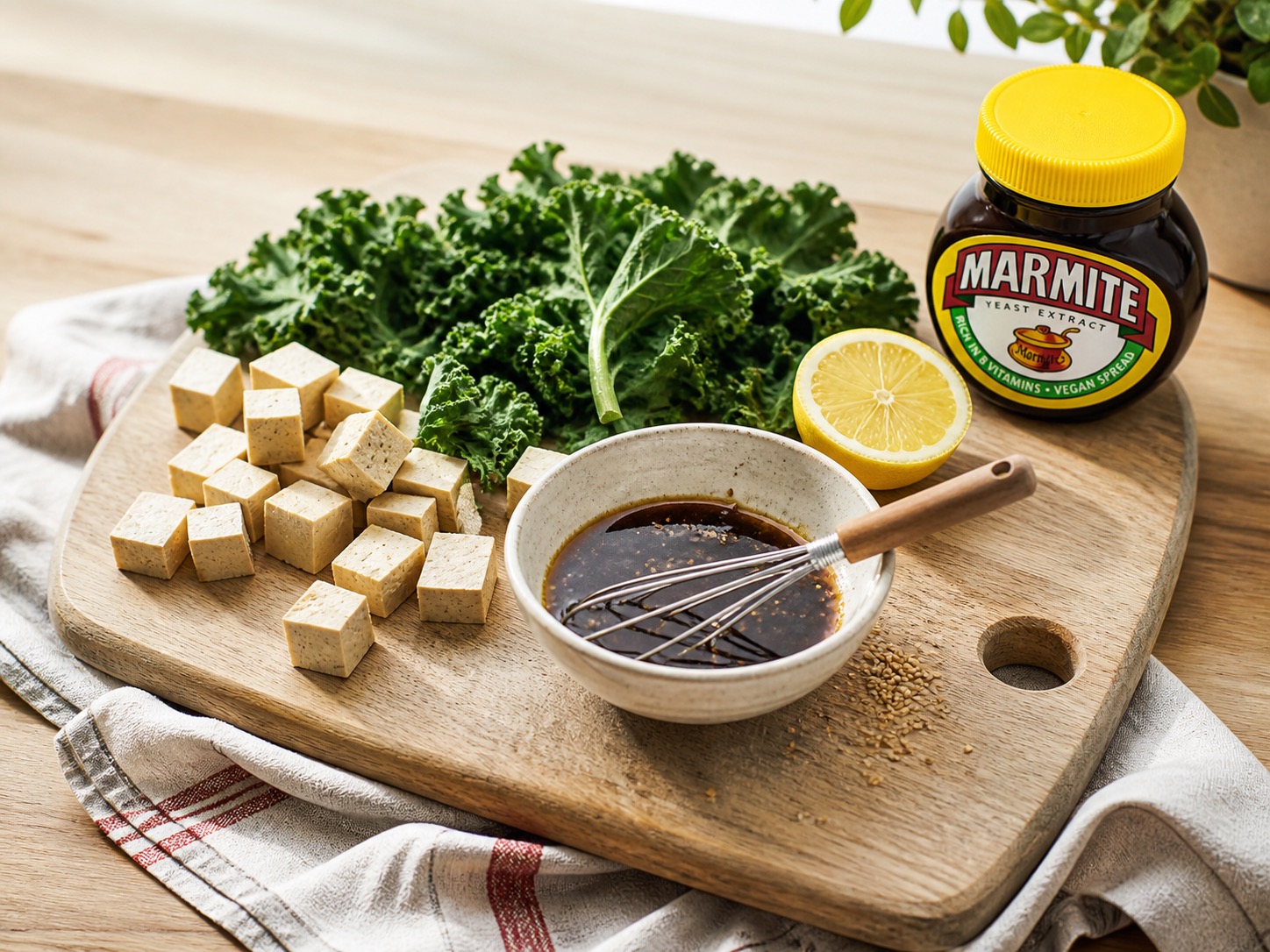
- Animal products. Marmite has been certified vegan-friendly for years. The yeast is grown on plant-based media; the vegetable juice and the flavouring are plant-derived; the vitamins are synthesised rather than animal-sourced.
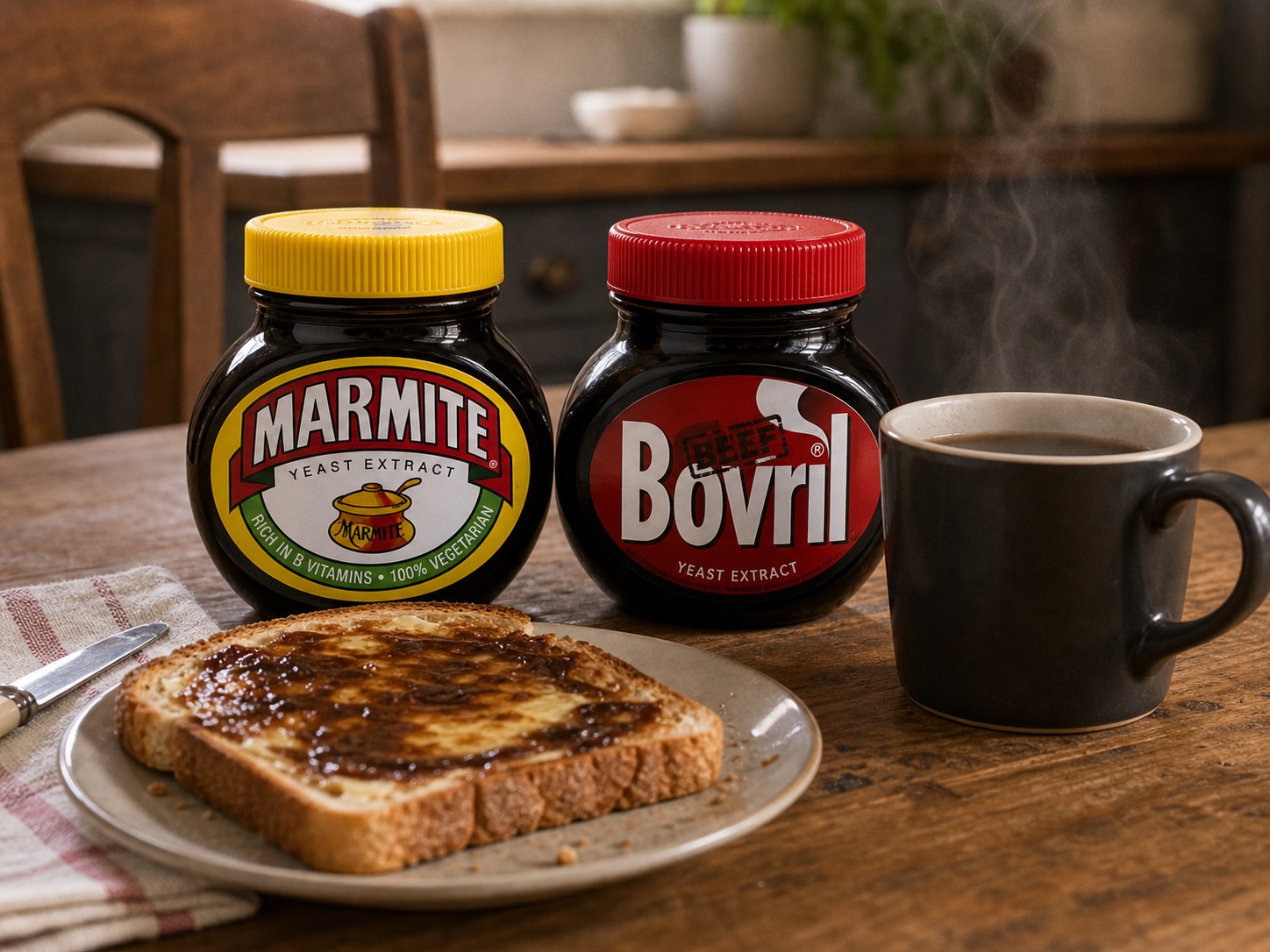
- Meat extract. Marmite is sometimes confused, especially abroad, with Bovril (beef extract) or with the older “meat extract” products of the early 20th century. It contains no meat and never has.
- Sugar. No added sugar appears on the list. The panel still declares 1.2g of sugars per 100g, which arrives with the ingredients rather than being added at the end.
- Artificial preservatives. None. The salt does the preservation work.
Why the ingredient list looks so different from most modern foods
A walk down any supermarket aisle will produce a dozen products with longer ingredient lists than Marmite. The reason Marmite’s is short is that the product is, in a real sense, pre-industrial. The technique is Victorian. The recipe is a 1902 idea with a 1930s vitamin top-up. Nothing about it requires modern emulsifiers, stabilisers, or extended shelf-life additives, because the yeast extract is already self-preserving.
This is part of what makes Marmite divisive on the modern label-reading internet. A product that lists five things, one of which is salt and one of which is a bracket of vitamins, does not give label-readers much to argue about. So they argue about taste instead, and the taste argument has been going for 124 years. If you have landed here without the basics, the plain-English guide to what Marmite actually is is the better place to start.
What is Marmite made of?
Marmite is made mainly from yeast extract, the concentrated soluble part of brewer’s yeast left over from beer making. To that base it adds salt, a small amount of vegetable juice concentrate, five added vitamins, and a natural flavouring that contains celery. That is five entries on the label, which is a remarkably short list for a modern food. Turning those ingredients into the spread is a separate process, and a stranger one: see how Marmite is actually made.
What are the main ingredients in Marmite?
By weight the largest ingredient by far is yeast extract, followed by salt at roughly a tenth of the jar. Everything else, the vegetable juice concentrate, the vitamins and the natural flavouring, is present in small amounts and works to round out and stabilise the flavour rather than to bulk the product out.
Does Marmite contain celery?
Yes. Celery is part of the natural flavouring, which is why the label carries a “contains CELERY” allergen warning. The amount is small, but UK allergen rules require celery to be declared wherever it appears.
Is there meat in Marmite?
No. Marmite contains no meat and never has. It is often confused with Bovril, which is a beef extract, but Marmite is built on yeast and has been certified vegan friendly for years.
Why does Marmite contain added vitamins?
The B vitamins were added during the 1930s, when B vitamin deficiencies were a public health concern in Britain. Yeast is naturally rich in several B vitamins, and folic acid and B12 were added on top. That fortification is why a daily scrape of Marmite is a meaningful source of B12 for many vegans and vegetarians.
Is Marmite gluten free?
No. Marmite is not gluten free. The yeast extract is grown on barley and wheat, so the label carries a “contains barley, wheat, oats and rye” warning. Anyone who is coeliac or sensitive to gluten should avoid it. There is more detail in our full guide to Marmite’s dietary status.
Is Marmite vegan?
Yes. Marmite contains no animal products and has been certified vegan for years. It is built on brewer’s yeast rather than anything from an animal, which is the main thing that sets it apart from Bovril. The jar is also fortified with vitamin B12, which makes a daily scrape a genuinely useful source of B12 for vegans and vegetarians.
Does Marmite contain beef?
No. Marmite contains no beef and no meat of any kind. The confusion comes from Bovril, a separate dark, salty spread that is made from beef extract. Marmite is made from yeast and is suitable for vegetarians and vegans. See how Marmite and Bovril actually differ. The same beef mix-up is behind most of the halal queries, answered in is Marmite halal.