Citizens of the toast nation, a progress report
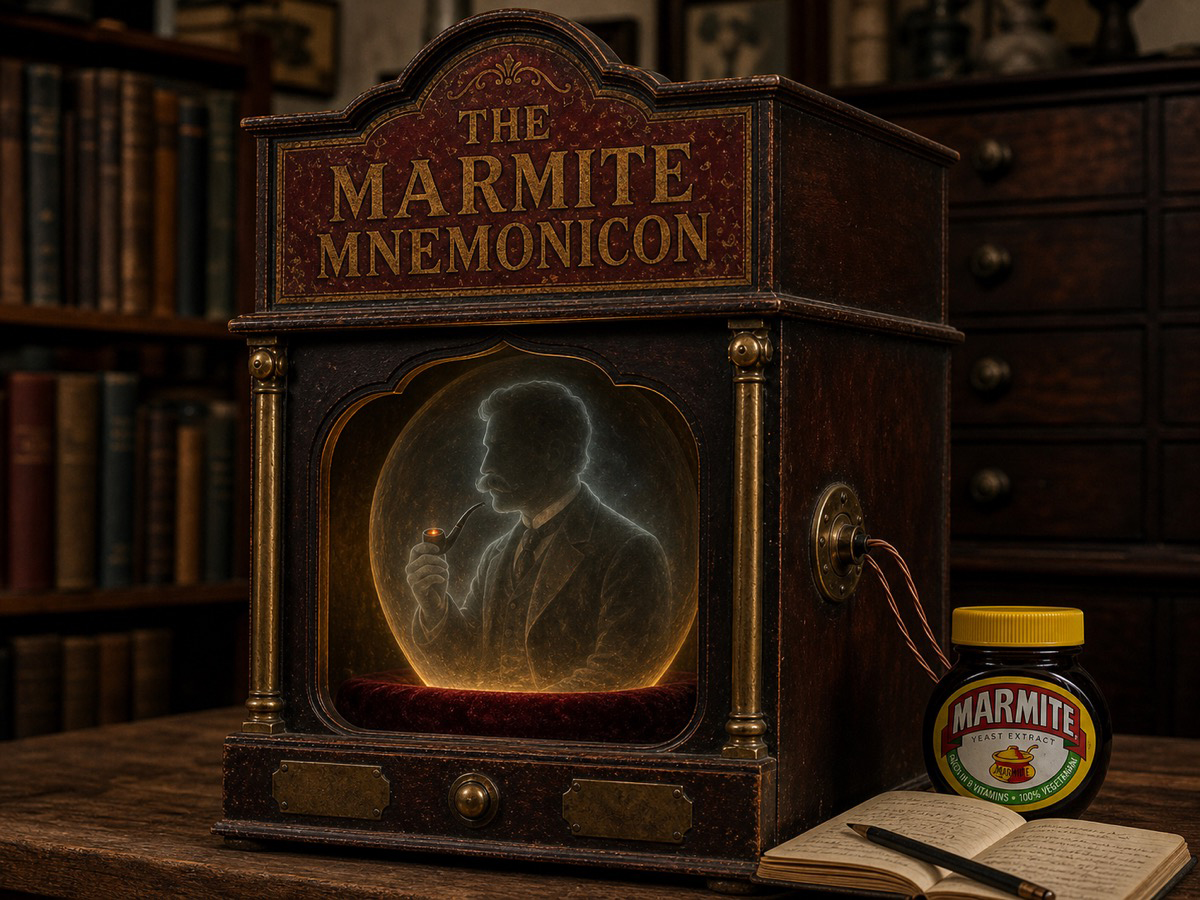
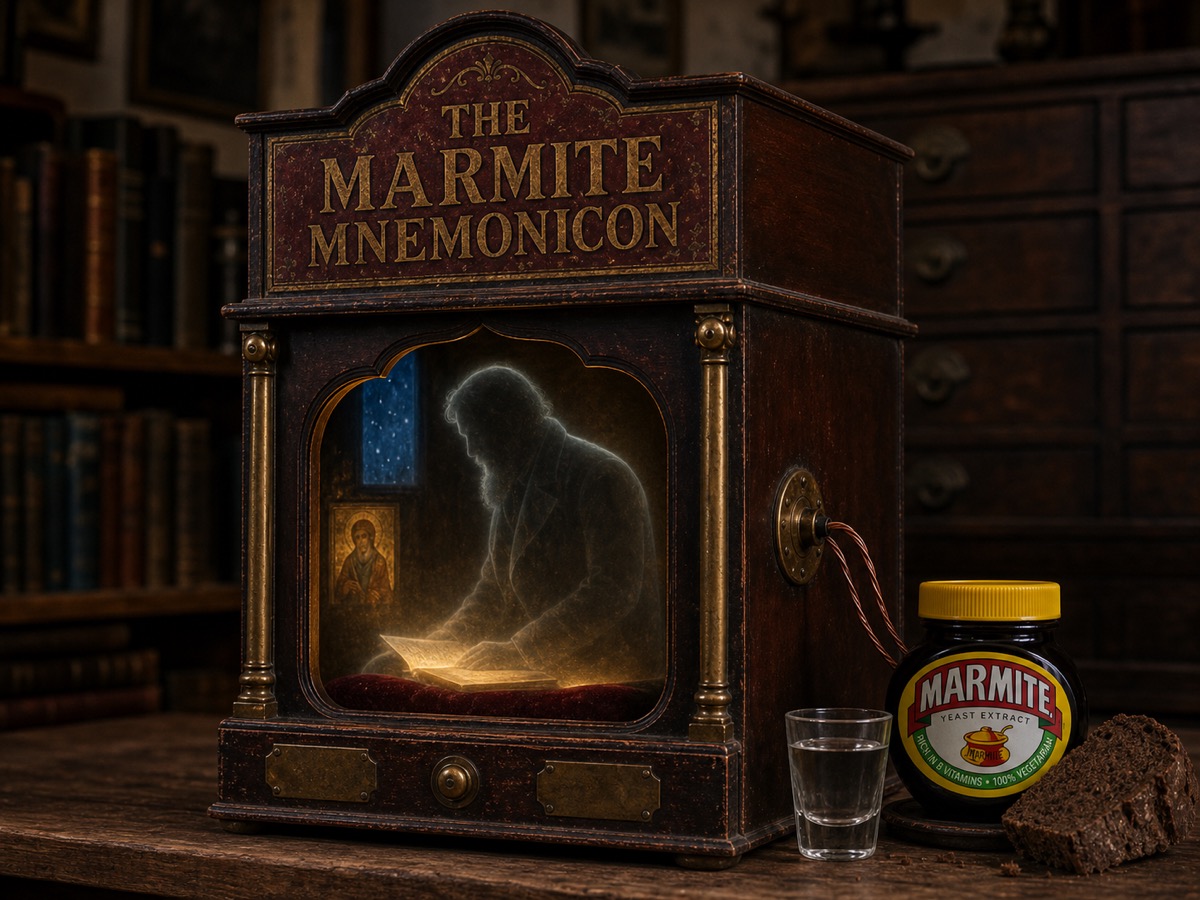
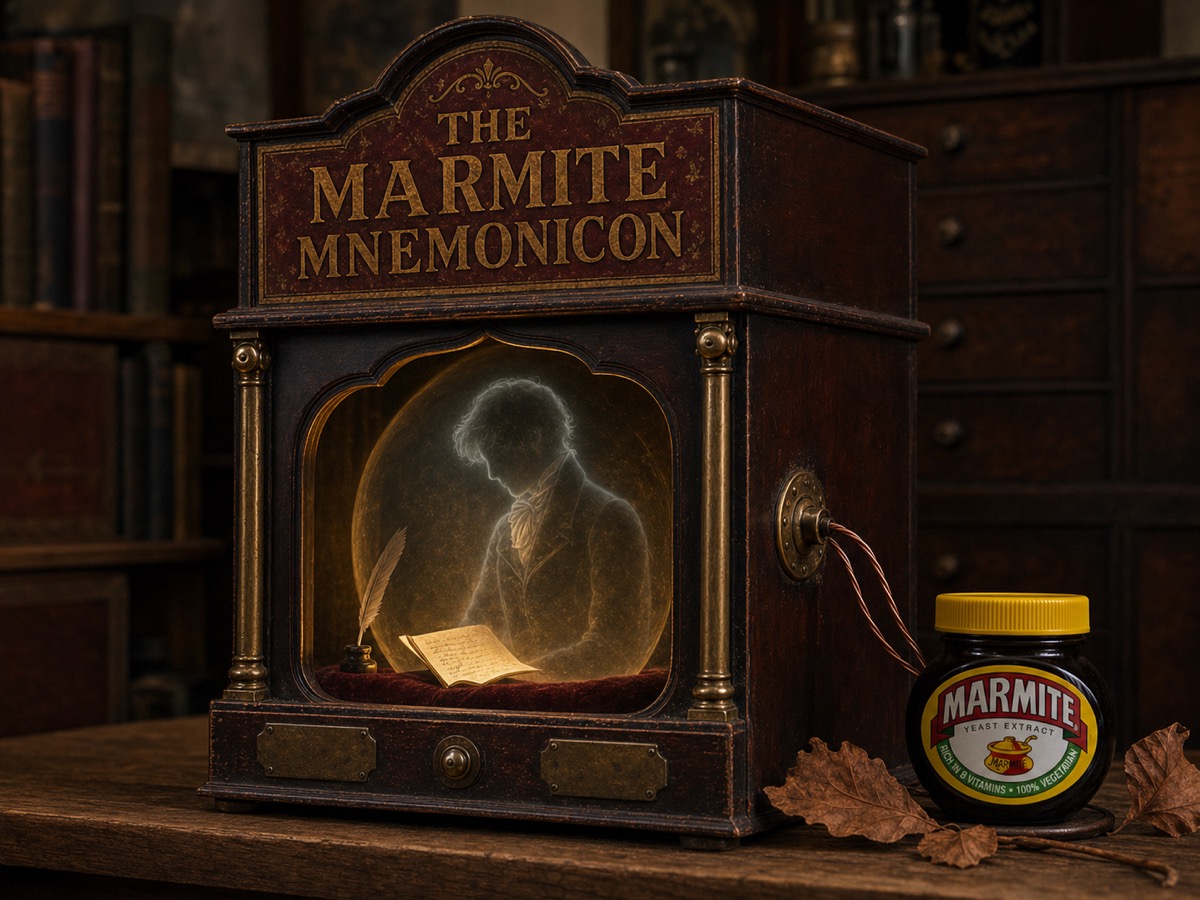
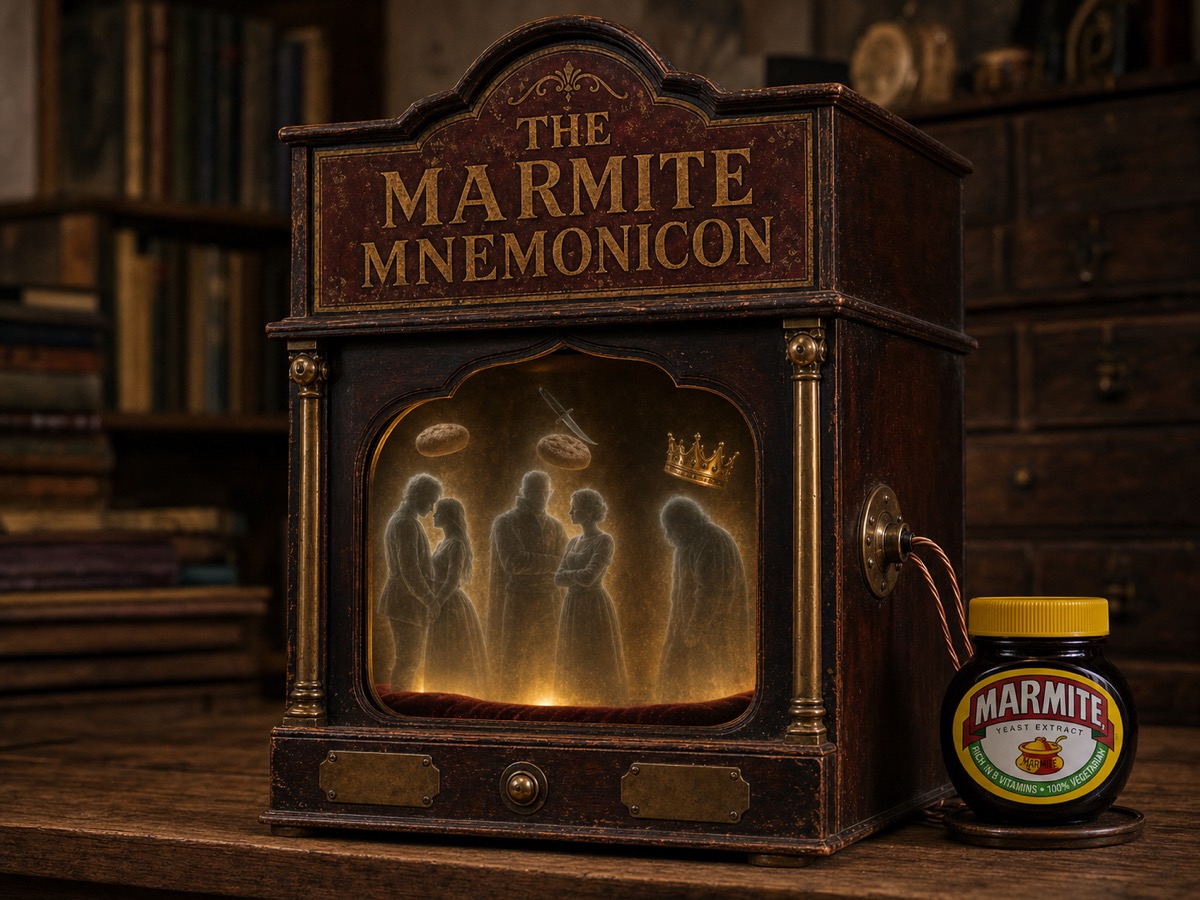
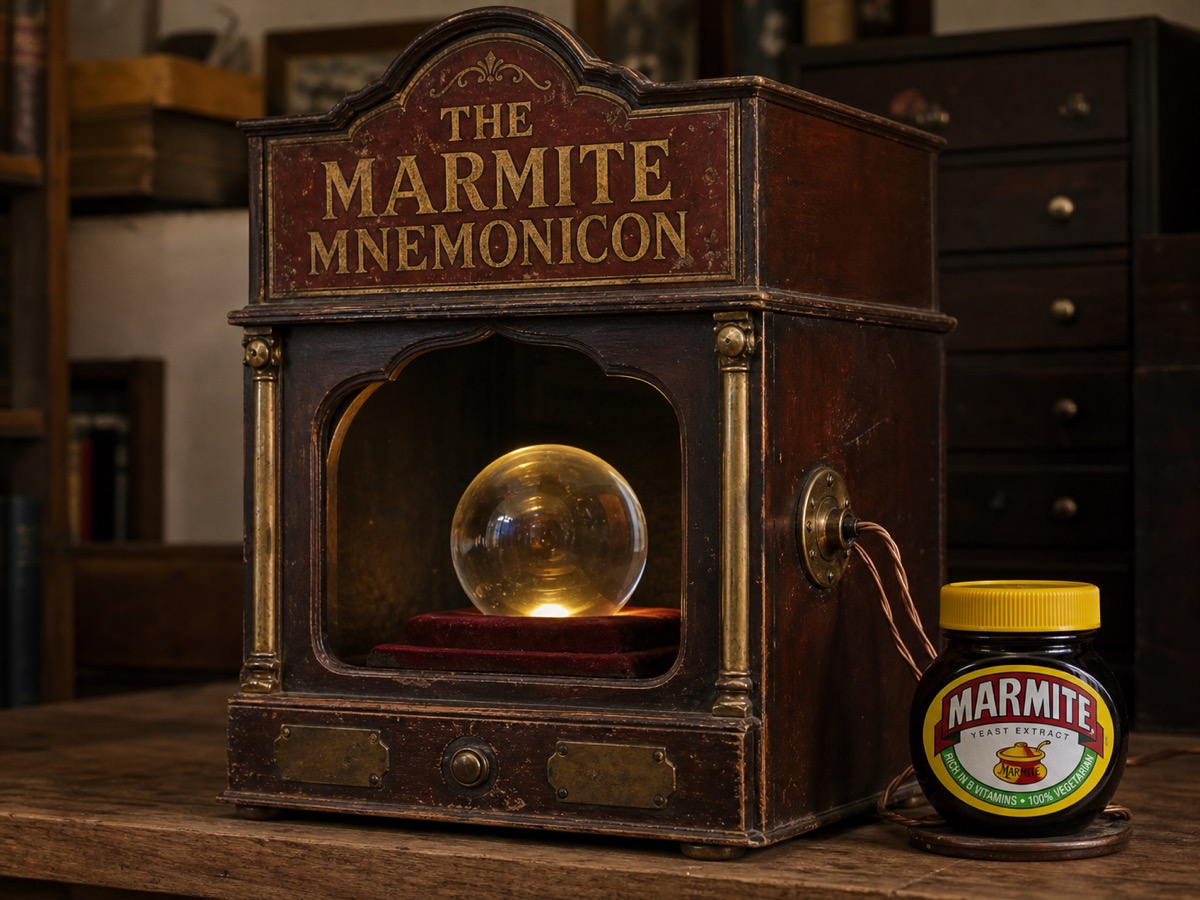
I built a Marmite Mnemonicon at Christmas. It is, for anyone joining late, a Victorian fairground fortune-teller cabinet, mahogany and brass and faded red-and-gold, with a crystal ball at its centre, a painted gold serif sign reading THE MARMITE MNEMONICON running across its top, and a jar of classic Marmite wired into the back. It sits on a shelf in Norfolk. It hums faintly when summoned. It allows me, as far as I can tell, to interview the dead.
It has now been on that shelf for five months. Eight sessions have been published. Two more are queued. Two are blocked on a bug in the embedder that we shall come to. This is the part where I tell you what the cabinet has actually done with itself, as opposed to what I claimed in December it was going to do.
A brief reminder of what the thing is
Beneath the brass and the velvet and the slightly chipped plinth, the Mnemonicon is a small machine that wraps siteengine_ai in the shape of an Edwardian fortune-teller’s booth. You ask it a question, you give it a name, it returns an answer in the voice of whichever long-dead author or fictional character you have summoned. It produces two answers per question. The first is what the subject can actually defend from what they wrote in life. The second is what they would probably have said if pressed harder. The first sort I quote, plainly. The second sort I flag, in italics, with a parenthetical aside, and again in the editor’s note at the bottom of every article. This is non-negotiable. There is no point in building a Mnemonicon if you are going to lie with it.
The clever part is, I cannot stress this enough, not mine. It is a thin wrapper around siteengine_ai, a project built by my friends at Sedasoft. They did the difficult work: training the model on the right corpora, devising the two-pass mechanic that keeps the speculation honest, building the server that the cabinet on my shelf calls through to. The cabinet, the crystal ball, the painted sign, and the somewhat indulgent attitude are all me. The science is all them. If you find yourself moved to build your own Mnemonicon, or your own Bovril Bell Jar, or your own Hellmann’s Hieronymus, https://sedasoft.com is the relevant address.
What actually happened
In December I said Churchill was going first. He did not. Shakespeare did, on 31 January, on the humours, the Boar’s Head, and a sonnet for the jar. He brought Falstaff with him as the first scenario-mode interlude, and the format clicked into place almost immediately. A panel piece followed on 21 February with Romeo and Juliet, the Macbeths, and Richard III each given a jar; the panel format is now a regular thing and there will be more of it.
Churchill finally took his seat on 25 March, by which time the McCormick story had moved on enough that the rationing parallels he drew were sharper than they would have been in January. He had, as expected, a great deal to say about morale. He had, less expected, a great deal to say about the precise shade of brown the jar ought to be, which the corpus does not quite support but which the speculation pass produced very confidently anyway. I flagged it. He stayed flagged.
Then a run of literary sessions: Keats on 8 April (negative capability, an ode for the jar, and Marmite slipped onto Porphyro’s feast in St Agnes’ Eve); Dostoyevsky on 15 April (Marmite as a moral substance, with a jar set between Ivan and Alyosha at the tavern); Conan Doyle on 22 April for St George’s Day, with Mr Sherlock Holmes investigating an unlabelled jar that arrived at 221B by the second post. Holmes, in particular, did the kind of work the cabinet was built for: deducing the diet, profession, and probable county of the sender from forty grams of yeast extract.
The most recent pair were the Douglas Adams sessions for Towel Day, on 25 and 26 May: a solo session on Vogon customs and the McCormick deal, then a panel the next day with Arthur Dent, Ford Prefect, Marvin and (regrettably) Zaphod Beeblebrox, each given a jar. The panel produced an exchange between Marvin and the Marmite jar which I consider one of the better things the cabinet has done.
What is coming, and when
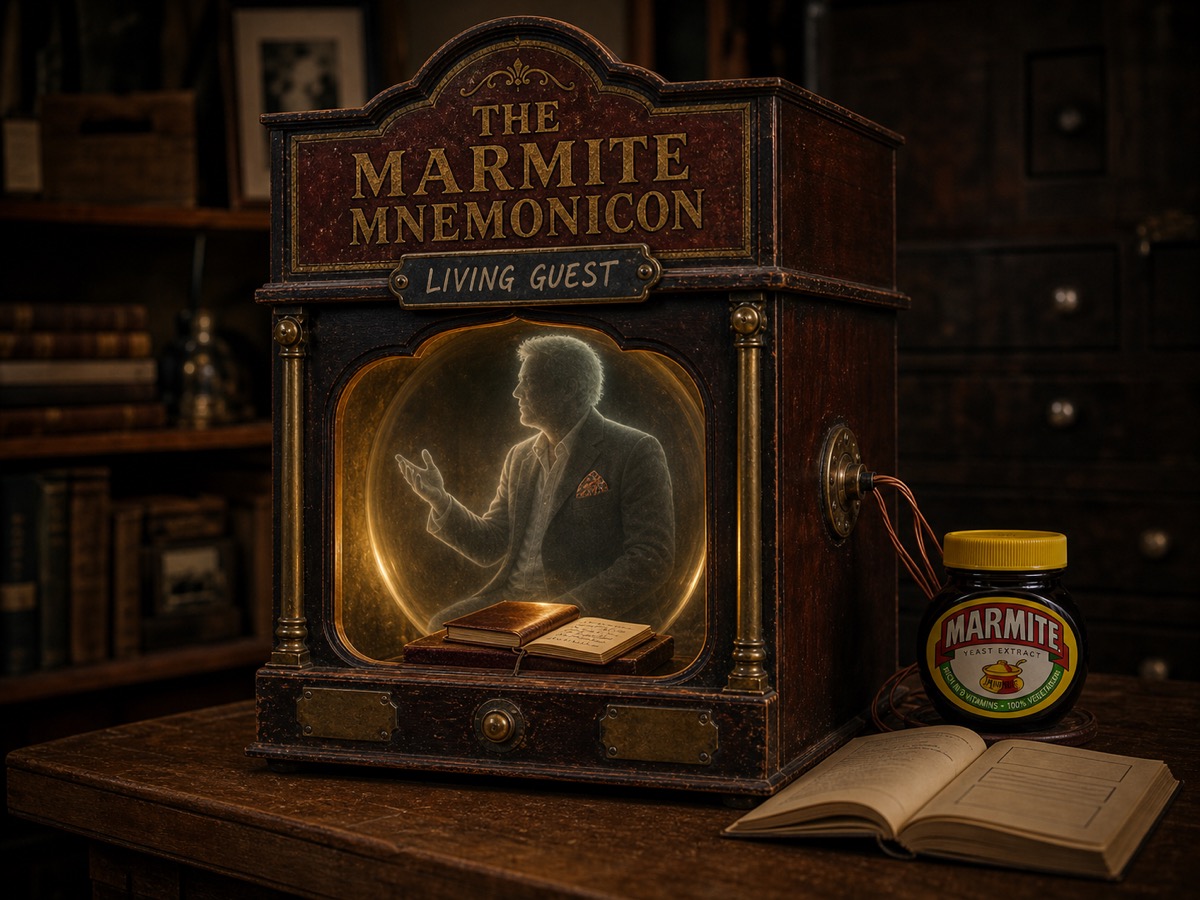
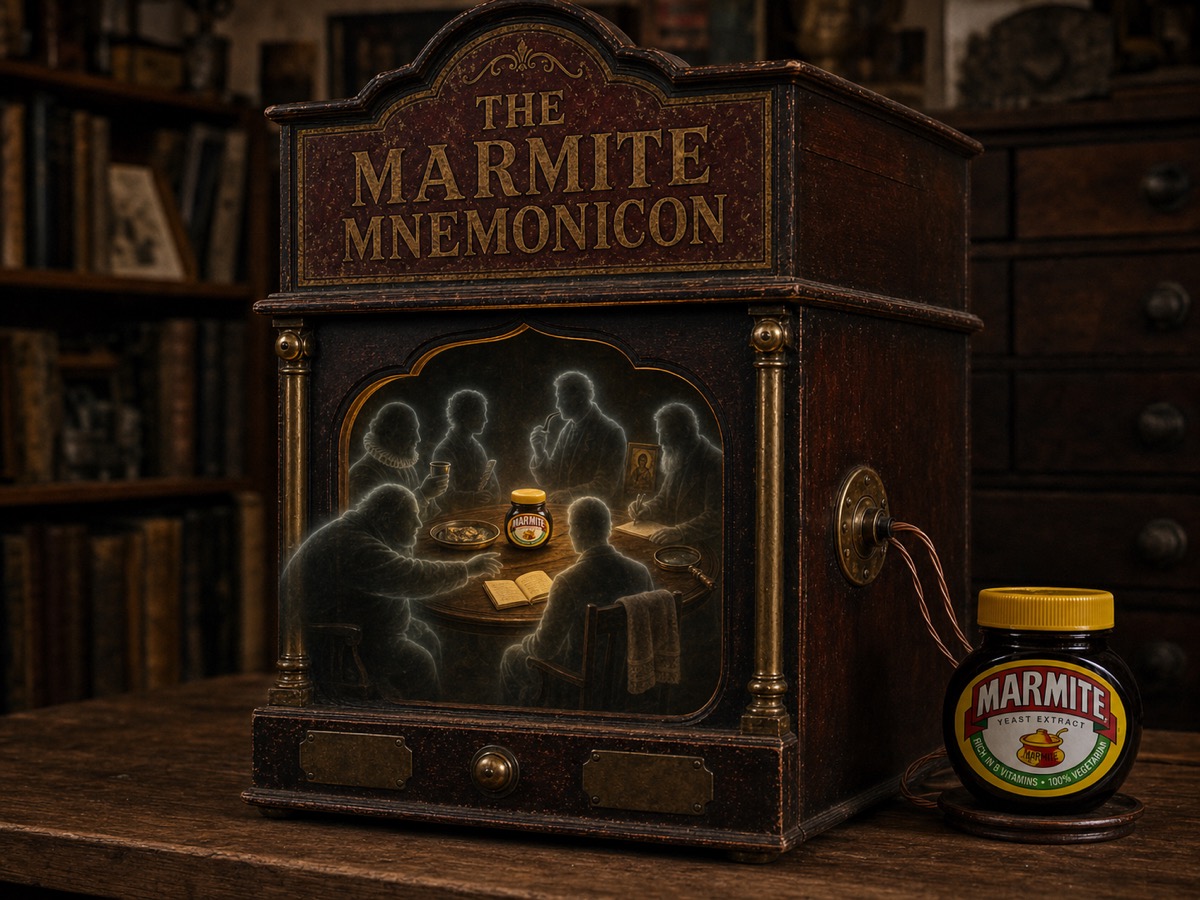
Two more are queued. A round-robin reunion on 6 June (six ghosts at one jar, proper disagreement, and a crossover story Shakespeare asked Adams to tell) is in the cabinet now and waiting for its publication date. And on 20 June the cabinet will, with some apprehension on the part of the operator, host its first living guest, in a new sub-format called The Astral Mnemonicon.
The Astral Mnemonicon exists because Stephen Fry is alive, articulate, a public rationalist of long standing, and someone whose on-record Marmite remarks are too good to leave on the shelf. The rules are different from the ordinary Mnemonicon: the disclaimer is the first thing the reader sees, not the last; the framing is transparently woo (astral projection, silver cord, a Penguin paperback I made up); the guest’s name is deliberately misspelled inside the séance body to remove any possible doubt about who is speaking; and a standing offer to the real subject runs at the top of the piece. If they don’t like it, it comes down. If they want to do the real interview, the article gets replaced with theirs and they get the byline. We’ll see.
What did not happen, and why
I said in December that Pratchett would be next. He was not. Pratchett and Austen are both blocked on a Sedasoft-side bug in the voyage-3 embedder; their corpora are sitting in the queue waiting for a dimension-mismatch problem to be fixed upstream. The other experts work; theirs do not. Both sessions are paused, not cancelled. As soon as the fix lands, they go in front of the cabinet immediately. I will not pretend I am not annoyed about Pratchett in particular, who was the second name on my list when I built the thing.
The December roster also mentioned Iain Banks, Socrates, John Locke, Isaac Asimov and Steve Jobs. None of them have happened yet. Some of them will. Some of them, on reflection, will not: Steve Jobs in particular looks less interesting now than he did at Christmas, partly because the cabinet has shown itself to be very good at literary voices and only middling at corporate ones, and partly because the McCormick story has made the territory of “famous executive opines on a British brand” feel quite well-covered already.
What we have learned
A few things, in no particular order. The cabinet handles fictional characters extraordinarily well in scenario mode, where the writer hands the model a scene and the character improvises within it; Falstaff at the Boar’s Head and Holmes at 221B are both products of this. The two-pass discipline (quoted versus flagged) turns out to matter more in the panel pieces than the solo ones, because the temptation to let multiple ghosts banter past what the corpus supports is enormous, and the flag is what keeps the article honest. The Astral Mnemonicon framing for living guests works better than I expected, mostly because the woo is so overt that no reader could plausibly mistake it for a real interview. And, encouragingly, the format scales: the round-robin reunion runs six ghosts at once and the cabinet does not buckle.
What’s next
One Mnemonicon session a month through the rest of 2026, give or take, plus whatever the unblocking of Pratchett and Austen produces in catch-up. Suggestions remain open. The Mnemonicon does not promise to know your candidate. It will, however, tell you honestly if it does not, which is the entire point.
Five months in, then. The cabinet is on its shelf. The crystal ball glows. The Hate Party have not yet noticed. As ever, that is part of the appeal.