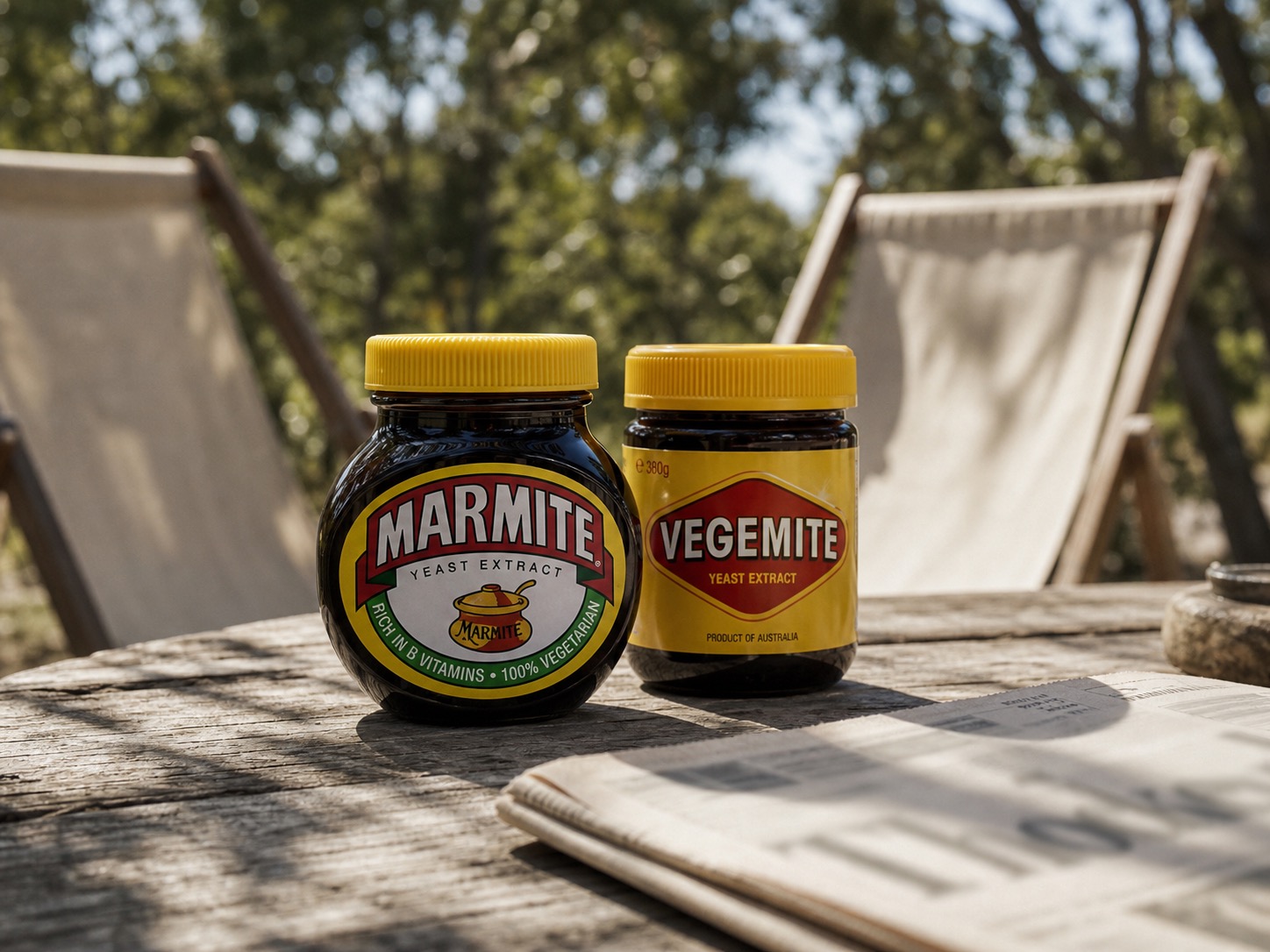

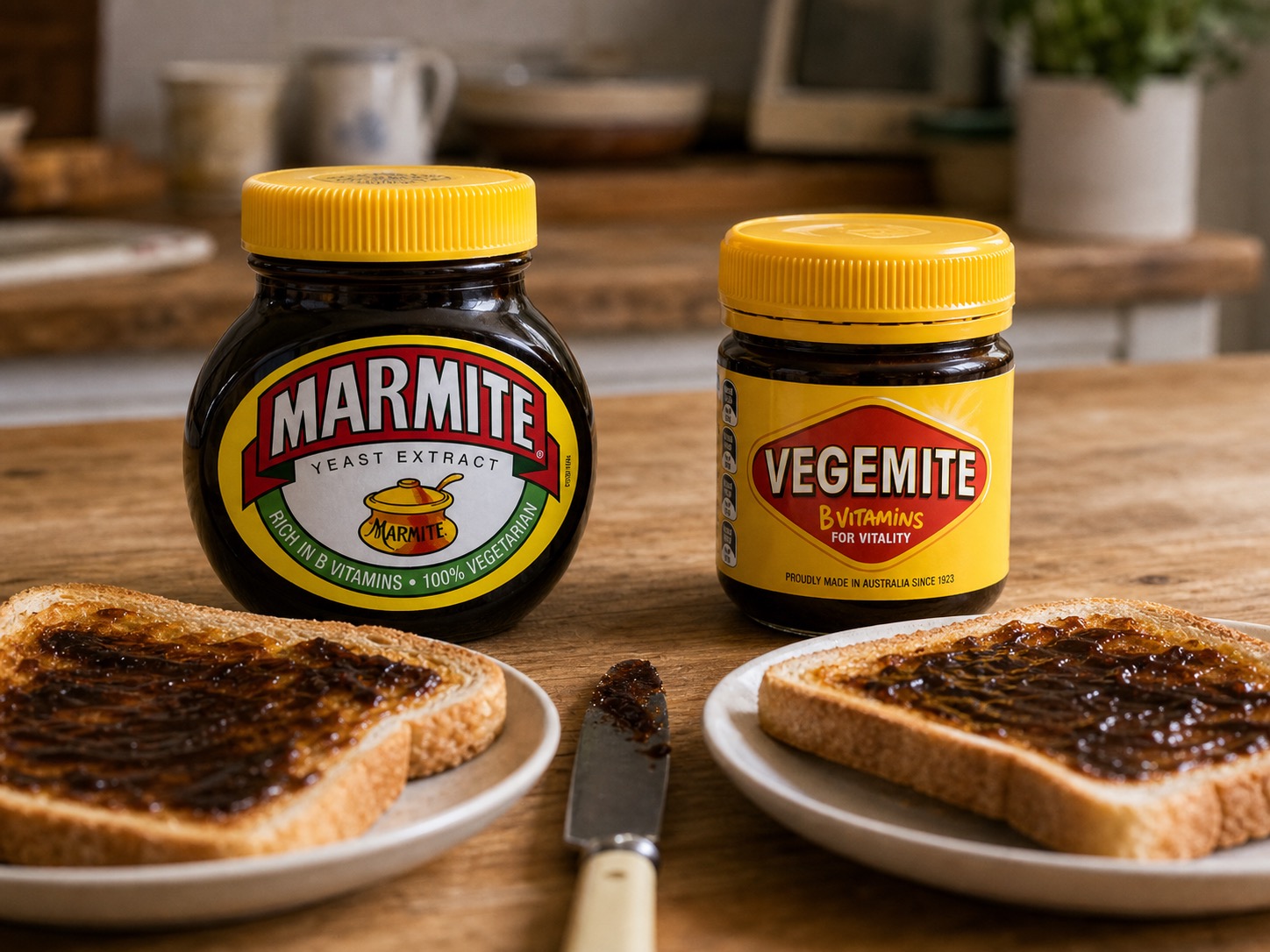
Marmite and Vegemite are both dark, salty yeast-extract spreads, and to an outsider they look identical. They are not the same. Marmite, the British original, is sweeter, more syrupy, and fortified with vitamin B12. Vegemite, the Australian one, is saltier, thicker, and more bitter. If you have only ever had one, the other will surprise you.
Here is the honest, full comparison, including the bit where I called Vegemite a rude name on Australian national radio and somehow got away with it.
The quick answer
| Marmite (UK) | Vegemite | |
|---|---|---|
| Country | British, made in Burton-on-Trent | Australian, made in Melbourne |
| First sold | 1902 | 1923 (developed 1922) |
| Made by | Unilever (being sold to McCormick) | Bega Group (Australian-owned since 2017) |
| Taste | Saltier than you expect, but slightly sweet and tangy | Saltier still, more bitter and malty, less sweet |
| Texture | Sticky, syrupy, runnier | Thick, dense, more like a paste |
| Vitamin B12 | Yes, fortified (a teaspoon covers most of your daily need) | Original has none; the reduced-salt version is fortified |
| Folate | Yes | Higher than Marmite |
| Extras | yeast extract, salt, spice, vegetable extract | Adds celery and onion flavours |
If you remember one thing: Marmite is sweeter and runnier, Vegemite is saltier and thicker.
Where they came from (and why there is a rivalry at all)
This is the part most people do not know, and it is the whole story. Vegemite exists because of Marmite, or rather because of the lack of it.
Marmite came first, in Burton-on-Trent in 1902, made from the spare brewer’s yeast that the town’s enormous brewing industry threw off. It became popular across the British Empire, Australia very much included. Then the First World War disrupted shipping, and British Marmite stopped reliably reaching Australian shelves.
So in 1919 an Australian company, Fred Walker and Co, handed a young chemist named Cyril Callister a brief: make us our own version from the yeast the local breweries are dumping. Callister used the same basic trick as Marmite, autolysis, the process where salt makes the yeast cells digest themselves, on waste yeast from the Carlton and United brewery in Melbourne. The result went on sale in 1923. The name was picked from a public competition, with a fifty-pound prize, and chosen by Fred Walker’s daughter Sheilah.
So Vegemite did not arrive as a bold new idea. It arrived as the local stand-in for the British original that the war had taken away. That is the root of the whole love-hate, us-and-them rivalry, and it is why an Australian gets as territorial about Vegemite as I do about Marmite. The full court-history of the antipodean yeast wars, including the later Australian challengers, is its own story (see the great Australian yeast-spread court case).
How they actually taste and feel
Side by side, the differences are obvious within one mouthful.
Marmite leads with that intense savoury hit but carries a faint sweetness and tang underneath, a little molasses-like. The texture is sticky and almost syrupy; it stretches off the knife and welds itself to the spoon.
Vegemite is darker in flavour as well as colour. It is saltier, more bitter, more malty, with none of Marmite’s sweet edge, and the celery and onion notes give it a slightly more “savoury seasoning” character. The big difference, for me, is the texture. Vegemite is thick and dense, closer to a stiff paste than a spread, where Marmite flows.
Neither is “stronger” in a simple way. They are intense in different directions, Marmite rounder, Vegemite sharper.
The nutrition difference that actually matters
If you are eating yeast extract for the B vitamins, and plenty of vegans and vegetarians do, the meaningful split is vitamin B12. Marmite is fortified with it, and a single teaspoon covers most of an adult’s daily requirement, which is a genuinely useful thing for anyone not eating meat. Original Vegemite does not contain added B12, although the reduced-salt version now is fortified with B12 and B6. Vegemite, for its part, tends to carry more folate. Both are salty, so both are a seasoning to use by the teaspoon, not the tablespoon. There is more on the British side of this in the honest guide to whether Marmite is good for you.
The time I insulted Vegemite on Australian radio
I should declare my bias properly, and there is no better way than this.
Around 2002, Marmite’s centenary year, I was asked to do an interview with ABC radio in Australia, one of those popular early-morning breakfast shows with two presenters bouncing off each other. We recorded twenty-odd minutes and they broadcast nearly all of it, so it must have gone well.
They opened, in that broad Australian twang, with the obvious trap. “Seamus, when you think of Australia, what do you think of?” I stopped them right there. “Guys, I know exactly where you are going with this. Yes, I have had Vegemite.” They were delighted. And then I kept going. “But let us be honest. It is the Pepsi Cola of the yeast extract wars.”
That set the whole thing off, a proper good-natured back-and-forth that I have never forgotten. We talked about the history of Marmite, the centenary, and recipes, and I am fairly sure I subjected them to my views on a spoonful of Marmite in a chilli con carne. It remains one of the most fun interviews I have ever done, precisely because we both cared far too much about a savoury spread.
So which one wins?
I am hardly neutral, so take this for what it is. My honest opinion of Vegemite is that the consistency is the problem before the flavour even arrives. It is too thick, drifting towards a paste, where I want a spread. The flavour is not for me either, a bit too sharp and salty without Marmite’s tang. But I would happily eat it if there were nothing else in the cupboard. It is not the devil’s spawn. It is just not my favourite alternative to Marmite.
If you grew up in Australia, you will feel exactly the same way in reverse, and you will be just as certain you are right. That is the joke of the whole rivalry, and it is why it never gets old.
Can you use one instead of the other?
Yes, in a pinch. In cooking, where you are after the deep savoury background note rather than the spread-on-toast experience, Marmite and Vegemite are close enough to swap one for one. Use the same small amount, a teaspoon for a pan that feeds four, and taste as you go. The difference will be slight: a little more sweetness with Marmite, a little more salt and bitterness with Vegemite. On toast it is a different matter, because there the texture and the sweetness gap are exactly what you notice, and a loyalist will spot the substitution immediately. Mainland Europe has its own answer to the same question, and the German and Swiss yeast extracts, Vitam-R and Cenovis, land closer to Marmite than Vegemite ever does.
Quick answers
Are Marmite and Vegemite the same thing? No. Both are yeast-extract spreads made by autolysis, but Marmite (British, 1902) is sweeter and runnier, and Vegemite (Australian, 1922) is saltier, thicker and more bitter.
Is Vegemite just Australian Marmite? Almost literally, by birth. Vegemite was created in 1919 to 1922 as an Australian replacement after the First World War disrupted British Marmite imports. It has had a century to become its own thing.
Which has more vitamin B12? Marmite. It is fortified, and a teaspoon covers most of your daily need. Original Vegemite has none, though the reduced-salt Vegemite is now fortified.
Which is saltier? Vegemite, generally, and it tastes more bitter and malty with it.
Can I substitute one for the other in a recipe? Yes, one for one in cooking. On toast, a fan will notice the swap straight away.