

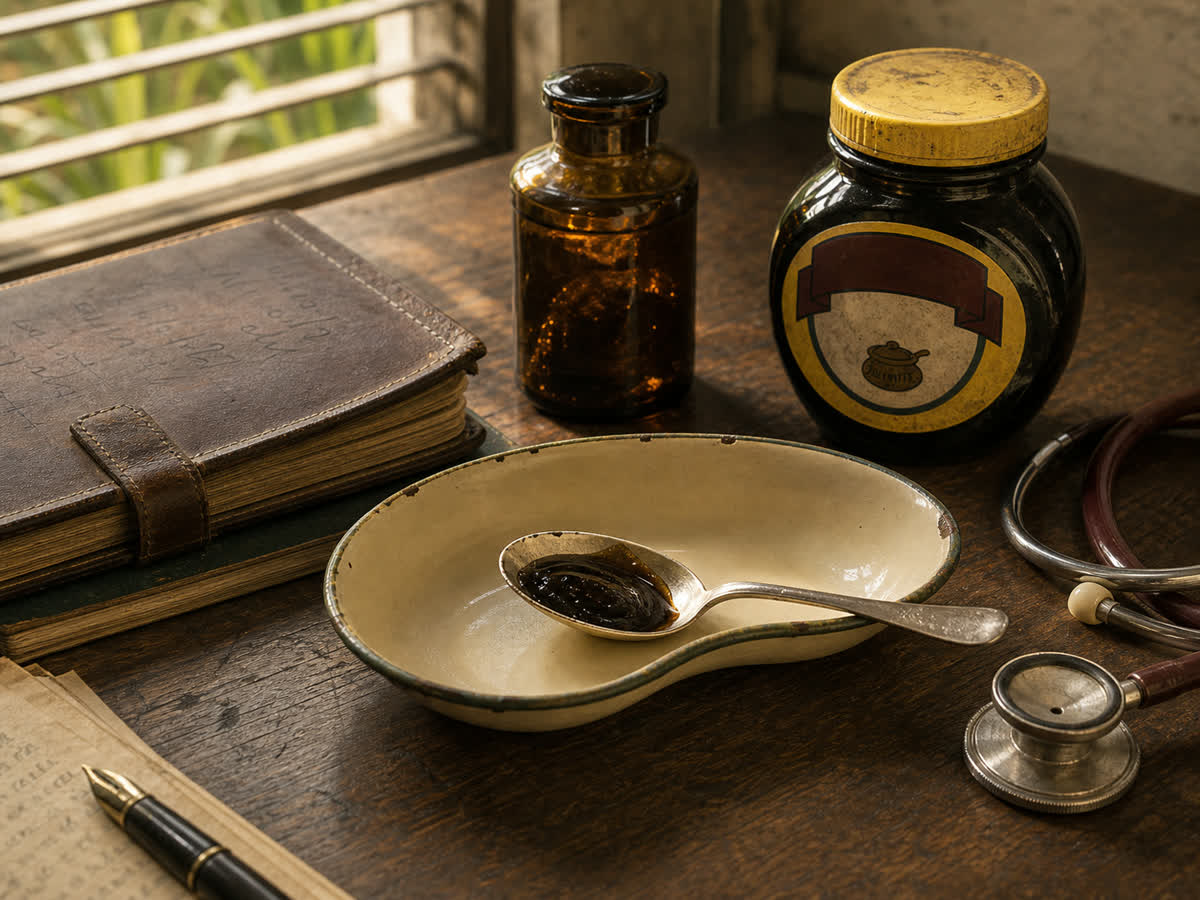
The doctor
Lucy Wills was an English physician who graduated from Cambridge in 1928 and went to work at the Haffkine Institute in Bombay in the early 1930s. She was particularly interested in a severe and often fatal anaemia affecting pregnant women in the Bombay textile mills. The condition was puzzling. It did not respond to iron supplements, which was the standard treatment for anaemia. The women were dying in childbirth in large numbers and no one could explain why.
Wills did the unglamorous, careful clinical work. She investigated their diets. She noticed that the affected women were almost universally on a thin diet of polished rice and very little else, and that the unaffected women were on slightly more varied diets. Whatever was missing was clearly in the food.
She started experimenting with food-based supplements. Among the things she tried, on a hunch, was Marmite.
What happened
It worked. The women on a daily Marmite regimen recovered. The anaemia, which had been killing pregnant women in Bombay for decades, responded to the yeast extract from a Burton-on-Trent factory. Wills published her results in 1931, and the substance in Marmite that was doing the work became known, somewhat charmingly, as the “Wills factor”.
It would take another decade for biochemists to isolate and identify the Wills factor as a specific compound. The compound turned out to be folate, otherwise known as vitamin B9 or folic acid in its synthetic form. The discovery of folate, and its later recognition as essential for the prevention of neural tube defects in pregnancy, is one of the foundational pieces of twentieth-century nutritional science.
And it started, in the form of a successful clinical trial in 1931, with a doctor in Bombay handing out daily doses of Marmite.
What this means
Two things, both worth holding onto.
First, Lucy Wills’ work is the original reason pregnant women are now routinely advised to take folic acid supplements. The advice, which has saved enormous numbers of babies from spina bifida and other neural tube defects, traces back to her observation that a jar of yeast extract could cure something nobody else could cure.
Second, Marmite was an active piece of mid-twentieth-century clinical practice. Not a heritage brand. Not a curiosity. An ingredient that working doctors put into treatment regimens because it visibly fixed a measurable health problem. The folate content was doing real medical work in real hospitals on real patients, decades before anyone knew what folate was.
This is the kind of brand history that you cannot manufacture and you cannot buy. It happens once, and then you have it forever.
A note on Lucy Wills
Wills is one of the great underrated figures in twentieth-century British medicine. She continued working for decades after the Bombay study, did important work on macrocytic anaemia in pregnancy more generally, and quietly mentored a generation of women into medical careers at a time when that was rare. The medical literature treats her as a foundational figure. The general public has mostly forgotten her, which is a shame.
If you ever find yourself standing in front of a jar of Marmite and feeling vaguely sceptical about its claims to be a useful piece of nutrition, remember Lucy Wills. The next time the brand puts out an anniversary campaign, this is the story they should be telling.
The Sri Lanka footnote
Marmite was also used to combat malnutrition during a major malaria epidemic in Sri Lanka (then Ceylon) in the mid-1930s. The same trick as the Bombay study, deployed at a larger scale, with similarly good results. The historical record on this is thinner than the Wills work but the broader picture is consistent: in the 1930s, Marmite was one of the most useful pieces of pocket nutrition in the British colonial medical kit.
Sources: BMJ obituary of Lucy Wills; original 1931 paper on macrocytic anaemia in Bombay; Wikipedia entries on Wills and on folic acid history.