

The collaboration
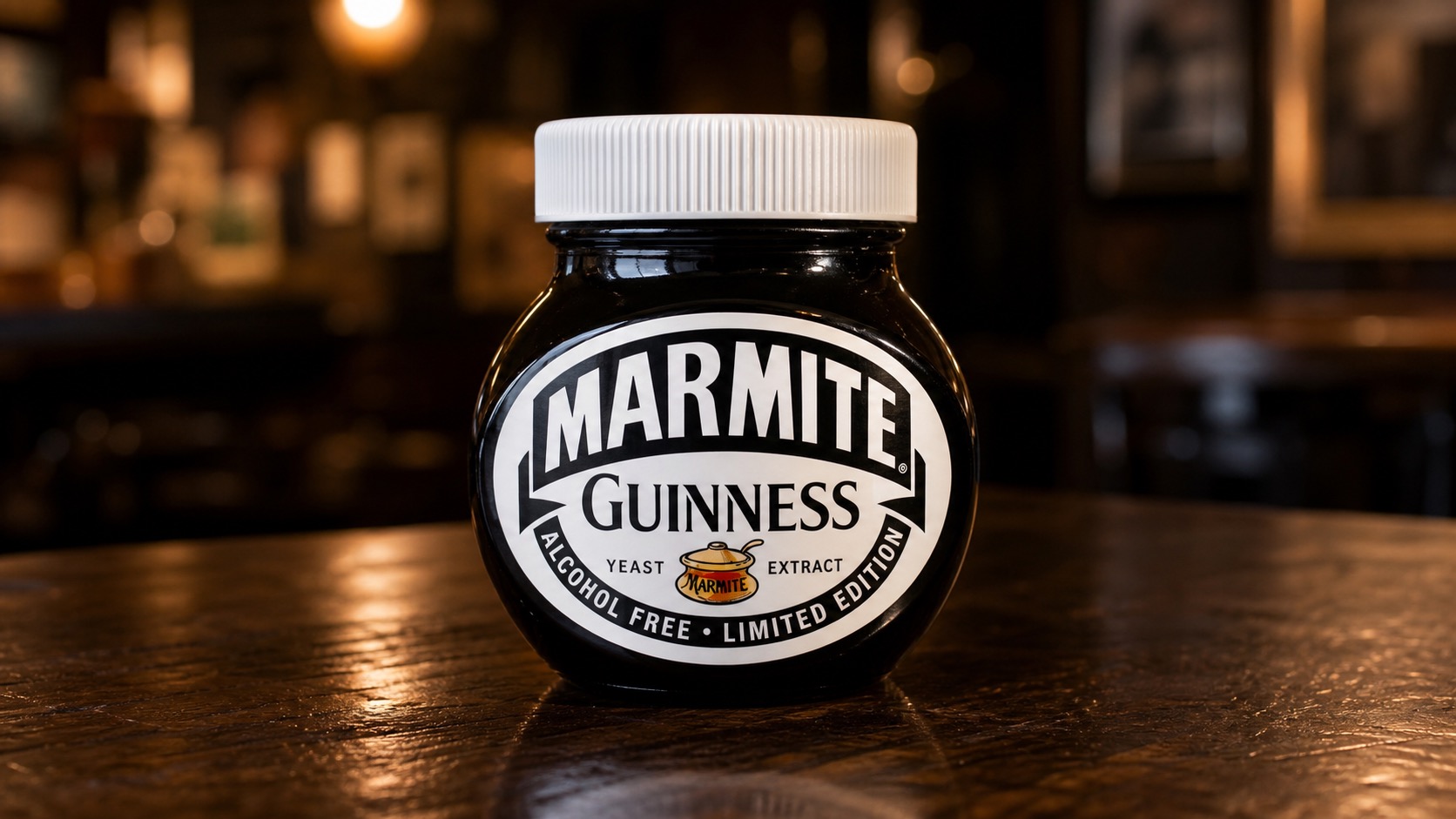
Marmite, as anyone who has read Burton-on-Trent, where the Marmite actually comes from will already know, has always sourced its raw material from leftover brewers’ yeast. For a hundred and twenty-three years that yeast has come from the breweries of Burton-on-Trent. In 2007, the brand did the obvious-once-you-think-of-it thing and ran a special edition made with yeast from a different brewery: Guinness’s St James’s Gate brewery in Dublin.
The resulting Guinness Marmite was the standard Marmite recipe with the Bass-style Burton yeast swapped out for spent Guinness yeast. Same processing, same seasoning blend, different source material.
The branding was the part everyone remembers. The jars were black-and-gold (Guinness colours), the label kept the marmite-pot motif but in gold-on-black, and the tagline was “My Goodness, My Marmite”, a pun on the 1929 Guinness slogan “My Goodness, My Guinness”. Whoever wrote that tagline deserved the bonus.
How it tasted
Different. Specifically: deeper, slightly darker, slightly more bitter, with a faint roasted-malt note that ordinary Marmite does not have. Guinness yeast carries the influence of the dark-roasted barley used in stout production, and that character carries through into the finished spread.
Was it better than the standard? Depends on who you ask. The Marmite purists (and there are more of these than you might think) thought it was an interesting variation but slightly off-balance. The Marmite enthusiasts who also like Guinness, a sizeable overlapping population, loved it. The Hate Party predictably hated both Guinness Marmite and ordinary Marmite, with the precise relative weights of their hatred varying by individual.
I had one jar at the time. Used it on toast over the course of a couple of weeks. It was good but not transformative. Worth having tried; not worth campaigning for a permanent return.
Why it worked as a campaign
Three reasons.
First, the cross-brand pun was genuinely clever. Pun-led collaborations usually feel forced. “My Goodness, My Marmite” is a graceful piece of writing that respects both brands’ heritage and trusts the audience to enjoy the wordplay.
Second, the visual identity. The black-and-gold jar in a sea of yellow-and-oxblood standard jars stood out on shelves. It was instantly recognisable as the special edition without anyone having to read the label.
Third, the underlying logic of the product was honest. Marmite is made from brewers’ yeast. Guinness is a brewer. Therefore Guinness Marmite. The collaboration was not a forced marketing fit, it was the most natural cross-brand pairing you could possibly invent.
The collector’s market
Guinness Marmite jars now sell on eBay, depending on condition, for somewhere between fifteen and thirty pounds. Unopened, in original cardboard sleeve, you can push that into the forty-pound range. Not life-changing money, but a solid return on a three-pound jar from 2007.
If you happen to find one in a cupboard during a kitchen clearout, do not open it. Even Marmite has a shelf-life eventually, and an eighteen-year-old jar is well past the point of being good on toast. As a collectible it is worth more sealed than opened.
The 125th anniversary of Marmite is in 2027, and the collectible-jar market will tick upwards in the run-up. Same applies for the Ma’amite Diamond Jubilee jar, the Olympic 2012 jars, the various Champagne-flavoured runs, and the final Elton John Pride jar. Hoard accordingly.
Source: Marmite 2007 launch; the Telegraph contemporary coverage; eBay completed listings.