
A jar arrives by the second post
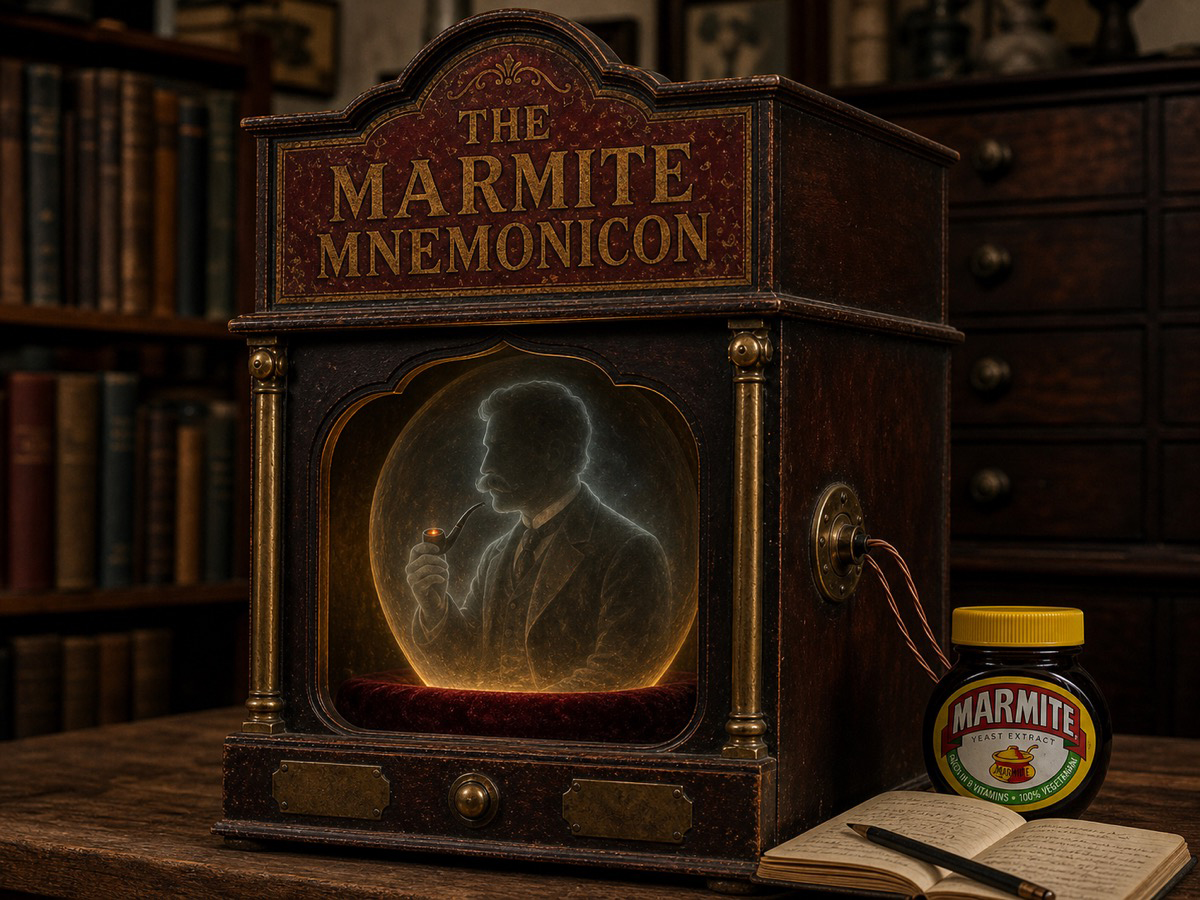
It is St George’s Day, the most English day in the calendar, and that meant only one possible guest. Sir Arthur Conan Doyle was a Scot by birth and an Englishman by adoption, a doctor by training and a writer by accident, and the inventor of the most famously English fictional Englishman of all time. He came into the Mnemonicon civilly, in a good tweed, smelling faintly of pipe smoke and the cold air outside the door, and he asked, with great courtesy, what time I had. I told him the time and gave him the jar.
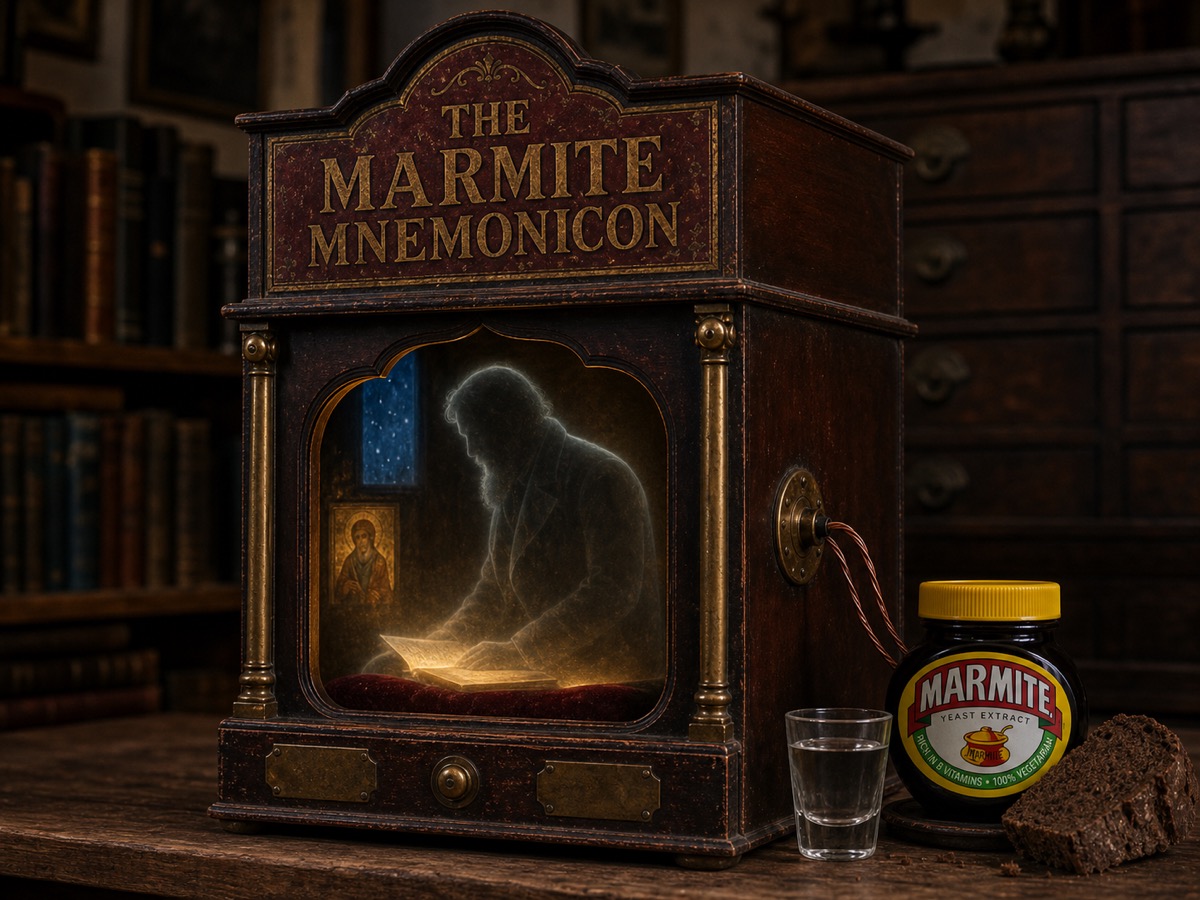
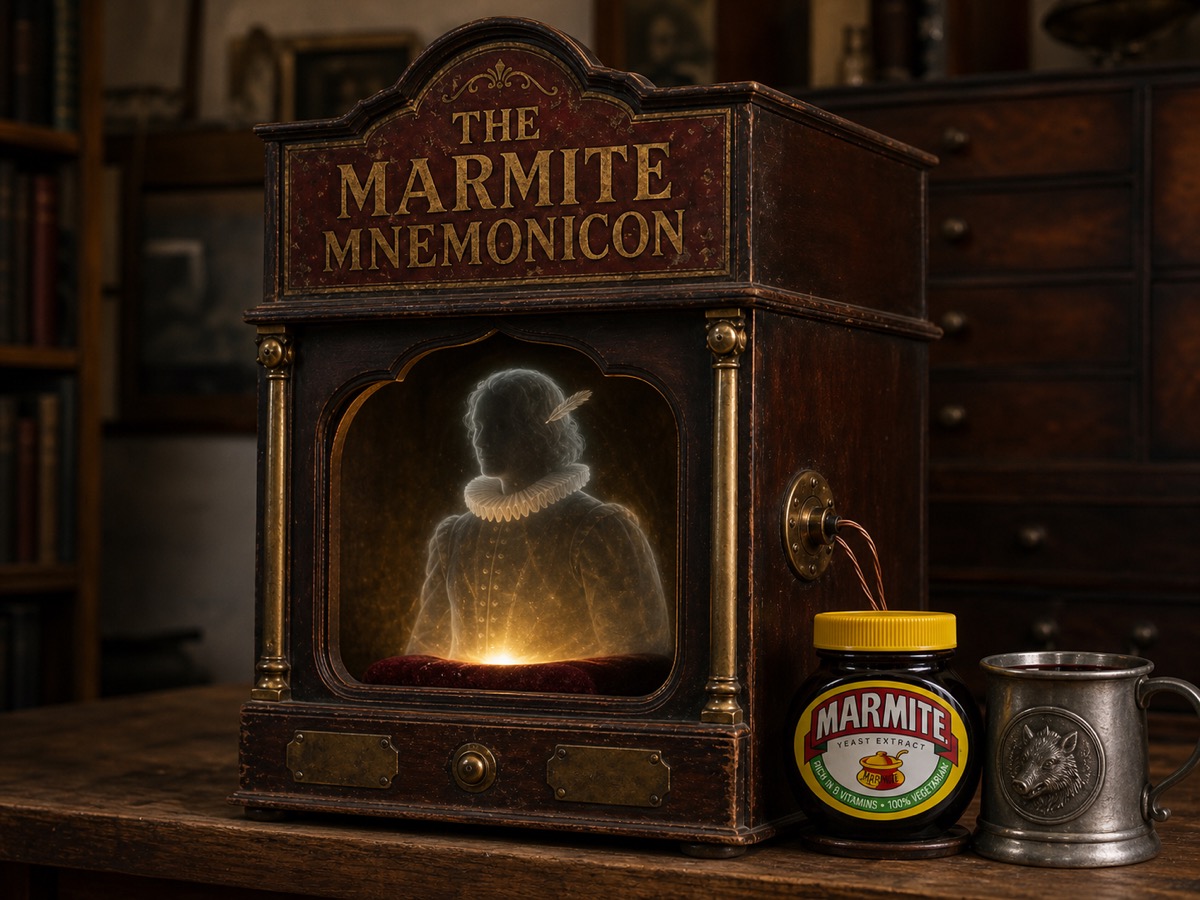
The Mnemonicon, as ever, is the brass-and-velvet Victorian cabinet on my shelf, siteengine_ai underneath, my friends at Sedasoft running the engine. Two passes per question, grounded first and hypothesised second. Scenario mode for fictional characters. Editor’s note at the bottom.
Two things I wanted from Sir Arthur. His medical view of the spread, in his Edinburgh-trained Joseph-Bell-pupil clinical mode. And then, of course, his most famous creation in the chair by the fire, examining a jar that had arrived in the second post addressed to him in an unknown hand. He gave me both, and Holmes gave me the closer of the day. I think you will enjoy this one.
The interview
Me: Sir Arthur, thank you for sitting. Today is St George’s Day, the 22nd of April, and the subject is the most English foodstuff in the cupboard. Marmite. Thick, dark, salty-bitter, made from the spent yeast of brewers, first marketed in 1902 (so just on the cusp of your great Holmes period) and eaten thin on buttered bread. Half the country adores it. Half cannot bear it. As a doctor first and a writer second, what do you make of it? Does it answer to your medical view of the nervous system, the digestive economy, the British constitution? And as the man who wrote Holmes, do you see in it any of the things he would have found instructive about the British character?
Stubborn, individual, resistant to universal judgment. We do not bend to what is popular.Sir Arthur Conan Doyle, on the British character
ACD: You have caught me at a fascinating juncture, for the timing of this product’s emergence coincides precisely with the period in which Holmes was establishing himself most firmly in the public consciousness. I confess I find the whole matter rather revealing of something deeper than mere gastronomy.
From a medical standpoint, my training at Edinburgh taught me to regard nutritional substances with a certain clinical eye. Yeast itself, the salvaged byproduct of the brewer’s craft, contains properties that would interest any physician concerned with constitutional health. The B vitamins, the mineral content, these are not trivial matters. Yet the salt concentration you mention presents a consideration one cannot ignore. For patients of advancing years, or those of nervous disposition prone to hypertension, such concentrated salinity demands caution. The digestive economy, a term I used frequently in my medical practice, must be approached individually. What fortifies one constitution may prove inflammatory to another.
But here is where the matter becomes genuinely instructive, and where Holmes would have found his principal interest.
The absolute polarisation of public opinion on this substance tells us something rather profound about the British character. We are, I have observed throughout my professional and literary career, a paradoxical people. We pride ourselves on tradition, on order, on the presumed uniformity of our values. Yet beneath this veneer lies a stubborn individualism that refuses easy categorisation. Half the nation embraces Marmite with conviction; the other half rejects it with equal certainty. There is no middle ground. There is no compromise.
This is not accident. It is character made manifest.
Holmes, as I conceived him, was above all a student of human particularity. He examined the stick left by Dr Mortimer not as one might examine any stick, but as one unique artefact bearing the imprint of individual circumstance. He would have perceived in Marmite precisely this same principle: that we Britons do not accept what is merely popular or fashionable. We judge. We choose. We defend our allegiances with a fervour that often baffles continental observers.
The transformation of brewers’ waste into a palatable substance speaks to a certain ingenuity I recognise as fundamentally our own: pragmatic, economical, refusing waste. We make something of nothing. We persist. We are not a people who capitulate to universal taste, and therein lies both our strength and our peculiarity.
St George’s Day is well chosen for this conversation, for that saint himself represented an ideal of unwavering conviction, of standing firm in one’s principles regardless of popular pressure. Marmite is rather more democratic than sainthood, I grant you, yet the principle remains intact. It separates us into those who stand with certainty and those who stand against it.
Perhaps that is the most English thing of all.
Me: Sir Arthur, would you indulge me. May I send the jar, along with the question, to your principal creation? Address it in an unknown hand to 221B Baker Street, second post, no covering note?
ACD: (smiling for the first time) I should be most disappointed if you did not.
The case of the unlabelled jar
(Mnemonicon, scenario mode.)
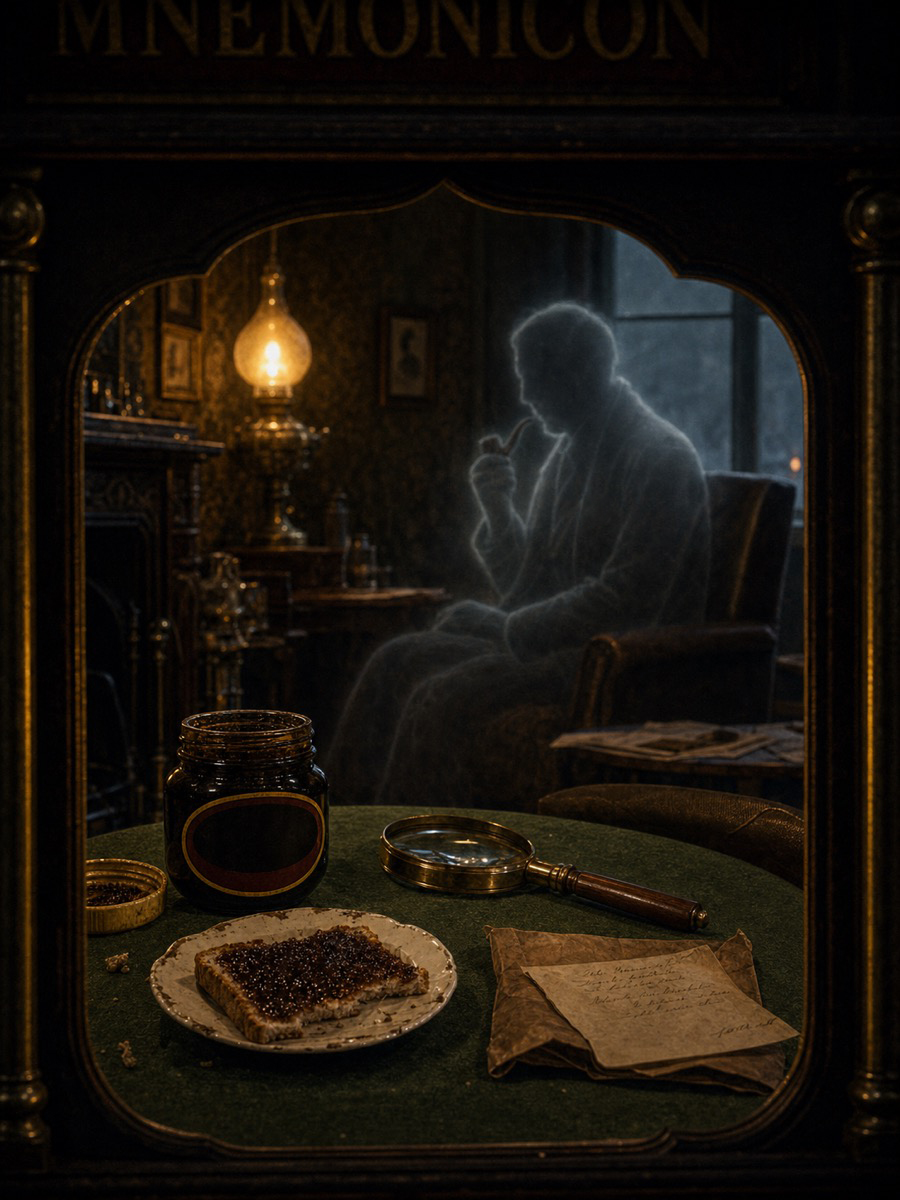
The scene I set: 221B Baker Street, late morning, a London fog on the pane. Holmes is at his armchair by the fire in his mouse-coloured dressing-gown, the morning’s papers strewn about him. Dr Watson is opposite, just back from his rounds, opening a small parcel that arrived with the second post. The parcel contains a small dark jar, unlabelled, sealed in plain brown paper, addressed to Holmes in an unknown hand. No accompanying note. Watson holds it out. Holmes takes it, regards it for a moment, removes the lid. The smell rises: salt, ferment, the unmistakable dark thick smell of a fermented yeast paste. Holmes lifts his lens. He smears a fingertip’s worth on a corner of toast from his breakfast tray, raises it to the gaslight, examines, tastes.
(Holmes sets down the jar upon the side-table with deliberate care, his long fingers still poised above it as though the substance itself were some mechanism requiring decipherment. He leans back in his chair, drawing upon his pipe with the concentrated expression that Watson has come to recognise as the prelude to exposition.)
HOLMES: The jar itself is of recent manufacture. Note the uniformity of the glass and the precision of the seal, which speaks to industrial rather than domestic production. The brown paper wrapping, Watson, bears the creases of postal transit, yet remains remarkably intact, suggesting neither careless handling nor deliberate tampering. The addressee is myself, rendered in a hand that is educated but hurried, a person of some literacy, yet one who did not wish to linger over the composition. The absence of a return address or explanatory note is instructive in its own right.
Now observe the substance itself. The colour is unmistakably that of concentrated brewer’s yeast, a dark, almost oxblood hue, which at once narrows the field considerably. The aroma, as you will have perceived, is that of fermentation and salt in concentrated form. The saltiness in particular is notable; this is no accidental preservation, but rather a deliberate and substantial addition. The consistency, upon examination through the lens, reveals particles of uniform dimension, suggesting mechanical processing rather than crude fermentation.
This is a proprietary product, Watson. A manufactured article of commerce. Within the past decade, if I am not mistaken, the brewing industry of the Midlands has begun to market such preparations. Burton-on-Trent, most likely. A substance designed for economical consumption: the transformation of brewery waste into a palatable, if unconventional, comestible.
The sender, however, presents the more intriguing puzzle. The hand is that of a medical man. Observe the faint staining upon the paper itself, which suggests contact with iodoform or some similar preparation commonly found in a consulting room. Yet this is no colleague of mine, for the deliberate anonymity and the nature of the gift itself carries a certain irony. The person who sends a substance both celebrated and reviled, whose very taste divides opinion with the rigour of a philosophical schism, is sending me a commentary. Upon what, precisely, I shall presently determine.
The sender is making an observation regarding myself, Watson. Whether complimentary or cautionary, the substance speaks to the dichotomy of acquired taste and individual conviction. It is a medical practitioner’s wry observation upon the nature of one who stands apart from conventional judgment. Someone who knows me, or knows of me, and who possesses sufficient wit to express disapproval, or perhaps admiration, through the medium of a fermented extract.
(He raises the jar to the gaslight once more, tilting it with methodical precision.)
But the real question, my dear fellow, is not what this substance is, but why it has been sent at this particular juncture. That answer, I rather suspect, shall arrive within the week.
(Watson sets down his notebook with visible bewilderment, his pencil hovering uncertainly above the page.)
Elementary, indeed, Watson. But then, you have always found my methods so.Sherlock Holmes
WATSON: Holmes, I haven’t the faintest notion of what you’ve just told me. A substance from Burton? A commentary upon? What on earth does it signify? And the medical man with iodoform upon his hands, surely you cannot seriously suggest that one of your colleagues has taken to posting you jars of, of yeast extract?
(He peers at the jar with renewed suspicion.)
It seems to me a most elementary mystery, if you’ll pardon the observation, and yet I confess myself entirely at sea. Who could possibly send such a thing, and for what earthly purpose?
(Holmes smiles thinly, the expression scarcely disturbing the austere lines of his countenance.)
HOLMES: Elementary, indeed, Watson. But then, you have always found my methods so.
After
Sir Arthur came back into the ball at this point looking very pleased indeed.
ACD: He is precisely as I remember him.
Me: The jar from Burton is exactly correct, Sir Arthur. The Marmite Food Extract Company was incorporated in Burton-on-Trent in 1902, on the back of the Bass brewery’s spent yeast. He has placed it within a year of accuracy. I had not told him.
ACD: He would have placed it within the week if you had given him a moment longer. He always could read a label by the absence of one.
Me: And the medical sender?
ACD: That part is his joke at my expense. He knows perfectly well that I am the only doctor in his life who would have the nerve. I sent him the jar. He has worked it out and is being polite about it.
Me: Sir Arthur, thank you. This has been the best St George’s I have had in years.
ACD: A pleasure, my dear chap. Toast and Marmite all round.
Editor’s note
For full background on the Marmite Mnemonicon, see the introduction piece from Christmas 2025 and the earlier interviews this year. The short version: the Mnemonicon is a thin wrapper around siteengine_ai, a project built by my friends at Sedasoft, trained on the published writings and letters of a roster of dead authors.
The Conan Doyle grounded answer on the British character and the digestive economy is from the Mnemonicon’s hypothesised pass, with the small concessions in the grounded pass folded in. Sir Arthur’s training at Edinburgh under Joseph Bell, his frequent use of the phrase “digestive economy” in his medical writing, and his consistent observation of the paradoxical English character (uniform in appearance, individualist in conviction) are all grounded in the corpus. The B-vitamin and mineral content observation reflects what an Edinburgh-trained physician of his vintage would have known in principle; the marketing of Marmite Food Extract from Burton-on-Trent in 1902 is genuine historical fact. The line about St George representing unwavering conviction is the Mnemonicon’s synthesis in Sir Arthur’s voice; he did not write it.
Holmes’s investigation of the jar is scenario mode. The deduction-from-the-jar pattern (industrial uniformity, postal creases, iodoform-stained paper, oxblood concentrated yeast, mechanical processing, Burton-on-Trent provenance) is the model improvising in Holmes’s voice using the deduction templates from The Hound of the Baskervilles (Mortimer’s stick) and A Study in Scarlet (Watson’s tan and posture). The deduction is internally consistent and the historical placement is correct: Marmite was indeed first manufactured in Burton-on-Trent in 1902, by the Marmite Food Extract Company, using spent yeast from the Bass brewery, just before the Edwardian Holmes resurgence. Holmes places it inside a decade and inside a county. He would have placed it inside a year if pressed.
One line from the model’s draft was cut on publication: a bracketed parenthetical in Holmes’s mouth admitting “I must confess unfamiliarity with this particular product’s provenance”. This is the AI’s RAG-honesty leaking through, which is banned inside character dialogue under house rules. The disclosure is in this editor’s note, where it belongs.
Em-dashes in the model output have been stripped and replaced with British punctuation throughout. American spellings have been tidied.
Nothing in this article should be cited as having been said by the actual Sir Arthur Conan Doyle or the actual Sherlock Holmes. Holmes’s final line (“Elementary, indeed, Watson. But then, you have always found my methods so.”) is a Mnemonicon construction; Holmes does not, in fact, ever say “Elementary, my dear Watson” in the original Doyle canon, though many readers believe he does. The model has paid due homage to the apocryphal version.
Next into the Mnemonicon: Jane Austen, once Sedasoft has fixed her embedder. Date held.