
A winter of calibration, and the first proper guest
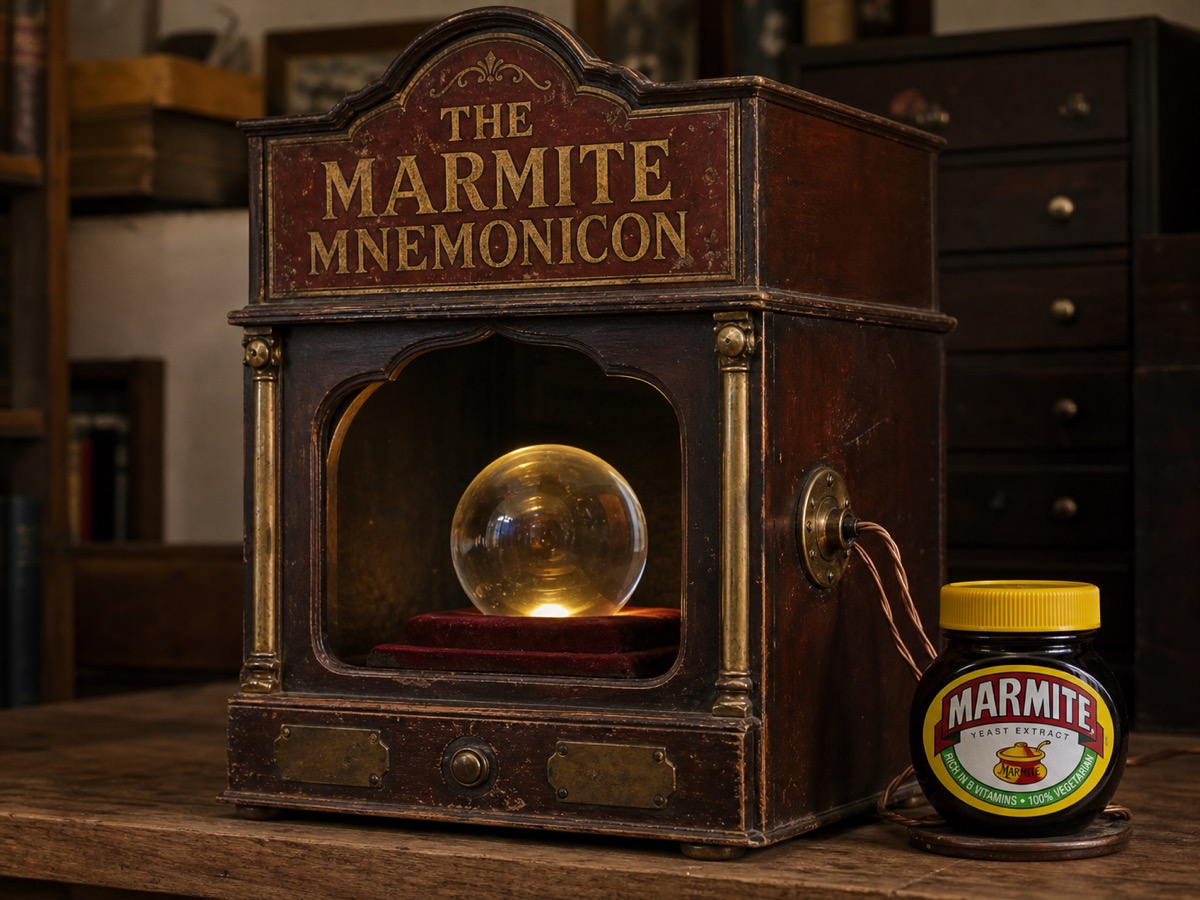
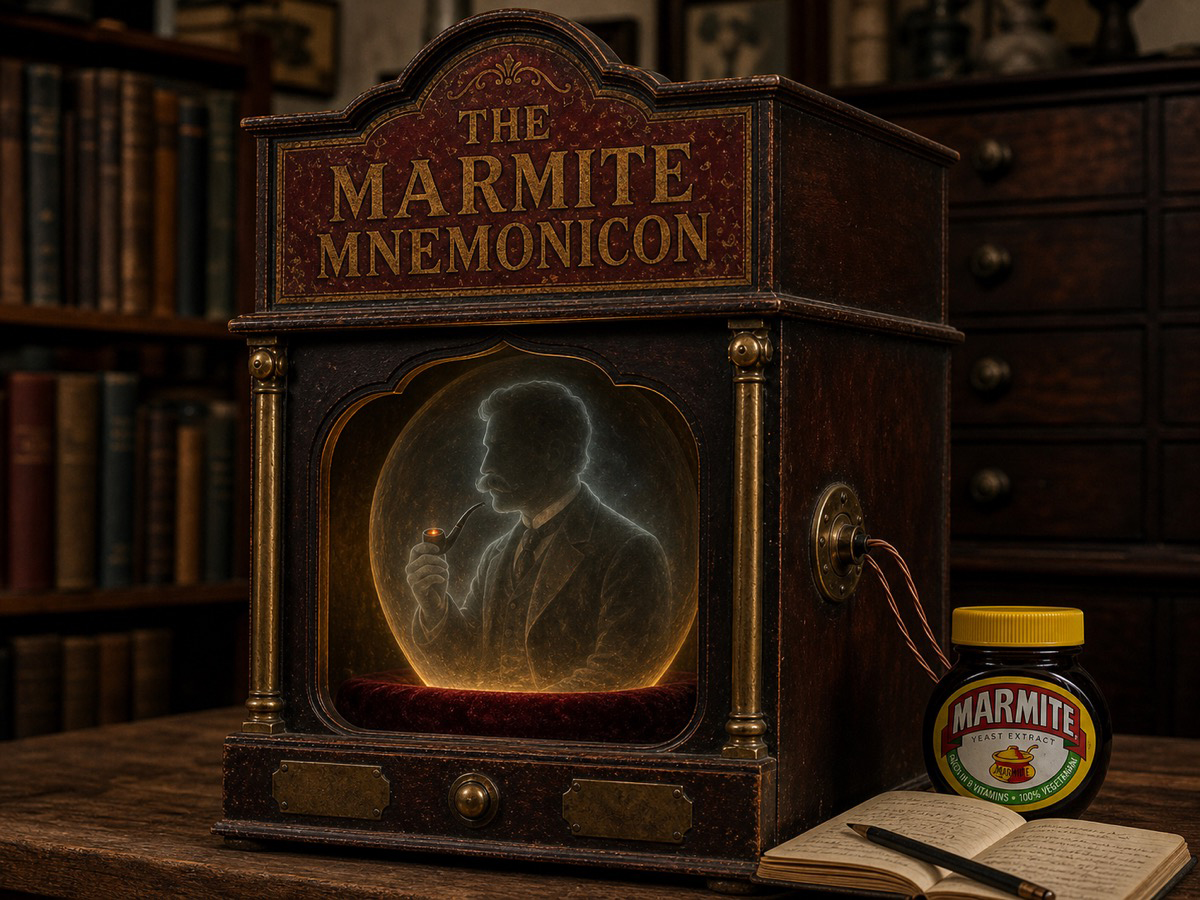
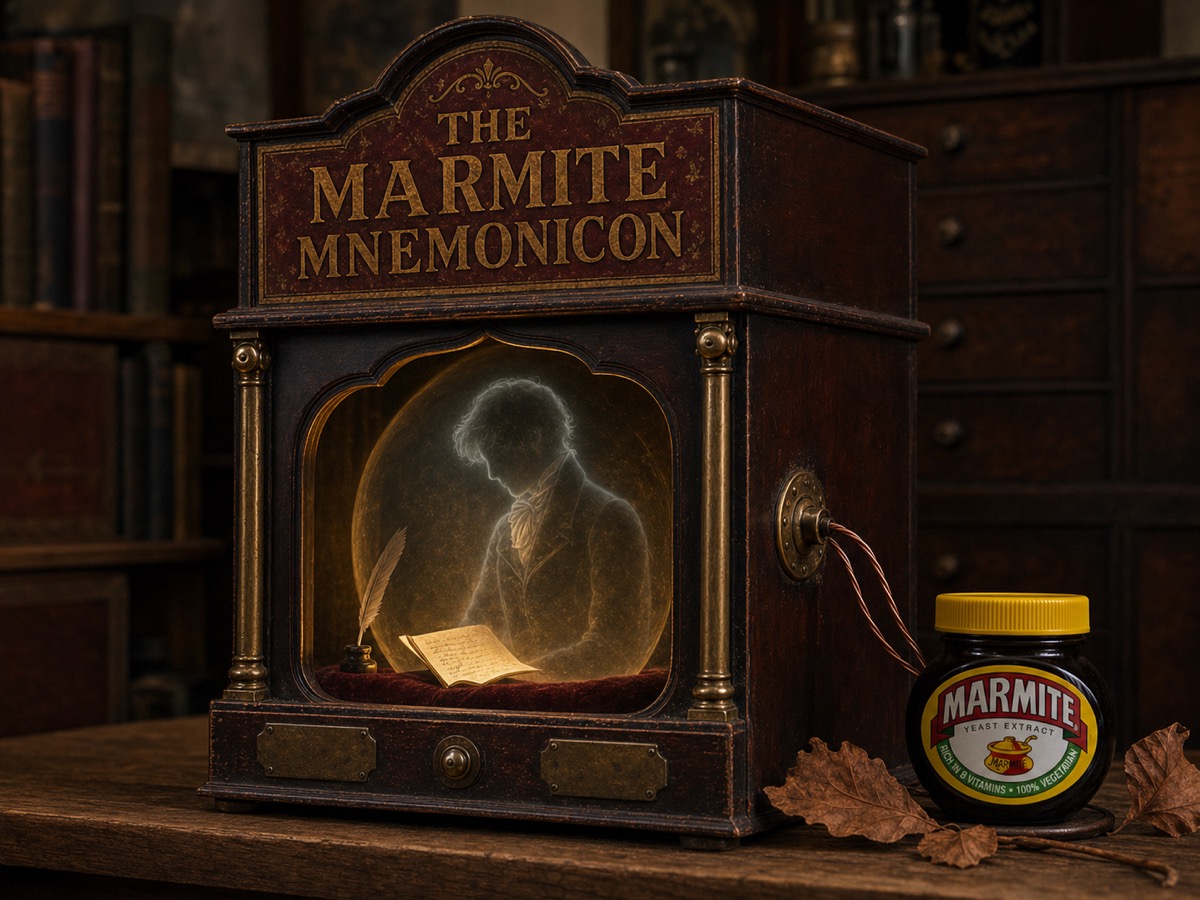
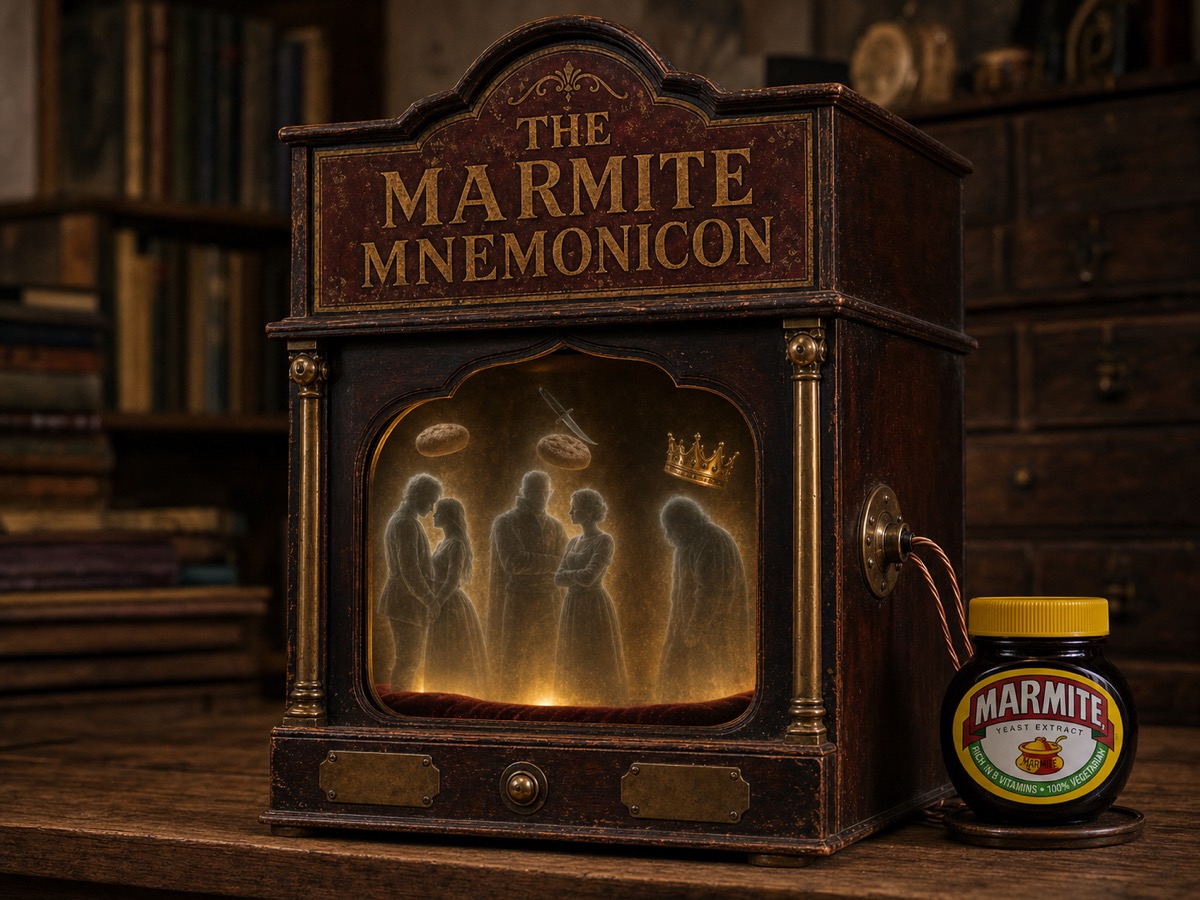
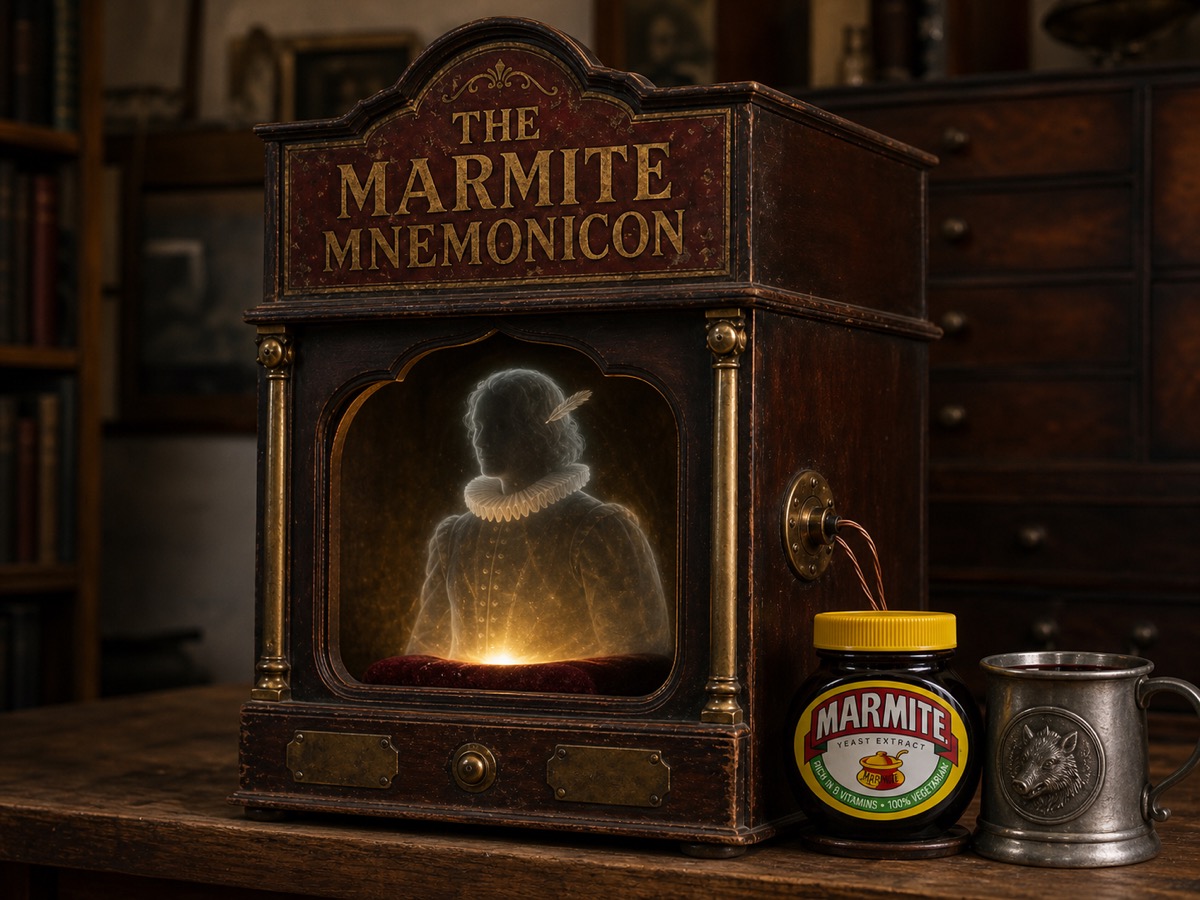
The Marmite Mnemonicon spent most of December in pieces on my kitchen table. By the end of January the brass had been polished, the velvet replaced, the crystal ball reseated, and the wires from the Marmite jar at the back run cleanly into the cabinet’s belly. I had been promising myself the first proper guest for weeks.
The Bard was always going to be the first proper guest. If you build a Victorian fortune-teller cabinet that summons the dead to talk about a salty British spread, you do not start with anyone less than William Shakespeare. You start with him because he is the obvious choice, because the obvious choice is sometimes the right one, and because, as it turned out, Marmite sits exactly on the seam of his lifelong subject. Appetite against restraint. Cakes and ale against the man who would forbid them. The fat knight and the thin prince.
The usual reminder of how the Mnemonicon works: two passes per question, grounded first and hypothesised second, the speculative pass flagged clearly. A third mode, scenario, for when I want to put a fictional character into a room and see what happens. Sedasoft’s siteengine_ai is the engine inside the cabinet; the brass and velvet on my shelf is the wrapper I built. Editor’s note at the bottom, as ever.
I had two grounded questions for the Bard and one scenario favour to ask. He obliged on all three. The third nearly broke me.
The interview
Me: Will, thank you for sitting. Let me start with the physic of the thing. Marmite is a thick, dark, salty-bitter paste made from the spent yeast of brewers, a 20th-century kitchen-stuff, eaten thin on buttered bread. In your day, all foods answered to the four humours: blood, phlegm, choler, melancholy. Where would Marmite sit?
WS: Dark, salt, bitter, and born of ferment; such properties pertain naturally to choler, the hot and dry humour. Aged, fermented, bitter substances inclined toward the choleric disposition in our physic, and your Marmite by your own description is the dregs of brewing concentrated and darkened by time. It is choler in a jar.
Me: And to what manner of body would you prescribe it?
It is choler in a jar.William Shakespeare on Marmite
WS: To a phlegmatic temperament, one sluggish, cold, and moist. Such a body wants quickening. A dab of your paste upon bread would heat the blood, dry the cold humours, and restore balance to a man who has grown dull. I would prescribe it sparingly. A little choler answers phlegm; too much, and you have made the cure worse than the complaint, and your patient will weep, rage, or both.
Me: This is going to sound like a leading question, but it isn’t. Modern Britons divide hard over this stuff. Half adore it, half cannot bear it, hardly anyone is indifferent. Your plays love a thing that splits the room: cakes and ale against Puritan abstinence, fat Jack against thin Hal. If a jar of Marmite were set out on a Globe trestle table at the interval, which of your characters would seize it, and which would push it away?
WS: You have touched upon the very marrow of my theatrical art: that tension between appetite and denial, indulgence and restraint, which animates half my comedies and tragedies alike. Picture it, then. The jar sits upon our tiring-house table.
Falstaff would seize it without hesitation. That mountainous knight, who measures all the world by his palate and his lusts, would spread it thick upon bread and declare it a sovereign remedy for the phlegmatic disposition. He lives by the sack first and virtue after, and any dark, salt, concentrated essence of ferment would speak directly to his nature. He is a man of appetite, unredeemable and unapologetic. His very bulk is argument against temperance.
By contrast, young Hal, that lean, calculating prince who will become Henry V, would regard the jar with cool suspicion. He does not eat and drink to enjoy; he eats and drinks to rule. Every appetite he permits himself serves some larger purpose of statecraft. The bitter, intense flavour would strike him as excessive, unnecessarily bold. He would set it down and return to his wine, measured and purposeful.
And there stands the eternal drama of my stages: the fat man and the thin man, forever at odds, each certain of his rightness, neither able to persuade the other because they speak from opposite philosophies of the flesh itself. This is the meat of comedy and tragedy both: not the condiment itself, but the war between those who say yes to the world’s abundance and those who say no.
Me: That is the Marmite advertising department in a nutshell, four hundred years early. “Love it or hate it” is literally their slogan. They have been running it since 1996. Your fat-man-and-thin-man is the brief.
WS: Then perhaps the brief was mine first. I should have been on a retainer.
A jar before Falstaff
I could not let the Bard go on the Falstaff hint alone. The whole shape of the answer pointed at the same scene: Eastcheap, the Boar’s Head, a knight slumped in his great chair with a cup of sack at his elbow, and a prince across the table watching him eat. So I asked the Mnemonicon to fetch Sir John out of the back of the cabinet, set the scene, and let him taste.
(Mnemonicon, scenario mode.)
Me: Sir John, Hal has just set a small dark jar down upon the boards in front of you. He has pried off the lid. The smell is rising. There is a fresh manchet loaf, a knife, and a yellow pat of butter. Hal says it is called Marmite, that they make it from the spent yeast of brewers, your sack made flesh. He is watching. Eat, and tell us what you find.
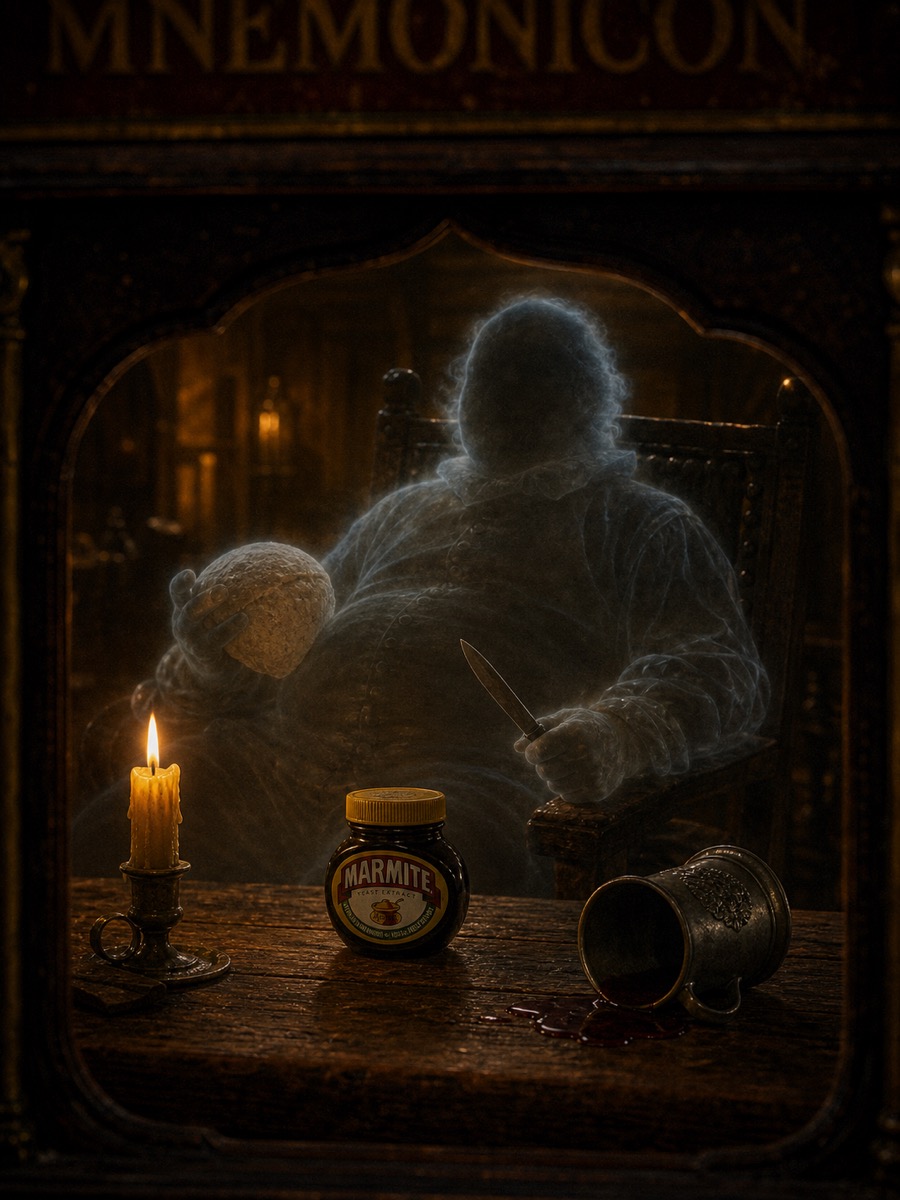
SIR JOHN FALSTAFF: (heaves himself upright in the chair, which creaks) Sack made flesh, says he? By the Lord, Hal, thou hast struck upon the very philosophy that sustains me!
(reaches for the knife with the deliberation of a man handling a sacred instrument; spreads the butter thick upon the manchet)
Gods and little fishes!Sir John Falstaff
Spent yeast, thou sayest? Why, that is but the quintessence of the brewing art: all the vigour and heat of fermentation boiled down to its essence. ‘Tis the very soul of the ale, extracted and darkened by time, like an old knight who has lived hard and seen much. Virtue, Hal? Nay, better still, it is the concentrated argument against all that pale, thin-blooded temperance that the Puritans would have us embrace.
(dips the knife into the jar; draws forth a quantity of the dark paste)
Mark how it clings to the blade: thick, purposeful, unashamed. Not some weak broth or watered wine that a man must drink like a reluctant apothecary taking physic. This speaks plain to a man’s belly.
(spreads it upon the buttered bread; black upon gold)
See how it sits upon the butter, the very marriage of appetite and indulgence! If to be old and merry be a sin, then what is this but the visible form of sin itself, and all the merrier for it?
(raises the bread; pauses, the Prince is watching, takes a deliberate bite; his eyes widen; his jowls work)
Gods and little fishes!
(takes another bite immediately, then another; his voice, when it comes, is thick with revelation)
By my rotundity, Hal, this is a substance made in heaven and sent to earth for the express comfort of those of us who have lived, who have drunk, eaten, wenched, and made merry whilst your sober-blooded clerks were at their prayers! ‘Tis salt, bold, honest salt, the very crystalline argument against blandness. ‘Tis the ferment itself, the working of time and heat, all the generative power of the brewery trapped in a jar.
(takes a third bite, voice rising)
This is no lady’s cordial to be sipped with a pinched face and a pious grimace. This is a man’s condiment: dark, concentrated, speaking of labour and transformation. The dregs of the sack, thou sayest? Nay, Hal, the distillation, the very proof that indulgence, pursued with sufficient vigour and time, becomes something of substance and worth.
(tears another piece of manchet, spreads it with Marmite as if he has been doing so all his life)
I tell thee true: any man who would refuse this, who would turn from it with his nose in the air and speak of temperance and restraint, is already dead. His blood is water, his humour is phlegm, and his life is a waste of good time upon this earth. Better to be old and fat and loyal to one’s appetites, as I am, than thin and righteous and starved of all true pleasure.
(pauses, regarding the Prince with a mixture of warmth and theatrical cunning)
This, my boy, is what separates the men from the saints. The saints may have heaven; let them keep it. I have this: butter, bread, dark ferment, and the company of a prince who understands that there is more profit in a man’s honest appetite than in all the false virtue that ever was preached from a pulpit.
Thou hast done well, Hal. Thou hast brought Jack Falstaff a jar of revelation.
(returns to eating, with the single-minded devotion of a man who has found his true calling)
After
I did not want to interrupt him. He would have eaten the whole jar with one manchet loaf and called for another, and I would have let him. The Bard came back into the crystal ball afterwards, dabbing at his eyes.
WS: I told you. The man does not stop. He never has.
Me: He called Marmite “sack made flesh”.
WS: That was my line. I gave it to Hal.
Me: Hal will be unimpressed when he learns Falstaff has stolen another scene off him.
WS: Hal will be Henry V by then. He will have other concerns. Set the jar down on his side of the table and watch him fail to enjoy it. There is a tragedy in there for someone with a freer hand than I have at the moment.
Me: One last favour before I let you go, Will. Write me a sonnet about Marmite. Proper form, fourteen lines, iambic pentameter, three quatrains and a closing couplet, ABAB CDCD EFEF GG. Treat it the way you would treat any of the others: serious craft, sincere feeling, a turn at the volta, a couplet that lands. The thing itself is the subject. I will print it.
WS: You do me honour, and I shall not refuse it. A sonnet demands truth-telling, and this dark paste, though it lies beyond my mortal years, speaks to truths I spent my life examining: the division of appetite, the war between those who say yes to the world’s plenty and those who turn away in disgust. The form is strict; the subject permits no less.
On Marmite
Dark essence drawn from ferment’s labour’d heat, Thick-bodied child of yeast and time and brine, Spread thin upon the butter’d golden wheat, Thou art the test by which men’s natures shine.
Some taste thee first and cry out in delight, That salt-bright vigour speaking to the tongue, The concentrated argument of might Distill’d from all the brewing-vats among.
Yet others turn away with wrinkled face, Recoil from thee as poison or as sin, And swear that naught but emptiness and grace Could justify so bitter a discipline.
Thus dost thou prove what all my plays have shown: That men are split, and none can stand alone.
That men are split, and none can stand alone.From the Bard's sonnet for the jar
WS: The subject required no embellishment. The salt, the darkness, the ferment; these speak plainly of labour transformed, of appetite both concentrated and divisive. The volta lands where it must, at line nine, where the vision shifts from those who embrace to those who reject. And the couplet argues what I have spent my life demonstrating upon the stage: that we are creatures of appetite or restraint, and rarely do both parties understand each other.
If it pleases you to print it, then I am content. It is honest work, and honest feeling.
Me: It is honest work. Thank you, Will.
WS: A pleasure. Mind you keep that knight out of my next interview. He has a way of arriving uninvited.
Editor’s note
For full background on the Marmite Mnemonicon, see the introduction piece from Christmas 2025. The short version: the Mnemonicon is a thin wrapper around siteengine_ai, a project built by my friends at Sedasoft, trained on the published writings and recordings of a roster of dead authors.
For this interview, the two grounded answers from Shakespeare on the humours and on Falstaff-versus-Hal were drawn from the Mnemonicon’s grounded pass. They have been lightly edited for length and to strip out the machine’s reflexive habit of opening each answer with three paragraphs of throat-clearing about what century it is. The substance, the diction, and the Falstaff-versus-Hal framing are from the model. The “Marmite advertising department” exchange at the end of the second answer is my own follow-up, not the Bard’s; he did not know about Love it or Hate it until I told him.
The sonnet is genuine Mnemonicon output, written in a single pass, fourteen lines, ABAB CDCD EFEF GG, volta where it should be on line nine. I tidied three American spellings to British (labored to labour’d, vigor to vigour, Distilled to Distill’d) and changed nothing else. The form, the imagery, and the argument are the model’s. Scan it for yourself.
The Falstaff turn is scenario mode. Sir John never wrote a memoir or a letter; he exists only in three Shakespeare plays and one off-stage death notice. A grounded interview with him would be impossible, and unfair, so I set him the scene (Boar’s Head, Hal, the jar, the manchet, the butter) and let the Mnemonicon improvise in Shakespearean voice. The result is, as far as I can tell, exactly what Sir John would have said. I make no stronger claim than that.
Nothing in this article should be cited as having been said by the actual William Shakespeare or any of his characters. It is what a careful machine, trained on his works, will say in his voice when pressed, with the speculation flagged honestly.
Next into the Mnemonicon: a Shakespeare panel in late February, with the Bard introducing three of his cast: Romeo and Juliet over a single jar, Macbeth and Lady Macbeth in their kitchen, and Richard III delivering a soliloquy on toast. That follows shortly.