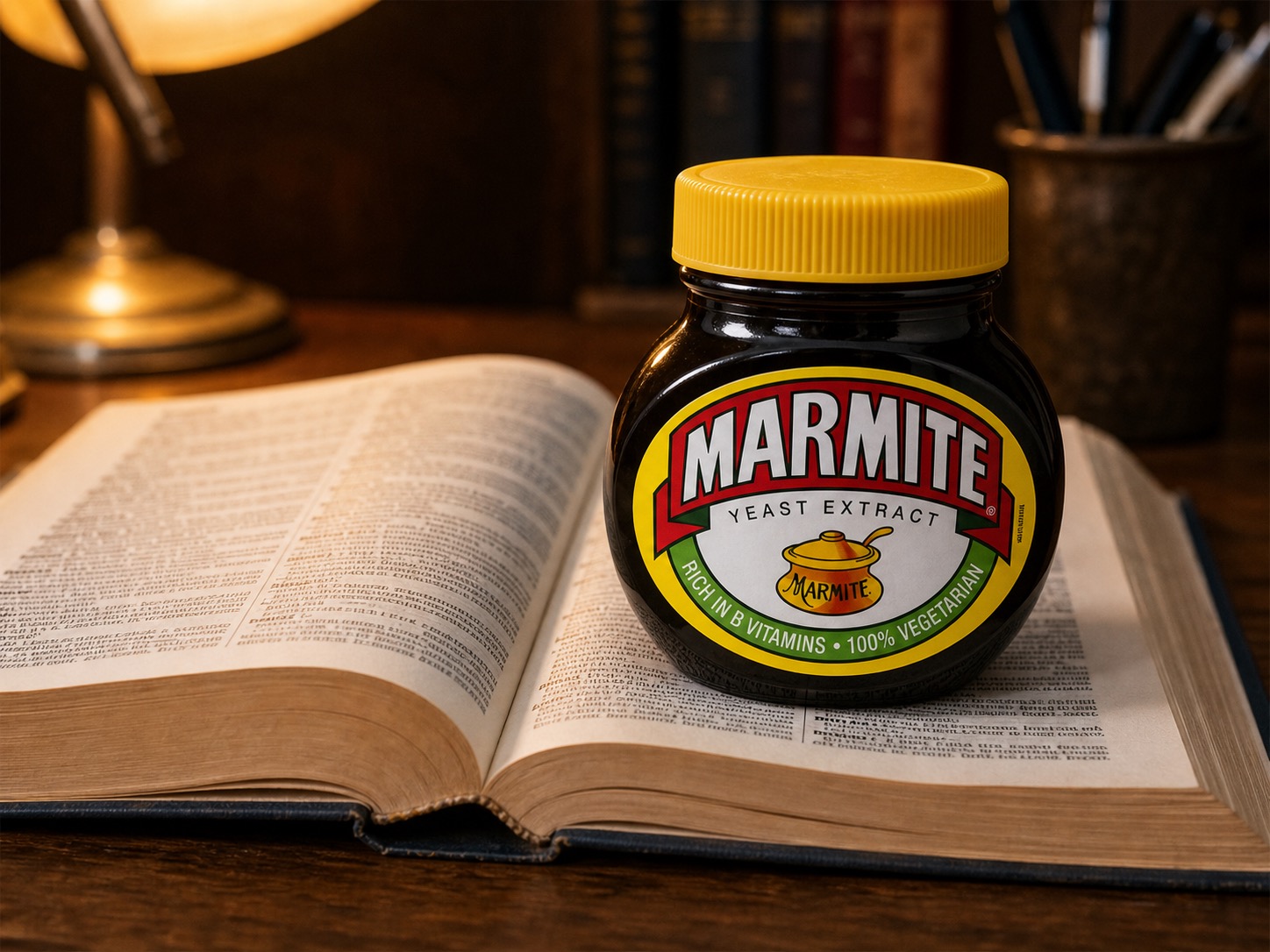


We treat “love it or hate it” as if Marmite’s advertising people invented it in 1996. They did not. They found it lying around. Nine years before the advert, and nine years before the dictionary would call Marmite an adjective, somebody had already typed the whole idea out, in full, on the early internet.
When the Oxford English Dictionary traces the word “Marmite”, one of the messages it cites was posted to a Usenet group called net.cooks on 9 April 1985. Here is the line:
“Marmite, for those people who have not had the joy/sorrow to taste it, is a yeast extract… People who have tasted it fall into two groups; those who fall in love with it and those who wouldn’t even stay in the same room as a bottle of it.”
That is 1985. Before the web. Before most people had an email address. The love-it-or-hate-it split, “joy/sorrow”, “fall in love”, “wouldn’t even stay in the same room as a bottle of it”, already the first thing anyone thought to say about the jar.
net.cooks, and explaining Marmite to Americans
A word about where this turned up. net.cooks was an early Usenet newsgroup, a text-only forum from the days before the web, started in Berkeley in 1982 by a man named Steve Upstill. It became rec.food.cooking in the great Usenet rename of 1986, but in April 1985 it was still net.cooks, and a good chunk of its readers were American.
So picture it. Some Marmite-literate soul, a Brit or an expat, sat at a terminal in 1985, patiently explaining to a room full of Americans what this brown stuff is. And the explanation they reach for is not the ingredients, or the history, or the B vitamins. It is the divide. You will love it or you will leave the room. The thing that defines Marmite, even to a stranger, even in 1985, is that it splits people clean down the middle.
I have a soft spot for this one. I was born American and have lived here since I was two, which means I have spent a lifetime watching American relatives treat the jar like a minor biohazard. The “joy/sorrow” framing is exactly right. There is no neutral way in.
The brand did not start the argument, it joined it
This is the bit worth holding onto. By the time the famous campaign arrived in 1996 with “you either love it or hate it,” the country, and apparently a fair slice of the American internet, had been saying that for over a decade. The slogan was not a clever invention. It was a clever bit of listening. The advertisers noticed what people already said about Marmite and put it on a poster, which is a different and harder skill than it looks.
The dictionary backs this up at every turn. Marmite the product has been in the OED since 1902. Marmite the adjective, the “a bit Marmite” sense, traces to a 1994 newspaper review of Rab C Nesbitt. And the love-hate framing in plain words goes back at least to this net.cooks post in 1985. Three different decades, one idea that never changes: nobody is indifferent. There is more on the dictionary side of it in a bit Marmite.
Some things do not change
What gets me is how little the argument has moved. Swap the green-screen terminal for a phone and that 1985 post would sail straight onto r/marmite tomorrow without anyone blinking. “For those who have not had the joy/sorrow to taste it”. Forty years on, that is still about the most honest sentence anyone has written about the stuff.
The internet has argued about a great many things since 1985. There is something quietly cheering in the fact that one of its very first food fights, before the web, before the slogan, before the dictionary caught up, was about whether Marmite is wonderful or whether you should leave the room. It was both, obviously. It always has been.