
There are two wedges of Marmite Red Leicester in my fridge, because it was on the shelf in my local Tesco this morning and I have learned not to leave these things for next time.
A hundred and fifty grams, £3, and exclusive to Tesco, which is the first thing worth knowing if you were planning to look for it anywhere else.
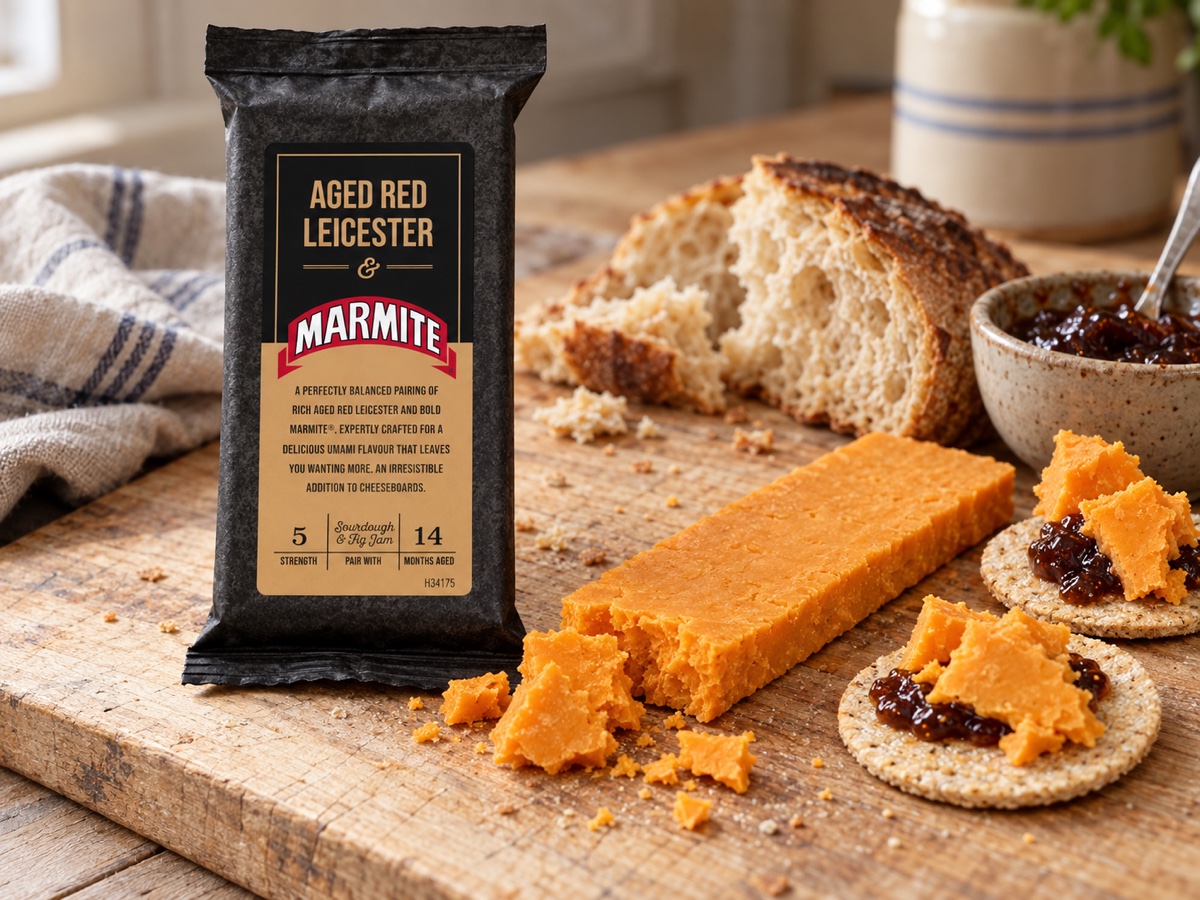
The pack is black with a copper panel and reads “Aged Red Leicester & Marmite”. The blurb promises “a delicious umami flavour that leaves you wanting more”, umami being what packaging says now instead of savoury, and calls itself “an irresistible addition to cheeseboards”. Down the bottom it gives you a strength rating of five, an aged statement of fourteen months, and a serving suggestion: sourdough and fig jam.
Fig jam. With Marmite. ?????
Who actually makes it
The Ilchester Cheese Co, in Somerset, under licence.
If you have ever eaten Applewood, or Mexicana, or any of the British cheeses that arrive with something else already mixed into them, you have eaten their work. They don’t make cheese from scratch. They take other people’s and blend things into it, which sounds like a criticism and isn’t: it’s a genuine speciality and they’ve been doing it for decades. They are part of Norseland, which belongs to the Norwegian dairy group Tine, so the chain from a Burton by-product to a Somerset blending plant to a Norwegian parent is longer than the wrapper suggests.
Why Red Leicester is the better idea
Marmite cheese isn’t new. There have been cheddar versions for years, along with cheese sticks, minis and whatever M&S is doing this month.
Cheddar is the obvious pairing and I love it. A sharp mature cheddar and Marmite are two loud, salty, assertive things having the same argument at the same volume, and neither gives way.
My assumption was that Red Leicester works because it’s the milder cheese, leaving somewhere for the Marmite to go. The pack confirms otherwise. Fourteen months aged and a strength rating of five is not a mild cheese: a supermarket Red Leicester is usually a two or a three, sweet and soft and mostly there for the colour. At fourteen months it has a dried out, sharpened and gone properly nutty, possibly with the crystalline crunch that aged cheeses develop.
So they haven’t taken the easy option. They’ve picked a cheese with enough backbone to stand next to Marmite rather than disappear under it, and the thing it brings is nuttiness rather than mildness. That’s a more interesting choice than I gave them credit for before I read the wrapper.
What the reviewers say, which is not what I expected
Eight reviews on the Tesco listing, averaging four and a half stars. Eighty-eight per cent of them are five star, twelve per cent are one star, and there is absolutely nothing in between.
A love it or hate it distribution, on a Marmite product. Of course.
Except the one-star review isn’t a hater. Read it and it says “Lovely taste but awful texture. Very wet so doesn’t slice very well”, and goes on to call the Marmite flavour excellent. That’s someone who liked the cheese and was defeated by the block.
They aren’t alone. The most detailed five-star review says the same thing: “it does soften and weaken the texture making it difficult if not impossible to slice. I just chop this kind of thing up.” Another five-star describes it as crumbly. So the consistent verdict across people who loved it and the one person who didn’t is that it is wet, soft and awkward to cut.
Which makes sense. You cannot blend a wet ingredient into a hard aged cheese and expect it to behave like a hard aged cheese. Buy it expecting to break bits off rather than lay down neat slices, and you have avoided the only genuine complaint anyone has made about it.
The rest is enthusiasm, some of it quite good: “dangerously” delicious, “phenomenal on a toastie”, and one reviewer who reports converting a friend who does not like Marmite.
How long has it got?
The dates on the Tesco page, running to the eighth of November, are the validity window on a Clubcard three for two offer. Not a discontinuation notice, which is what I took them for until I went and read the page properly. Nothing on that listing says this wedge is going anywhere.
But one of the reviewers put it better than I would have: “This is so good they’ll probably stop making it.”
That is the correct attitude to a Marmite tie-in. Flavoured cheese moves fast, Marmite collaborations in particular have a habit of appearing and vanishing without ceremony, and I have been caught out before assuming a thing would still be there in a fortnight. There is no evidence this one is going. There rarely is, right up until it does.
If you see it, buy it. If it turns out you hate it, you’ve lost £3 and gained an opinion, which is roughly the transaction this entire website is built on.
Where can you buy Marmite Red Leicester cheese?
The 150g Aged Red Leicester and Marmite wedge is a Tesco exclusive, priced at £3, or £20 per kilo. At the time of writing it was included in a Clubcard three for two offer on selected chilled items. Other Marmite cheese products exist elsewhere, including Marmite Cheddar and Red Leicester cheese sticks in Morrisons and Marmite cheese minis in Sainsbury’s, but the aged Red Leicester wedge itself is Tesco only. Availability varies by store and the range changes regularly.
Who makes Marmite cheese?
Marmite cheese is produced under licence by the Ilchester Cheese Co, based in Ilchester, Somerset. The same company makes Applewood and Mexicana. Ilchester specialises in blending existing British cheeses with other ingredients rather than making cheese from scratch, and is part of Norseland, a subsidiary of the Norwegian dairy group Tine.
What do reviews say about Marmite Red Leicester cheese?
The Tesco listings averag 4.5 stars, with 88 per cent rating it five stars and 12 per cent one star. Praise for the flavour is close to unanimous. The one consistent criticism, raised by positive and negative reviewers alike, is texture: the cheese is soft and wet and does not slice cleanly, so it is better broken or chopped than cut into neat slices.
Is Marmite Red Leicester the same as Marmite cheddar?
No. They use different base cheeses. This one is an aged Red Leicester, matured for fourteen months and carrying a strength rating of five on the pack, which makes it considerably sharper and nuttier than the mild Red Leicester most people picture. Marmite cheddar versions use cheddar as the base, which competes with the Marmite on saltiness where the aged Red Leicester brings nuttiness instead.