
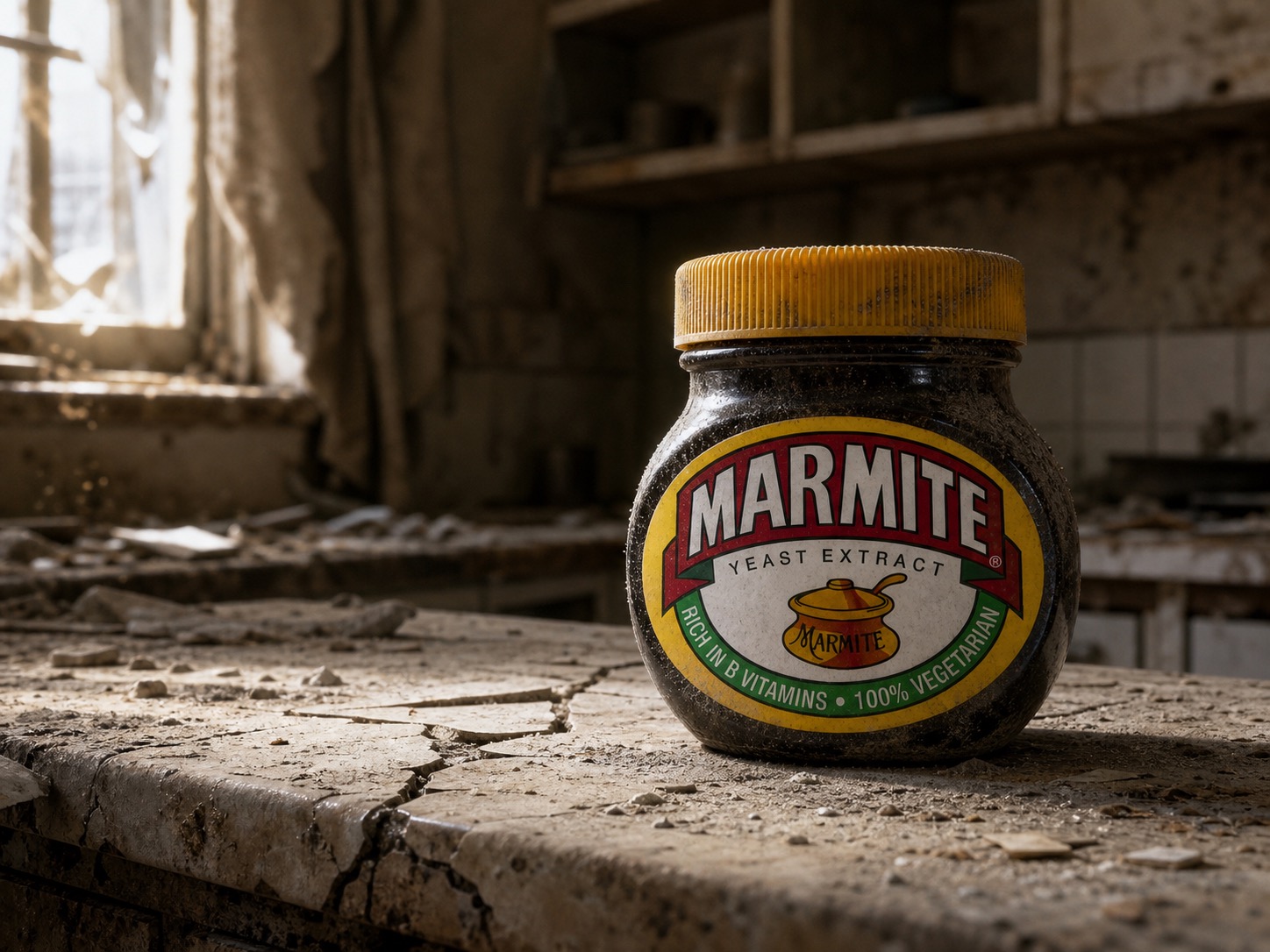
I have a joke I have been making for years. When the bombs finally drop and the dust settles, the only things left standing will be the cockroaches, and they will be sitting around a cracked kitchen worktop eating Marmite. It always gets a laugh, because both halves sound about right. The roach that survives anything, and the spread that never goes off.
So I did the obvious thing and checked whether the joke actually holds up. The honest answer is that it is half-true in a much more interesting way than I expected. Cockroaches are not the indestructible champions of legend. Marmite, on the other hand, very nearly is.
Can cockroaches really survive a nuclear bomb?
The myth that cockroaches would inherit a post-nuclear Earth has been around since Hiroshima, when survivors reported the insects scuttling about in the rubble. There is a kernel of truth in it. Cockroaches genuinely do tolerate far more ionising radiation than we do.
The most-quoted test is the one the MythBusters team ran, exposing German cockroaches to cobalt-60 over a month. At 1,000 rads, half the roaches were still alive after thirty days. At 10,000 rads, around one in ten survived. At 100,000 rads, none did. For comparison, a dose of 400 to 1,000 rads is enough to kill a human being, so a cockroach is somewhere in the region of six to fifteen times harder to kill with radiation than you are.
That sounds impressive until you meet the competition. The flour beetle shrugged off the same 100,000 rads that wiped out every cockroach. Fruit flies tolerate around 64,000 rads. And the runaway winner of the insect world, a parasitic wasp called Habrobracon, has been recorded surviving roughly 180,000 rads, which is something like 180 times the human lethal dose. Even all of those are amateurs next to the bacterium Deinococcus radiodurans, which laughs off well over a million rads. The cockroach, it turns out, is a mid-table player dressed up as a legend.
The bit the myth always leaves out
Radiation tolerance and surviving a nuclear explosion are not the same thing, and this is where the myth quietly falls apart. Anything close to the detonation does not die of radiation sickness, it is simply incinerated. At ground zero the temperature spikes to millions of degrees, and even fifty metres out you are still talking about thousands of degrees and a blast wave that flattens everything. A cockroach has no special resistance to being vaporised.
So the accurate version of the myth is this: a cockroach far enough from the blast to survive the heat and the shockwave would then cope with the lingering radiation a great deal better than any human in the same spot. It does not inherit the Earth. It just has a slightly better chance in the fallout, provided it was not standing too close in the first place.
Now the more important question: would the Marmite make it?
This is where my joke quietly wins. Marmite is one of the most stubbornly long-lived foods you can keep in a cupboard, and the reasons are pure food science rather than folklore.
Marmite is roughly 60% water by weight, which sounds like it should spoil, except that the water sits in a salt and glutamate solution so concentrated that almost nothing can live in it. Salt makes up around a tenth of the jar by weight, well into preservative territory. On top of that the spread is mildly acidic, sitting at about pH 5, which shuts out another whole category of spoilage organisms. And crucially it has already been fermented and concentrated during manufacture, so most of its biological activity has been wrung out before it ever reaches you. Microbiologists call this a low water activity food. Honey, soy sauce and tomato paste are in the same club, and they all last more or less forever.
That is why a sealed jar will comfortably outlive its best-before date by years, and why I argued at length, in the shelf-life guide, that the date on the jar is about flavour rather than safety. A bunker stocked with Marmite would not run into a spoilage problem. The spread would slowly darken and turn a touch more bitter as the yeast extract kept caramelising, but it would stay edible long after most other food had given up.
There is one honest caveat. The glass jar is the weak link. Anything near enough to a blast to shatter glass would ruin the contents along with everything else. But a jar tucked at the back of a larder a sensible distance from the action? That Marmite would keep. The Squeezy bottle, being plastic, might even fare slightly better on the survivability front, though it is not what I would choose for the last meal of civilisation.
So does the joke hold up?
More or less, yes, with the footnotes filled in. A cockroach that was not too close to the blast really would outlast a human in the radioactive aftermath, even if it is a poor cousin to the flour beetle and the Habrobracon wasp. And a jar of Marmite sitting in a cupboard a safe distance away really would still be good to eat, because it is built, almost by accident, to survive conditions that destroy ordinary food.
Whether the surviving roach would actually enjoy the Marmite is a question I am happy to leave open. It is, after all, the original love-it-or-hate-it food. Even at the end of the world, I suspect opinion would be divided.
Can cockroaches survive a nuclear bomb?
Partly. Cockroaches tolerate far more radiation than humans, surviving doses roughly six to fifteen times higher than the 400 to 1,000 rads that would kill a person. But they have no defence against the heat and blast of the explosion itself, so any cockroach near ground zero would be killed instantly. Their advantage only shows in the lingering radiation afterwards, and even then several other insects do far better.
What insect is most resistant to radiation?
Not the cockroach. The parasitic wasp Habrobracon has survived around 180,000 rads, fruit flies tolerate roughly 64,000 rads, and flour beetles withstand 100,000 rads, all of which beat the cockroach. The overall champion is a bacterium, Deinococcus radiodurans, which survives well over a million rads.
Would Marmite survive a nuclear war?
The spread itself would, if it were far enough from the blast to keep the jar intact. Marmite’s very high salt content, low available water and mild acidity make it extremely hostile to the microbes that spoil food, so it does not really go off. It would slowly darken and turn more bitter over many years, but it would remain edible long after most other foods had spoiled.
How much radiation can a human survive?
A whole-body dose of around 400 rads is fatal to about half the people exposed without medical treatment, and a dose approaching 1,000 rads is almost always fatal. By comparison, the gamma radiation released by the Hiroshima bomb has been estimated at around 10,000 rads, far beyond any survivable level for an unshielded person.
Sources and further reading
- MythBusters cockroach radiation test and the figures behind it, summarised at Science Notes
- Today I Found Out: cockroaches would not survive an extreme nuclear fallout
- Mental Floss: could cockroaches really survive a nuclear war?
- BBC Science Focus: is it true that cockroaches could survive a nuclear holocaust?