

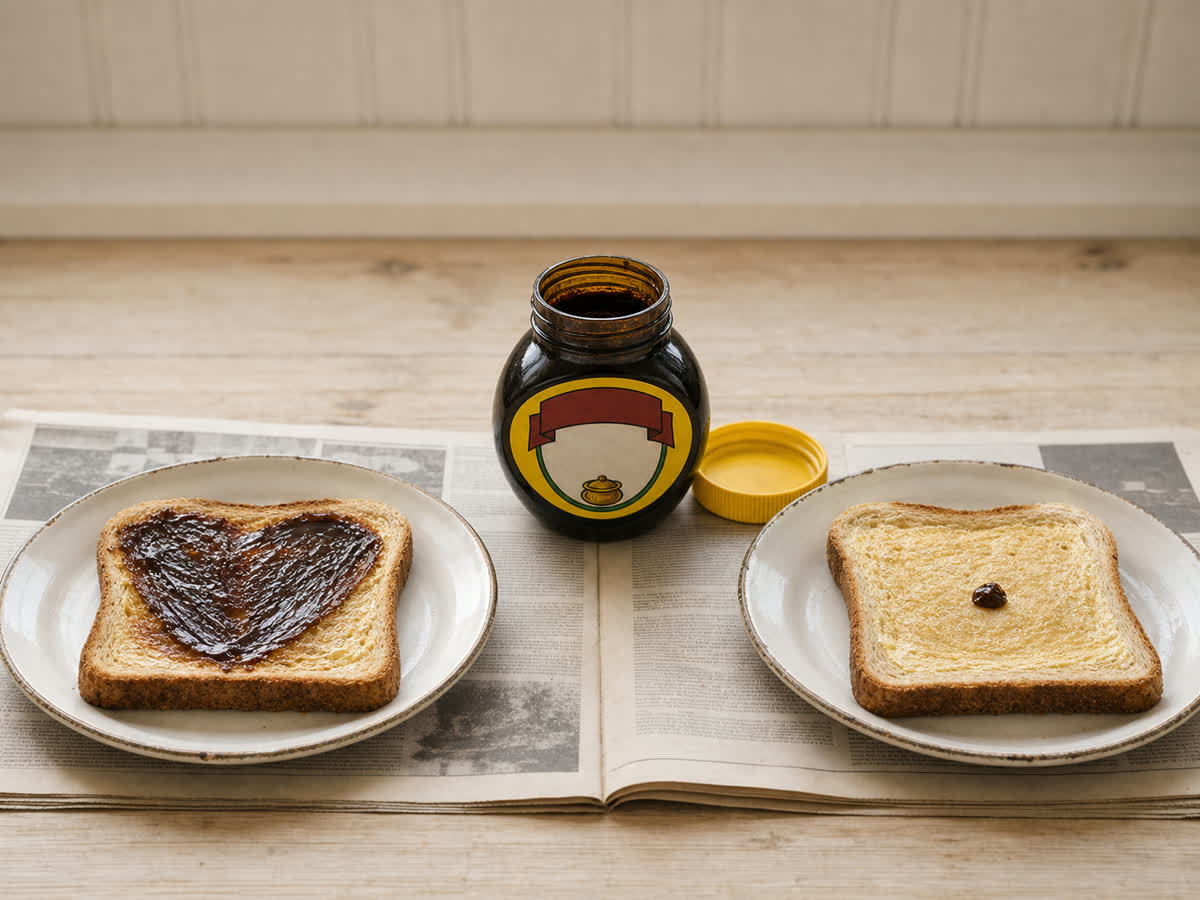
“Love it or hate it” is now so embedded in British marketing language that people use it about everything from political leaders to motorway service stations, usually without remembering that the phrase started life on the side of a specific small black jar. It is one of the most successful brand slogans of the last fifty years of British advertising. It is also a story that almost did not happen, because in 1995 Marmite was a fading product that nobody, including its owners, was sure how to save.
The brand in 1995
By the mid-1990s Marmite was in real trouble. Sales had been flat or declining for a decade. The product itself had not changed; the British consumer had. Margarine was on the run, butter consumption had collapsed since the 1970s, and breakfast was being replaced by cereal or skipped entirely. The savoury-toast moment that Marmite had owned for ninety years was disappearing. Best Foods, which then owned the brand, was actively weighing up whether to discontinue the UK product line or sell it.
The 1996 advertising brief that landed at BMP DDB in London was the kind agencies dread. Rescue a brand that the data suggested was uneconomic, with a small budget, and no room to reformulate or repackage. The creative team did the thing most marketing instinct says you should never do. They leaned straight into the product’s biggest weakness.
The insight
Marmite’s biggest weakness, as the brand’s own consumer research had been reporting for years, was that roughly half the British population actively disliked the taste. Other food brands in similar situations tried to convert the haters: softening the flavour, broadening the use case, launching milder variants. The BMP DDB team decided this was the wrong move. The haters were not the brand’s problem. The haters were the brand’s marketing asset.
The reasoning was simple. If half the country hates a product, the other half, the people who actually buy the jar, feel something specific about themselves. They are, by inclination, a tribe. Feeling about Marmite ran unusually high in both directions, and the brand could use the negative half as a foil for the positive half.
It is a well-understood tactic now. Marmite did it before almost anyone else.
The first ads
The campaign launched in spring 1996. The first wave of television commercials showed people having visceral, undisguised reactions to Marmite. Some loved it, some recoiled, and the recoiling was filmed with the same affection as the loving. The voiceover did not try to talk either group round. The line at the end was simply “Marmite. Love it or hate it”.
The honesty was the point. Most food advertising tells you that everyone loves the product. Marmite advertising told you that half the audience did not, and showed you why. British viewers found that disarming, and they remembered it.
Attention came quickly. Sales lifted within months. By 1998 Marmite was back into clear growth, with measured increases in both volume and average price per jar. The brand was no longer a discontinuation candidate. It was a turnaround case study.
What the slogan actually does
Five things, on close reading.
First, it admits reality. The slogan does not deny that the product is divisive. It states the division as a fact and moves on. Marketing people now call this a vulnerability move. The Marmite team did not have a name for it, but they did it cleanly.
Second, it makes you pick a side. Anyone reading the slogan has to place themselves on one side of it, and that act of placement is a small commitment to the brand. Even the haters are now thinking about Marmite.
Third, it gives the lovers a tribe. Once “love it” is half of the brand’s own slogan, liking Marmite becomes a small badge of personal taste. The brand has handed its loyal customers a piece of self-description for free.
Fourth, it removes any need to convert anyone. Most product marketing is a conversion machine. This slogan announces that conversion is not the goal. The targeting is precise. The brand spends its money on the half of the audience that will actually buy, and ignores the other half. Brutally efficient.
Fifth, it travels. It survived translation into the brand’s whole visual identity, into product extensions, into limited editions, and into thirty years of British cultural reference. The first four functions kept working every time it was redeployed.
What happened next
The campaign won industry awards in the late 1990s and was widely studied in British marketing courses through the 2000s. The phrase entered general British language remarkably quickly. By 2003 newspaper columnists were using “very Marmite” as an adjective without explaining the metaphor. By 2010 it was being applied to politicians (Margaret Thatcher, Tony Blair and Nigel Farage have all been called “Marmite figures” in the broadsheet press), to celebrities, to football managers, and to whole buildings.
That is the test of a great slogan. The phrase escaped the brand’s marketing and joined the general language. The brand benefits from every reuse, because every reuse is unpaid advertising.
The visual identity has been refreshed several times since 1996, most recently in the agency switch to adam&eveDDB in 2024 and the “Dishes of Love and Hate” cooking campaign that followed in April 2026, but the “love it or hate it” line has survived every refresh. There has been no serious internal proposal to retire it. There would be no reason to.
What the slogan tells you about the brand
Since 1996 Marmite has been unusually disciplined about who its audience is. The brand spends its marketing budget on people who already buy the product, persuading them to buy more of it and to use it in more ways. It does not spend that budget trying to win over people who dislike the flavour. This is rare. Most food brands, faced with a fifty-fifty population split, would try every five years or so to reformulate or rebrand towards the other half.
The Marmite slogan is, at heart, a permanent promise not to do that. The brand has made its peace with being half-loved. The half that loves it has, in return, stayed quietly loyal for thirty years.