
Ask whether Marmite is good for you and the British press will give you two flatly contradictory answers, sometimes in the same week. One week it is a vitamin-rich superfood that GPs are practically prescribing for B12 deficiency. The next it is a salt bomb the NHS would rather you ate less of. Both can be true at once. What it takes to square them is a closer look at what is actually in the jar and how much of it you actually eat.
The case for, in numbers
The jar declares a portion of 8g, a teaspoon spread across a slice of toast, and prints what that portion delivers against the Nutrient Reference Value:
- B12: 1.9 micrograms, 76% of the NRV
- Folic acid: 100 micrograms, 50% of the NRV
- Thiamin (B1): 0.62mg, 56% of the NRV
- Riboflavin (B2): 0.54mg, 39% of the NRV
- Niacin (B3): 5.5mg, 34% of the NRV
Those are the label’s own numbers, not an estimate. If you spread it thinner than the label assumes, and plenty of people do, halve them.
These are not small numbers. A single piece of Marmite toast at breakfast covers a meaningful fraction of an adult’s daily intake of five B vitamins. For a population that struggles to hit its B12 and folic acid targets consistently, meaning vegetarians, vegans, older adults and anyone on a restricted diet, that is genuinely useful nutrition.
The folic acid figure is worth dwelling on. Folic acid is one of the few nutrients with a strong, evidence-based case for supplementation in early pregnancy, to reduce the risk of neural tube defects. Marmite is one of the few non-supplement foods that meaningfully helps. The NHS does not name Marmite in its dietary advice, since that would count as brand promotion, but the broader category of “yeast extracts” does appear in its folate-rich-food guidance.
The B12 case is even more direct. B12 does not occur in any plant in usable quantities. The main natural sources are meat, fish and dairy. People who eat none of those, in any combination, need a fortified food or a supplement, and Marmite is a heavily fortified food that costs a few pence a serving. It has been doing this job in British vegetarian and vegan households for the better part of a century.
The case against, also in numbers
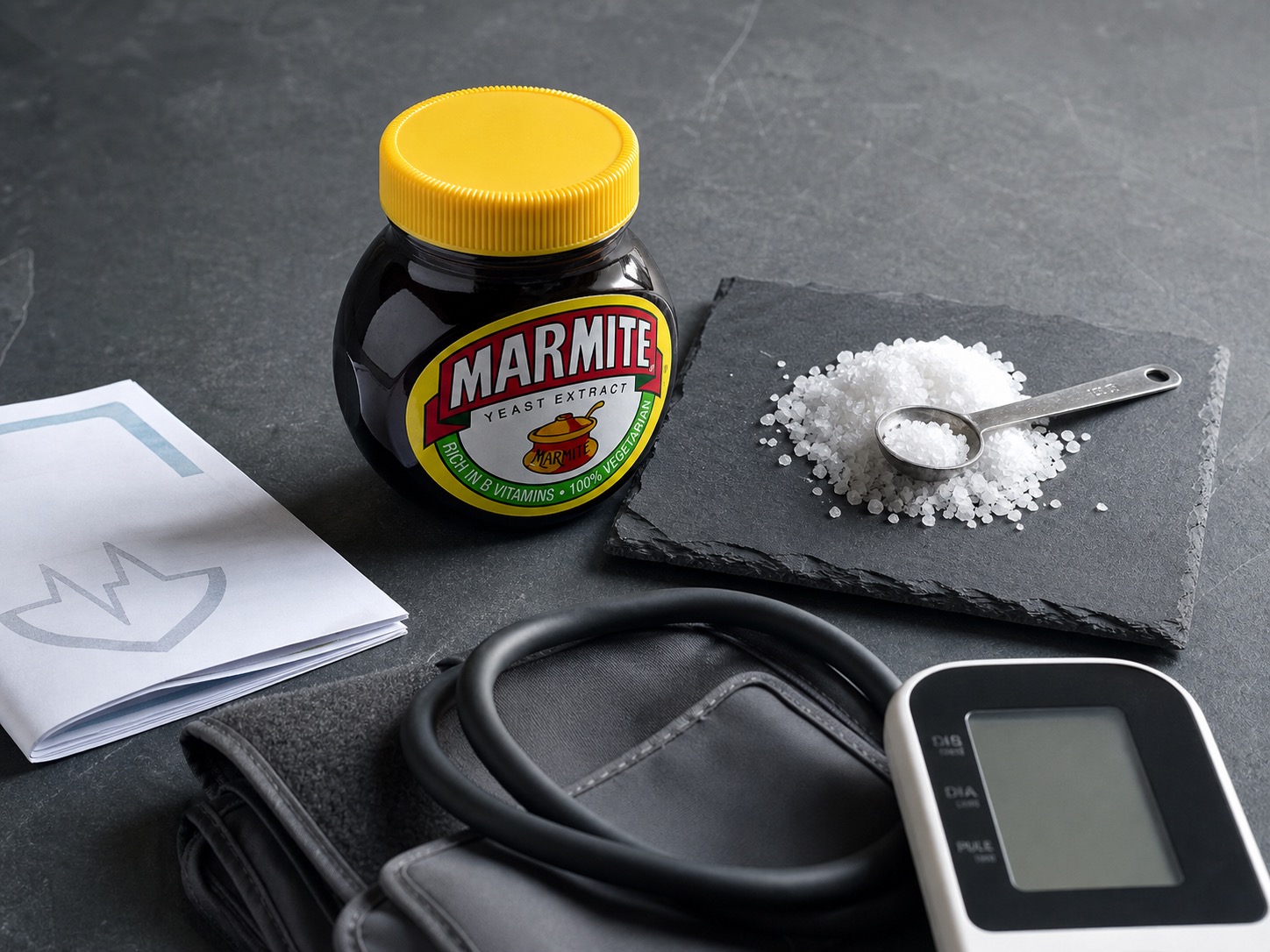
The one concern nutritionists raise about Marmite is salt. Taken at face value, the figures look bad. The panel on the jar says 10.8g of salt per 100g, which is higher than most cured meats and does look alarming sitting there in the 100g column.
The 100g column is not the relevant one, because nobody eats Marmite by the 100g. The label’s 8g portion carries about 0.86g of salt, roughly 14% of the NHS recommended maximum of 6g a day. A thin scrape of 4g halves that to about 0.43g, which is close to the salt in a slice of supermarket bread, and most people do not think of bread as a salt bomb.
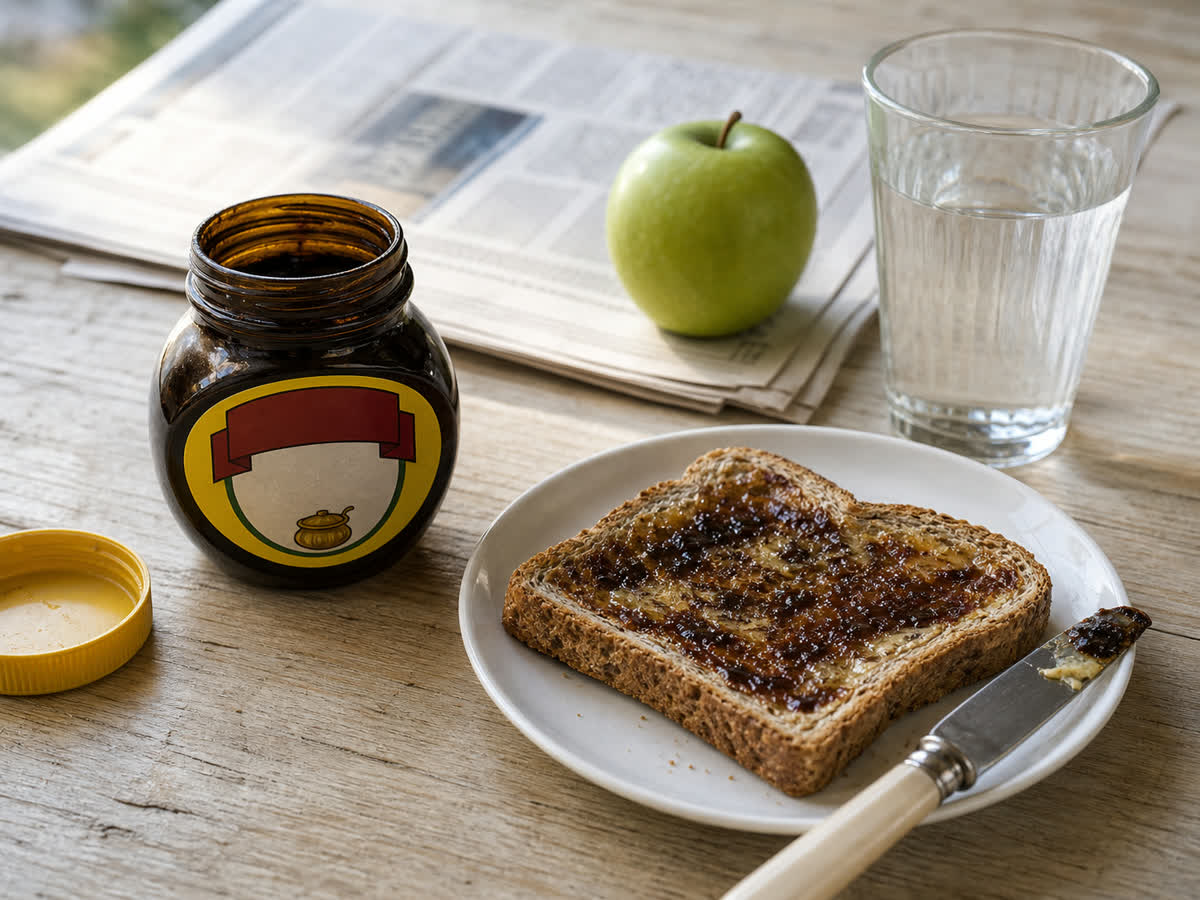
A round of Marmite toast is, salt-wise, the bread plus the spread. On the label’s portion the arithmetic looks like this:
- One slice of bread: about 0.4g salt
- 8g of Marmite: 0.86g salt
- Total: about 1.3g salt per round of toast
Eat two rounds in the morning and you are at roughly 2.5g, about 42% of the daily maximum, though a thinner scrape brings that down quickly. That is not nothing. It is also not, on its own, dangerous for an adult without an existing blood-pressure condition. The sensible way to think about it is as part of the day’s total. A piece of Marmite toast for breakfast, then a low-salt lunch and dinner, sits well within range. A piece of Marmite toast plus a salty lunch plus a salty dinner is where the arithmetic stops working.
People with high blood pressure, on a doctor-recommended low-sodium diet, or with kidney conditions should treat Marmite the way they would any concentrated savoury condiment: sparingly, and only after counting it in the day’s total.
The headline-friendly framing
Marmite gets opposite write-ups in the press because journalists pick whichever column of the nutrition panel suits the story they want to tell.
A “Marmite is good for you” piece quotes the per-serving B vitamin numbers and notes that they are clinically useful for several groups. Both points are true.
A “Marmite is dangerously salty” piece quotes the per-100g salt number and notes that it is higher than crisps or bacon. Those points are also true. The framing is misleading, because nobody eats Marmite by the 100g, but the numbers themselves are not invented.
The honest summary is the boring one. Marmite is a usefully fortified condiment eaten in small quantities, with a salt content that matters if your overall diet is salt-heavy and barely registers if it is not. The other half of the reputation, the idea that the jar is an energy product, comes from wartime advertising rather than the nutrition panel: whether Marmite counts as an energy food has a shorter answer.
The “low-salt Marmite” question
A “reduced-salt” Marmite variant has been rumoured, leaked and partly trialled by Unilever for several years. As of early 2026 it has not arrived on UK supermarket shelves at any scale, and the persistent low-salt Marmite shortage stories of February 2026 referred to a small-batch product that briefly appeared and then sold out. The brand has been understandably cautious. Salt is part of the flavour, and a 30% reduction in salt would produce a noticeably less Marmitey Marmite.
The technical alternative, replacing some of the sodium chloride with potassium chloride, gives you a product that tastes broadly similar but with a slight metallic edge that some testers find off-putting. It also makes the product unsuitable for people on potassium-restricted diets, who are a small but real medical population. The low-salt question is, in short, harder to solve than the headlines make it sound.
For now, if you want less salt, the answer is to eat less Marmite per slice rather than to hunt for a different jar. The per-teaspoon figures, and who genuinely needs to watch them, are set out in how much salt is in Marmite.
Specific situations worth flagging
A few groups for whom the answer to “is Marmite good for you?” takes a more specific shape:
Pregnancy: Marmite is widely considered safe and is a useful folic acid source. The standard advice is to make sure your total folic acid intake (Marmite plus fortified cereals plus a supplement, if one is prescribed) is sufficient, and not to lean on Marmite as the sole source.
Vegans and vegetarians: Marmite is genuinely useful as a B12 source. Many vegan nutritionists recommend a teaspoon a day as a baseline contribution, alongside whatever other fortified foods you eat.
Children: Small portions are fine from weaning age onward. The salt content per teaspoon is manageable for a toddler. The flavour is divisive, so do not force it.
Older adults: B12 absorption falls with age, which is one of the reasons B12 deficiency is more common in the elderly. A scrape of Marmite on toast at breakfast is a low-effort daily contribution.
People with high blood pressure or kidney disease: Discuss it with your GP. The salt content matters more in your case.
People who simply hate the taste: You are not missing out on nutrition you cannot find elsewhere. Most of what Marmite provides is also in fortified breakfast cereals, fortified plant milks or a B-complex supplement, and the cost difference is small.
The honest one-line answer
For most people in normal quantities, Marmite is a small but genuine net positive for your nutrition. It is not magic, it is not a superfood, and it does not earn its keep on taste alone. The salt warning is real and matters for some people, but it does not apply to the way most people actually use the jar.
If you like it, eat it. If you don’t, don’t. The nutritional case is interesting, but it is not strong enough to override taste.
The newest thread in the argument is the gut-health one, after Tim Spector put Marmite on a list of fermented foods worth eating regularly. It is a more modest claim than the headlines made it sound, and what he is actually claiming, and what he is not is worth reading before repeating it.
Is Marmite good for you?
In moderation, yes. A normal scrape of Marmite delivers a useful dose of B vitamins, including B12 and folic acid, with very little fat and no added sugar. Its one real drawback is salt, but because you eat so little at a time the amount per serving is modest. The “salt bomb” headlines come from the per-100g figure, which is not how anybody actually eats it.
Why is Marmite so healthy?
Marmite is unusually rich in B vitamins for a savoury spread. A single 4g serving provides a meaningful share of an adult’s daily B12, folic acid, riboflavin and niacin, and it does so with almost no fat and no sugar. That nutrient density, in a food eaten in tiny amounts, is what gives Marmite its healthy reputation.
What are the health benefits of Marmite?
The main benefits are its B vitamins. Marmite is one of the most widely eaten dietary sources of B12 in British vegan and vegetarian diets, it is fortified with folic acid, and it supplies riboflavin and niacin too. It is also naturally low in fat and contains no added sugar. Some people use it as a savoury, low-effort way to top up B vitamins.
Can you eat Marmite every day?
Yes, a daily scrape is fine for most people and is a good way to get B vitamins. The thing to watch is salt rather than Marmite itself, so if you are keeping an eye on your sodium intake, treat Marmite as one of several salty foods across the day rather than spreading it thickly.