
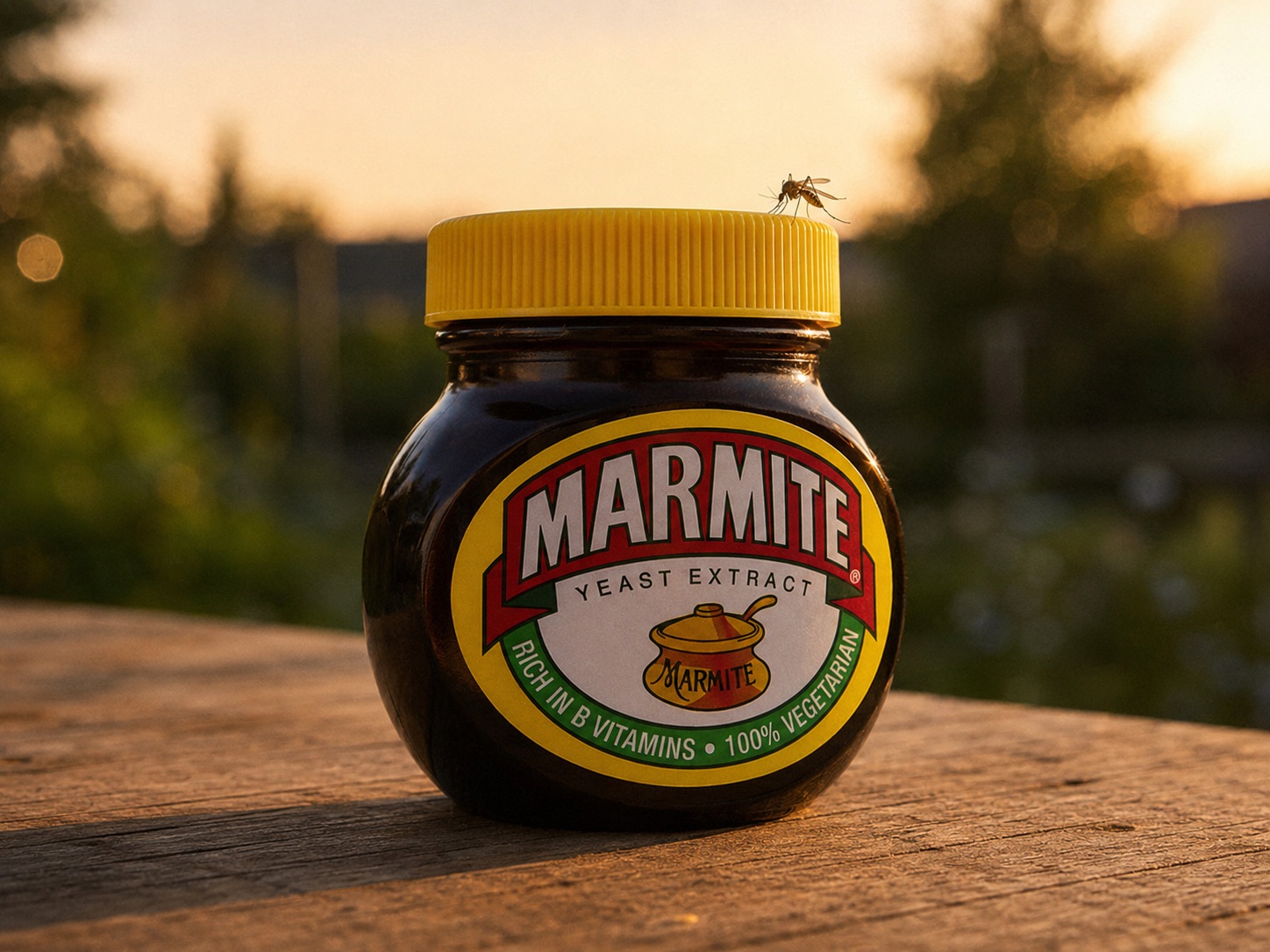
It is the kind of tip that gets passed around before a summer holiday, usually by someone very confident. Eat plenty of Marmite in the week before you travel, the theory goes, and the B vitamins come out in your sweat and put the mosquitoes off. No bites, no bother, and a patriotic excuse to eat more of the stuff.
It is a lovely idea. It does not work, and we know that with unusual certainty, because it is one of the most tested folk remedies in the whole field of keeping insects off people.
The verdict is in, and it has been for a long time
The active ingredient the myth points to is thiamine, vitamin B1, which Marmite genuinely contains in quantity along with the other B vitamins. The claim is that thiamine in the diet changes your skin or sweat chemistry enough to make you unattractive to a biting mosquito.
Scientists have actually checked this, repeatedly, for over fifty years. The first proper clinical trial, back in 1969, concluded flatly that vitamin B1 is not a systemic mosquito repellent in human beings. Every controlled study since has agreed. In 2022 a team went back over the entire literature, more than a hundred papers, and reached an unambiguous conclusion: oral thiamine cannot repel mosquitoes or other biting arthropods at any dose, by any route. Not in pills, not in food, not at all.
It is so settled that regulators have weighed in. As far back as 1985 the American food and drug authorities ruled that oral insect repellents, the swallow-a-tablet kind, are not recognised as safe and effective, which makes selling a supplement on that promise a labelling offence. The thing being debunked here is not just a Marmite rumour, it is an entire genre of “eat this and the bugs leave you alone” advice, and Marmite has simply been recruited into it because it is the most British source of B vitamins anyone can name.
Why people are sure it works
The interesting question is why so many people will swear blind that it does. Part of it is the genuine grain of fact: Marmite really is loaded with B vitamins, so the premise has a true-sounding first half, and the mind supplies the rest. Part of it is the way mosquitoes actually choose their targets. Who gets bitten depends on real things, body heat, carbon dioxide, the precise cocktail of chemicals on your skin, even your blood group, and those vary enough from person to person and night to night that anyone can have a bite-free evening and credit whatever they happened to eat. If you decided Marmite was your shield, a quiet night confirms it and a bitten ankle gets blamed on a missed dose.
That is how a remedy with no effect survives forever. It cannot fail in a way the believer will accept, because there is always another reason the bites got through.
I will own up to being a case in point. I take Marmite abroad with me, and I am rarely the one in the group ending the evening covered in bites. I also know exactly what that is worth, which is nothing. I am the believer in the paragraph above, quietly crediting the jar for a calm night it had no hand in, while someone else with the same jar gets eaten alive and blames the wind. That is the whole engine of the myth: it turns its own believers into its evidence, me included. I am not the first on this site to fall for it either: a 2004 piece here passed the claim on approvingly, quoting a public health consultant who recommended it to travellers.
What Marmite is actually good for
None of this is a knock on the jar. Marmite is a real and useful source of B vitamins, including the B12 that matters so much on a plant-based diet, and that nutrition is the genuinely interesting story, far more so than a repellent power it has never had. If you want the honest version of what those vitamins do and do not do for you, there is a piece on whether Marmite is good for you, and one on what is actually in the jar.
So eat the Marmite, by all means. Just pack the proper repellent too, because the mosquitoes have never read the theory and never will.