

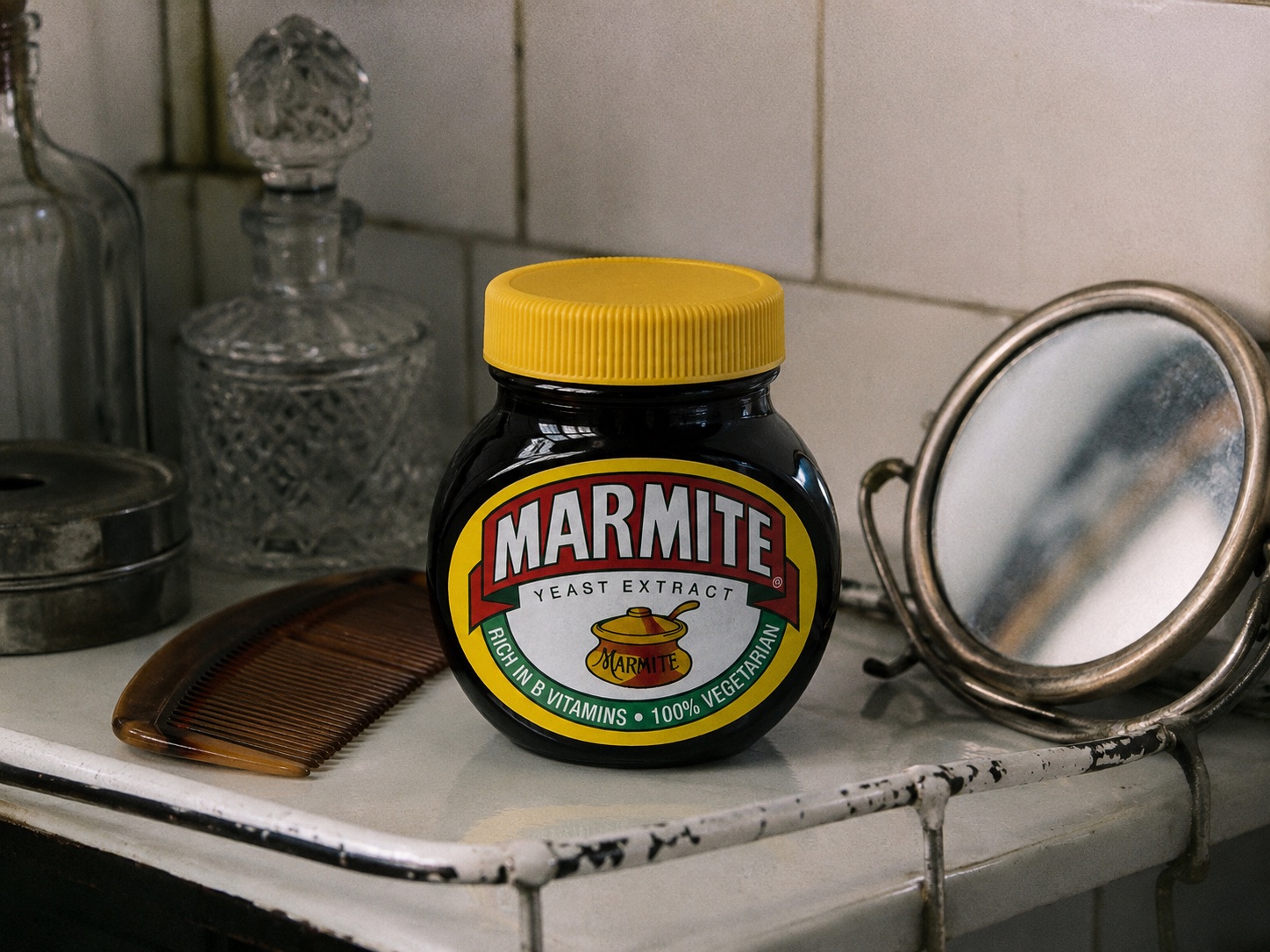
There is a myth, strongest in the north-east of England and especially around Newcastle, that Marmite is a secret cure for going bald. The recipe varies, but the gist is always the same: smear it generously over the thinning bits, leave it on overnight, and wake to find nature reversing itself, all thanks to the folic acid in the jar. Anyone in the area with a suspiciously good head of hair is, by this logic, quietly at it.
It does not work. What it gets you is a pungent, sticky pillowcase and a partner with questions. But the folic acid the myth fixes on is real, and once you follow it back you find a story far better than any hair-tonic fantasy.
I should declare an interest before going further. I am fifty-six, I have a full head of hair in its original colour, and I eat Marmite most days. By Newcastle logic that closes the case. By any honest reckoning it proves precisely nothing, and that is exactly how a myth like this keeps itself alive: every believer with good hair is walking proof, every bald man who tried it simply was not doing it properly, and nobody runs the experiment that would actually settle it. I am the suspiciously good head of hair the legend points at, and I am telling you it is a coincidence.
The myth, briefly
There is no evidence, none at all, that putting Marmite on your scalp regrows hair. Male-pattern baldness, the commonest kind, is driven by genetics and hormones, and no amount of yeast extract applied to the outside of the head touches either. Folic acid does matter for healthy hair in the sense that a genuine deficiency can cause hair to suffer, but that is a long way from being a cure for ordinary balding, and rubbing it on the skin is not even how you would address a deficiency if you had one. The Newcastle version is folk medicine in its purest form: a real nutrient, a real-sounding mechanism, and a conclusion that simply does not follow.
The myth has been around long enough that Marmite’s own advertising has played with the idea of the spread doing mysterious things to people, and the hair legend is part of that same affectionate northern lore. It is a good joke. It is not a treatment.
The folic acid is real, and the history is extraordinary
The folic-acid thread the myth pulls on leads somewhere genuinely important.
In the late 1920s and early 1930s a British doctor named Lucy Wills was working in India, investigating a severe and often fatal anaemia that struck pregnant women, particularly poor textile workers in Bombay. She worked out that it was something missing from their diet, and in a piece of research that has become famous she found she could prevent and treat it with, of all things, Marmite. The yeast extract contained whatever the missing factor was. That factor, not yet isolated or named at the time, was folate, and what Wills had found became known for a while as the Wills factor before it was identified as folic acid.
So Marmite is not just incidentally rich in folic acid. A jar of it was, quite literally, the tool a British physician used to crack one of the important nutritional puzzles of the twentieth century and save a great many lives. The B vitamins that the hair myth waves at vaguely are the same ones with a real and honourable place in medical history. That is a far stronger reason to respect the jar than any imagined effect on a bald patch.
The shape of the thing
This is the most flattering myth in the whole Marmite collection, in a way. The others, the Denmark ban, the prison ban, the mosquito repellent, take a small true thing and inflate it into a false drama. The hair-restorer myth takes a genuinely remarkable true thing, Marmite’s real link to the discovery of folic acid, and waters it down into a daft cure for baldness. The legend is wrong. The reason people reach for folic acid when they talk about Marmite is, for once, completely sound.
Keep the Marmite on the toast, then, not the scalp. For the honest account of the vitamins it really does deliver, including that famous folic acid and the B12 that matters on a meat-free diet, there is a piece on whether Marmite is good for you.