
Every so often the claim resurfaces that Marmite is banned in British prisons. The reason given is always the same and always cheering: inmates were using it to brew their own alcohol, a jailhouse drink the internet likes to call the Marmite Mule, so the authorities took the jars away.
It is a good story. It is mostly wrong, and the part of it that sounds most scientific is the part that falls apart first.
There is no blanket ban
Start with the claim itself. There is no documented, service-wide ban on Marmite across British prisons. What there is, here and there, is the ordinary business of a prison confiscating something it thinks is being misused. Individual prisons control what comes in, and a governor who suspects a wing is brewing hooch can pull all sorts of things off the canteen list, sugar and fruit and yeast products included. That is a local decision about contraband brewing, not a national edict against a savoury spread.
The confusion is helped along by Australia, where Vegemite, Marmite’s antipodean cousin, has a much firmer reputation for being restricted in prisons for exactly this reason. The Australian story gets retold with a British jar in it, and a local crackdown somewhere becomes, in the telling, a countrywide ban. The specific British case people point to, a report from Dartmoor, is a single prison, not the system.
The science the myth needs is not there
The trouble is the science. The whole story depends on Marmite being able to ferment, on its yeast being alive and hungry and ready to turn sugar into alcohol if a resourceful prisoner gives it the chance. That is not what Marmite is.
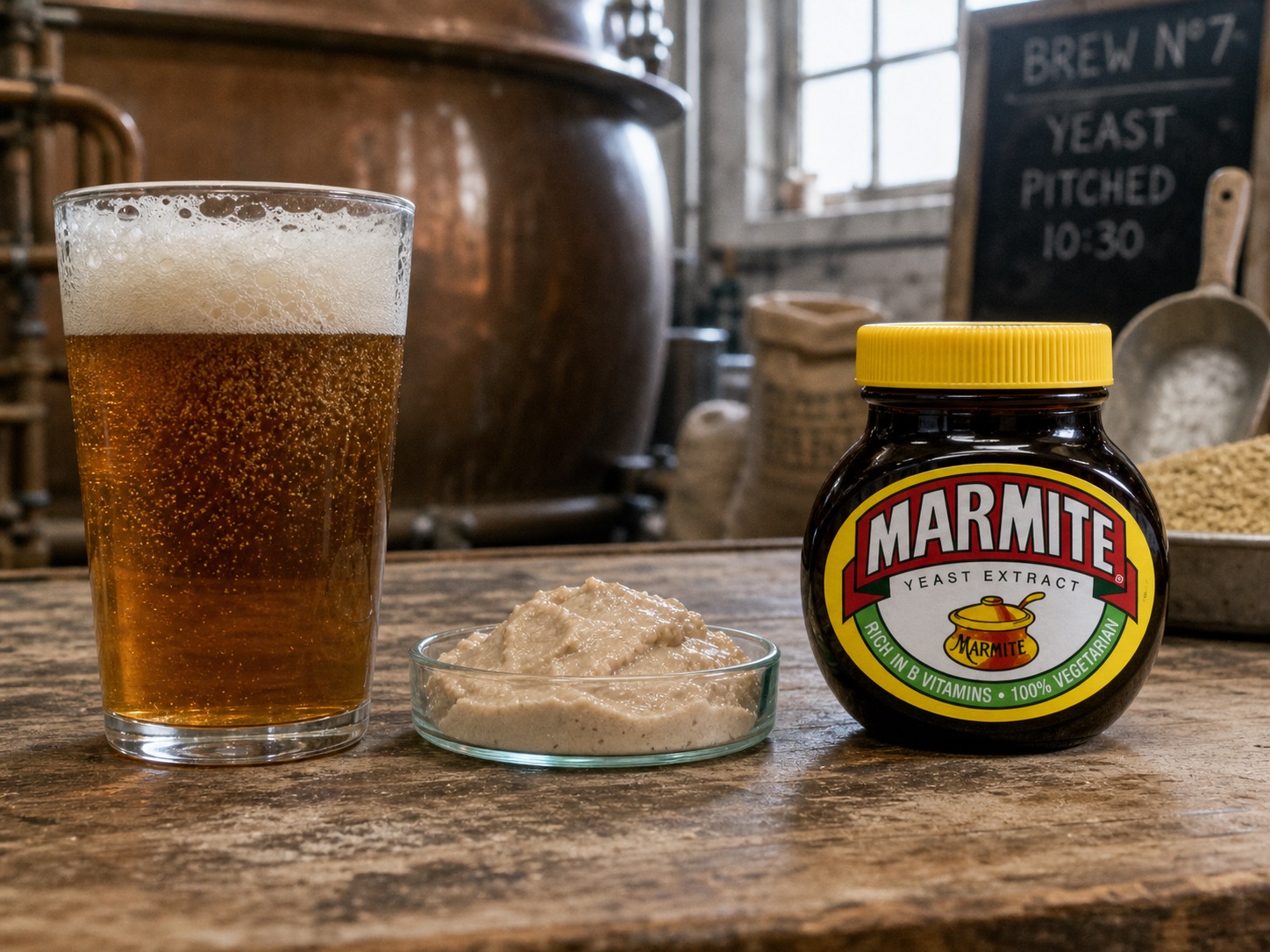
Marmite is made from spent brewer’s yeast that has already done its fermenting in a brewery, and the manufacturing process, autolysis, deliberately breaks the yeast cells down. By the time the stuff is in the jar the yeast is dead, digested, reduced to a concentrated savoury extract. Dead yeast does not ferment. You cannot reanimate a spoonful of Marmite into a working brewery any more than you can plant a tin of corned beef and grow a cow.
The most you can honestly say is that Marmite, being rich in the nutrients yeast likes, could in theory act as a feed for other, living yeast that a brewer had got hold of from somewhere else. In that version Marmite is not the engine of the still, it is at best a bag of fertiliser standing next to it, and even that is marginal. It is not what turns prison sugar into prison wine. The sugar and a live yeast culture do that, with or without a jar of Marmite in the cell.
Why it sticks anyway
So why does the ban story keep coming back? Because it joins two ideas that each feel true on their own. Everyone knows prisoners brew illicit drink, and everyone half-remembers that Marmite is “made of yeast”, and yeast is the brewing word. Put the two together and you get a conclusion that sounds obvious and saves anybody the trouble of asking whether the yeast in question is alive. It is the same shape as the Denmark ban: a real institutional fact, prisons really do confiscate brewing kit, dressed up into a dramatic national ban that did not happen.
There is a small true thing at the centre, as there usually is. Prisons do remove things they think will be fermented, and a jar of Marmite has occasionally been one of them. But “a prison once confiscated a jar” and “Marmite is banned in British prisons” are not the same sentence, and only one of them is true.
For the science of how Marmite is actually made, and why that dead-yeast process matters here, there is a piece on how Marmite is made. And for the most famous “banned” story of all, the one about Denmark, that has its own myth to bust.