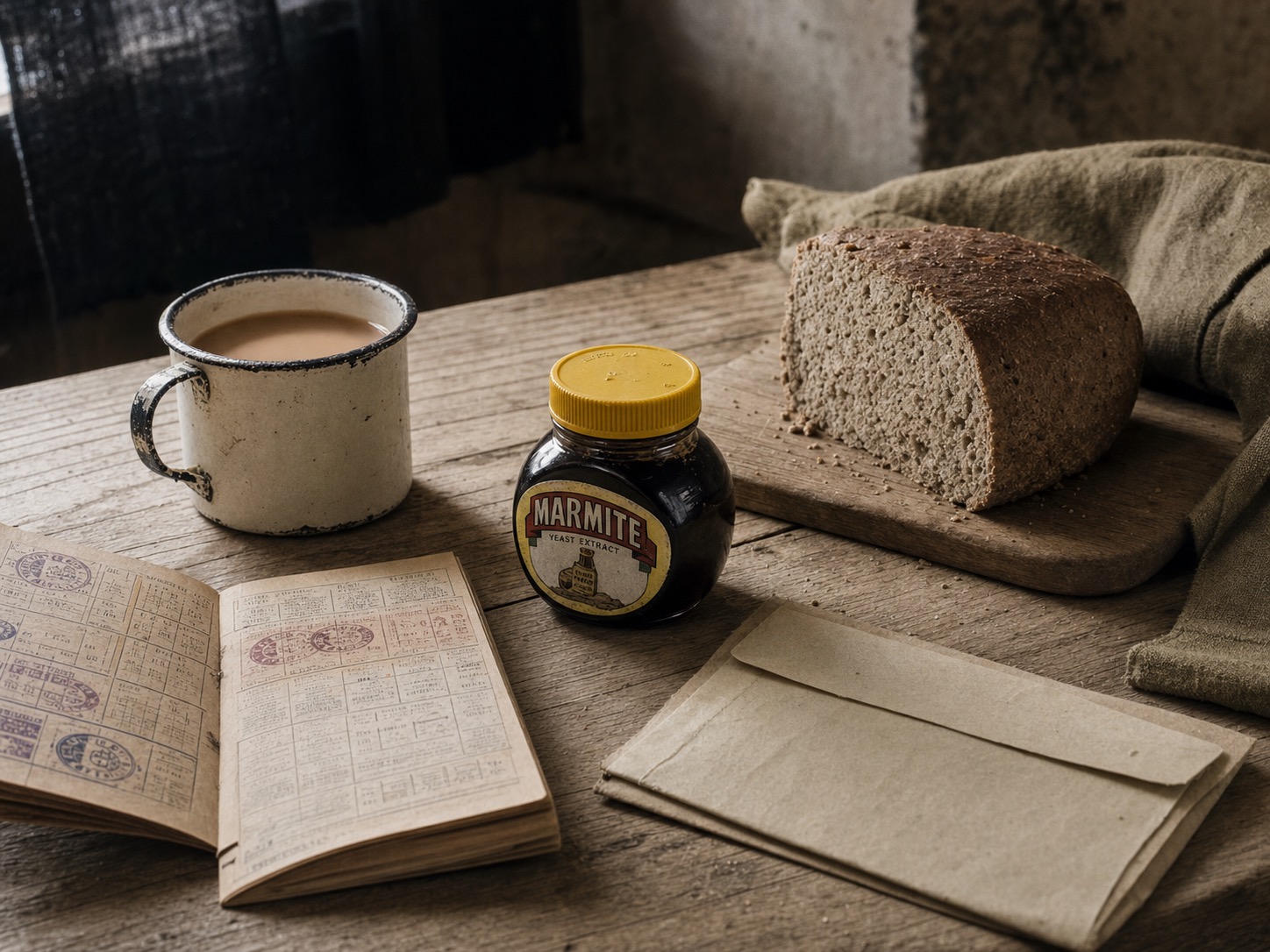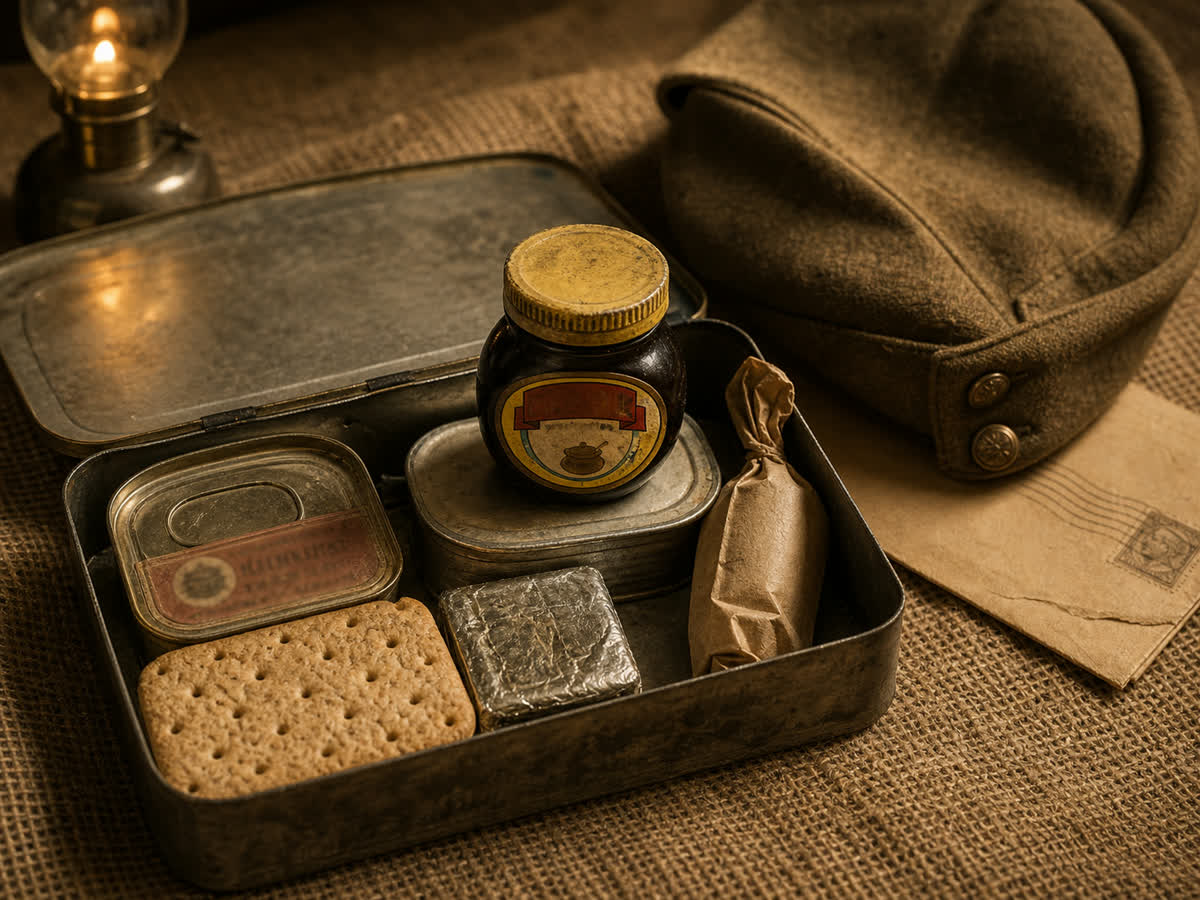

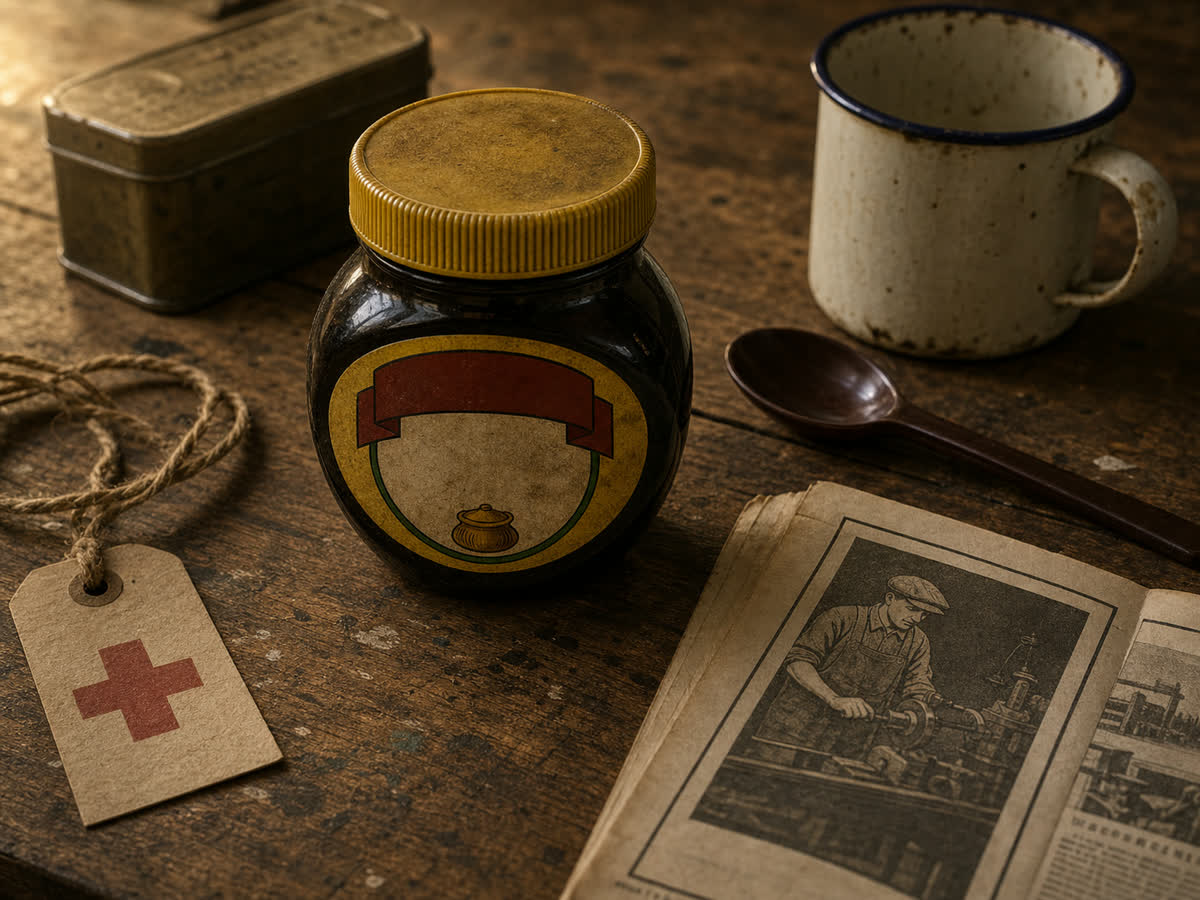
The Marmite jar that sat on the British breakfast table during the Second World War did more national-mood work than almost any other commercial product of the period. Between 1939 and 1945 Marmite was a vitamin supplement for civilian workers, a Red Cross parcel staple for prisoners of war, an army ration component for desert and jungle campaigns, and the subject of one of the most distinctive advertising campaigns the wartime British press carried. The campaign aimed at industrial workers is the one that keeps coming up in archives, and it is worth looking at in detail.
What the workers’ campaign was for
From the start of the war, the British Ministry of Food made one argument repeatedly and explicitly: British industrial production depended on British workers being well enough fed to keep working. Calories from rationed bread, potatoes and dripping kept bodies moving. Vitamins were a separate problem. Without B vitamins in particular, workers slowed down, took more sick days, made more mistakes on the production line, and produced less ammunition, fewer aircraft, slower ships.
Marmite walked into this problem with an unusually good product. A teaspoon a day delivered useful doses of thiamin, riboflavin and niacin to people whose diets were short on all three. The brand’s wartime advertising made the argument directly. Posters and press advertisements showed factory workers, dockworkers, riveters and welders next to a few lines of copy that promised more energy, fewer sick days, and a steadier hand on the night shift. The implication, sometimes spelled out, was that buying Marmite was an act of national service.
This was not a stretch. In its own public-information campaigns, the Ministry of Food listed yeast extracts among the foods it actively encouraged civilians to eat for their B-vitamin content. Marmite was not named, because the Ministry could not be seen to endorse a specific brand, but the category was named and Marmite was the dominant brand in it. The workers’ campaign was the commercial echo of an official message.
What the campaign actually looked like
The wartime Marmite advertising sits in several British archives, including the Imperial War Museum and the History of Advertising Trust at Raveningham, Norfolk. The visual style is recognisable to anyone who has spent time with 1940s commercial graphics: heavy black ink, strong line drawing, hand-lettered headlines, and the assumption that the reader is in a hurry and needs the message in three or four lines.
A representative example, undated but probably 1942 or 1943, shows a male factory worker in cap and overalls holding a slice of toast at lunch break, with the headline “MARMITE, for the man who’s keeping things going”. Beneath it sit four short lines: that Marmite was rich in vitamin B; that vitamin B helps you resist fatigue; that one jar gave fifty servings; and that the spread was made in Burton-on-Trent. The Burton mention is the interesting bit. Locating the factory in a specific Midlands town was a small piece of “British production, British workers, British food” signalling that would have read clearly to a 1940s industrial audience.
Other ads in the same campaign featured women in similar workplace settings: welders, machinists, bus conductors. The famous “Land Girl” ad, slightly later in the war, used the Women’s Land Army as its visual hook. The campaign was carefully gender-inclusive long before that was a phrase, because the British workforce had been so by necessity.
The advertising was placed in regional and trade press as much as in the national papers. Engineering journals, factory newsletters and union magazines all carried versions of the same message. The brand was buying attention in the publications its target audience actually read.
The Red Cross parcels
A second and quieter wartime use of Marmite gets discussed far less often. Marmite jars were a standard component of Red Cross parcels sent to British prisoners of war held in German and Italian camps. The parcels were assembled in Britain, shipped through Switzerland, and distributed by camp Red Cross officials. The standard parcel contained a tin of corned beef, biscuits, a tin of butter or margarine, a chocolate bar, tea, sugar, and a small jar of Marmite.
The choice was practical. Marmite is dense, calorie-rich on a per-gram basis, vitamin-dense, keeps through long shipping, and produces meaningful flavour from a small amount. For a prisoner eating a monotonous camp diet of bread and watery soup, a scrape of Marmite was both nutrition and morale. Letters home from PoWs frequently mention the Marmite specifically, almost always with affection.
The Red Cross parcel link is one reason Marmite carries the cultural weight it does for the generation born in the 1920s and 1930s. For many British families, Marmite was the food a returning prisoner spoke about in his first days back, and that memory was passed down two generations.
The desert and the jungle
Marmite jars also turn up in the field-ration archive of the British Army’s overseas campaigns. The North African desert war made particular use of Marmite as a vitamin supplement and salt source for troops sweating heavily in extreme heat. Burmese-campaign veterans recalled diluting Marmite with water to make a hot drink, a kind of impromptu yeast-extract broth, when proper rations ran short.
This is the same product that today sits on supermarket shelves. The military jars were the same recipe and the same factory output. Marmite did not have a separate “wartime” formulation. It simply happened to be a product that was useful in conditions much harsher than the toast-and-butter use it was originally designed for.
The “marmite-coloured tan” myth
A persistent piece of wartime folklore says that British women, denied real stockings, painted their legs with Marmite to mimic the tan colour of nylon. This is half-true. Wartime women did paint their legs with various substances: tea, gravy browning, cocoa, and shop-bought “leg tan” products. Marmite is sometimes mentioned in interviews and memoirs, usually as a brand-name shorthand for “a brown food substance” rather than a literal sole ingredient.
The chemistry argues against Marmite as the primary choice. It is sticky, salty and difficult to wash off. Most contemporary sources are more reliable when they describe diluted gravy browning or tea-and-burnt-cork combinations. The Marmite-leg story has stuck because it is a vivid image and because Marmite is a recognisable cultural object, but the historical record is thin.
What this meant for the brand after the war
The war ended in 1945 with Marmite in an unusual commercial position. Three generations of British consumers, the parents of the war years, the workers of the war years, and the children fed Marmite as part of their B-vitamin intake, had been heavily exposed to the product as an essentially patriotic object. The brand spent the late 1940s and 1950s trading on that association.
The “Spread some on a soldier” advertising of the late 1940s, the Coronation-year jars of 1953, and the long association with British school lunches throughout the 1950s and 1960s all rested on the wartime memory. By the time the “love it or hate it” repositioning arrived in 1996, Marmite had been a piece of British emotional infrastructure for half a century, and most of that emotional weight had been laid down during the war.
The ration-tin half of the same story, the army issue and the B-vitamin deficiency it was bought to prevent, is covered in Marmite’s wartime rationing role.