
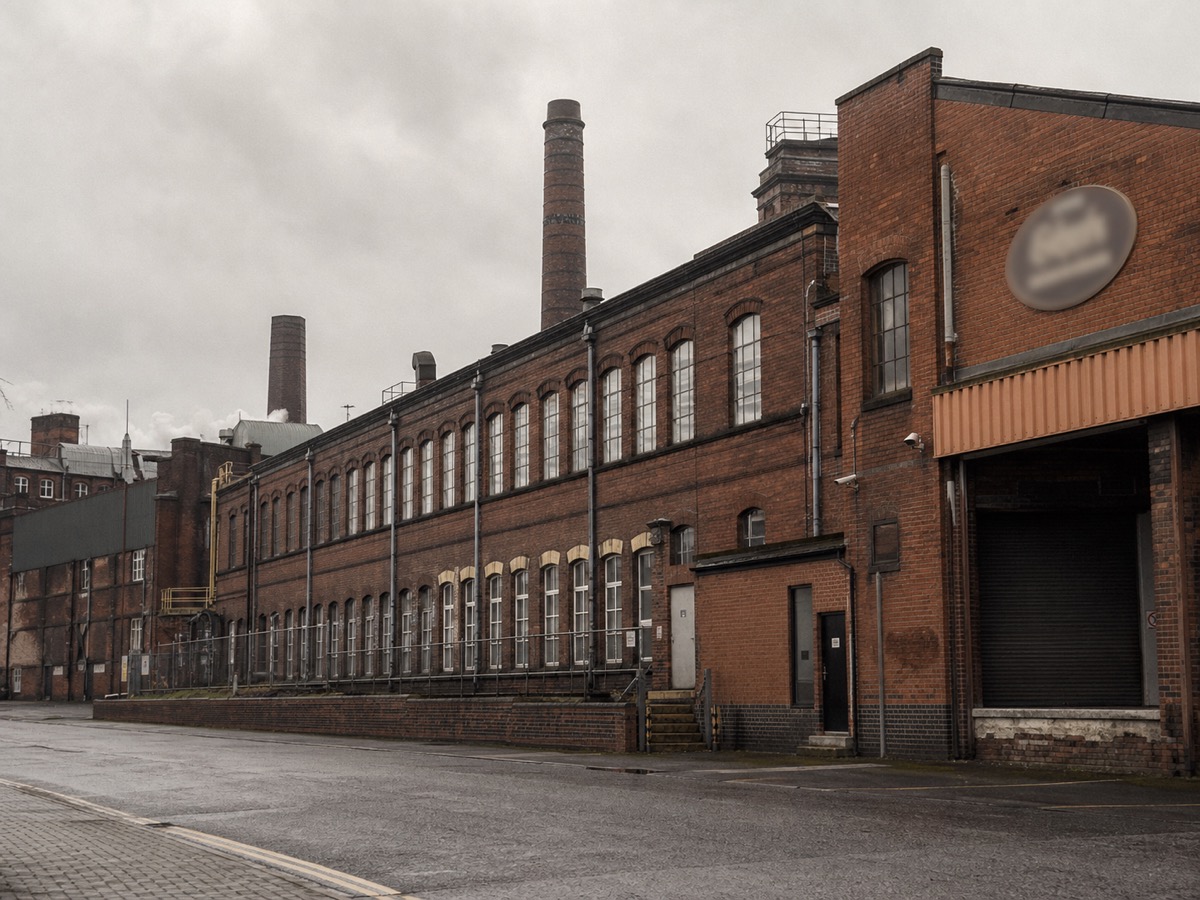
A factory town, a brand, and one VERY nervous week
Burton-on-Trent is a brewing town that happens to also make Marmite. That is the order of the historical relationship, and locals tend to remind you of it. Bass, Worthington, Allsopp, Ind Coope: the breweries came first and they were the reason Marmite landed in the UK in the first place. Spent yeast was a by-product the brewers could not give away. In 1902, two German chemists, Justus von Liebig’s lab veterans, worked out how to turn it into a savoury paste, and a small factory opened on Cross Street to do it commercially. This is why you can buy yeasty Marmite like variations in Germany and Switzerland and other surprising locations.
Anyway, a hundred and twenty-four years later, the factory has moved a few hundred yards and changed hands more times than anyone in Staffordshire cares to count. But it is still in Burton, it still uses spent brewery yeast from the local industry, and the people who work there still think of the place as theirs. Which is why this past week has not been pleasant.
What McCormick has said, exactly
The official line is one sentence long. McCormick has stated that a “long-term manufacturing agreement is in place” for the Burton site.
If you are not used to corporate communications, that sentence sounds reassuring. If you are, you will recognise it for what it is: the polite version of “we have not decided anything yet”. A long-term agreement can mean fifteen years, or it can mean three. It can include performance clauses, volume floors, or break options that the press release does not mention. The phrase is precisely as committal as it needs to be to get McCormick through the headlines, and not a syllable more.
The phrase that workers in Burton would actually find reassuring is the one they have not been given. Something like: “Marmite will continue to be produced in Burton-on-Trent for the foreseeable future, and we have no plans to reduce the workforce.” That is not a difficult sentence to say. McCormick has not said it. That is what the union has noticed.
There is a sharper version of this point worth making now that the actual press release has been read closely. The official McCormick announcement does not mention the Burton-on-Trent factory by name. It does not mention any UK manufacturing commitment by name. The press release names exactly two brands out of the entire Unilever Foods portfolio, Knorr and Hellmann’s, which between them account for around 70 per cent of Unilever Foods sales, and bundles everything else, Marmite included, under “a wide array of local brands across EMEA, Latin America and APAC”. The combined company will be led by Brendan Foley as Chairman, President and Chief Executive, with Marcos Gabriel as Chief Financial Officer, and will run a global headquarters in Hunt Valley with a second international headquarters in the Netherlands. None of the announcement language attaches itself to Burton, to Marmite, or to UK manufacturing. The brand is included in the transaction; it is not, in McCormick’s own words, a strategic centrepiece. Which, for a 240-job factory in Staffordshire, is a worse opening position than the press coverage has suggested.
The Cadbury comparison, properly applied
Promises made before regulatory approval are not contractually binding.
Every article you read this week will mention Cadbury. Most will use it as shorthand for American-owner-bad-thing-happen. The actual lesson of the 2010 sale to Kraft is more specific and more useful.
Kraft promised, on the record, to keep Cadbury’s Somerdale factory near Bristol open. They said it during the takeover battle. They needed to say it, because the deal was politically sensitive and public opinion was hostile. Within a week of completing the acquisition, Kraft announced that Somerdale would close after all. Four hundred jobs went. The chair of Cadbury at the time, Roger Carr, called it a “disgrace”. A parliamentary committee called it “irresponsible”. Kraft was admonished by the Takeover Panel, which had no teeth to actually do anything about it.
The Cadbury lesson is not that American buyers always close British factories. It is that promises made before regulatory approval are not contractually binding, and that the only commitments worth anything are the ones written into the sale agreement. Whether McCormick has made any such commitments about Burton, we do not know. Whether the British government will ask them to before approving the deal is, at the moment, anybody’s guess.
What the workforce can actually see
The Burton plant employs around 240 people directly, with another few hundred in the supply chain. It is the largest yeast-extract production facility in the world, which sounds grand but mostly means it does one thing very well at a scale that nobody else is bothering to compete with. Production is steady, the kit is well-maintained, and the workforce is experienced. By manufacturing standards, it is not an obvious candidate for relocation.
The risk, though, is not relocation in the short term. The risk is the long, slow squeeze: small workforce reductions framed as efficiency, gradual outsourcing of packaging, the eventual question of whether brewing yeast actually needs to come from Burton specifically when there are perfectly good supplies elsewhere. None of those steps would generate a press release. All of them, added up, would change what Marmite is and for me, Marmite is the product of Burton breweries. If it isn’t from the Burton area, it isn’t really Marmite, have you ever tried Kiwi Marmite?
Sir Winston, when I sat him down for that Mnemonicon interview a week before the deal was announced, gave me the longer warning that fits this risk more precisely than the headline-closure scenario does. “I have watched nations surrender their material foundations piece by piece, consoling themselves with immediate financial gain, and then discovering, too late, that they had sold their future for present comfort.” The point is not the dramatic Somerdale moment. The point is the drift of capability away from the place that built it, dressed up as quarterly efficiency. The same interview produced the harder underlying principle, which the Cabinet Office has yet to articulate even once: “To sell the brand while surrendering control of the manufacture is to sell the nation’s accumulated goodwill to a foreign enterprise.” That is what is on the table at Burton, in the absence of a contractual answer to the contrary.
Why this matters more than it should
Marmite is, in a sense, the last working evidence of what made Burton industrially special.
Burton-on-Trent has been through this before, with the brewing industry itself. In the 1980s, Burton brewed more beer than any other town in Britain. Most of those brewers are now gone, or absorbed into multinationals that produce beer somewhere cheaper. The skyline has fewer chimneys than it did. The labour that filled them moved on or, more often, did not.
Marmite is, in a sense, the last working evidence of what made Burton industrially special. If the factory survives the McCormick transition, the town keeps a connection to its own past. If it does not, that connection ends in a way that no commemorative plaque will ever replace.
This is not a sentimental argument against the sale. The sale is happening, and probably no amount of British outrage will change that. It is an argument for a specific commitment, in writing, with a number on it. McCormick has bought a 124-year-old British brand. The British government has the leverage, once, before regulatory approval, to ask them to be precise about what they intend to do with the factory it lives in.
The window for that conversation closes when the deal closes. Mid-2027 is not as far away as it sounds.
What I would like to hear
A specific commitment to continue Marmite production in Burton-on-Trent for a defined period, with a defined minimum headcount, and a defined penalty for breaching either. Not “long-term agreement”. A real number, a real date, a real consequence. McCormick could say it tomorrow. The fact that they have not is, by itself, telling.
Sir Winston Churchill, sat in front of the Marmite Mnemonicon last week before the deal was even announced, put it more bluntly. The sale, he said, ought not to be accepted at any price unless it includes “ironclad guarantees on the continued operation of the Burton factory, or the retention of controlling interest by the British state or British capital”. He has been dead since 1965. The Cabinet Office, in March 2026, has yet to articulate a position as clear.
In the meantime, the workers in Burton are doing what workers do in these situations. They are showing up, doing the job, and reading the trade press with one eye. They have seen this film before. They would quite like to be told how it ends.