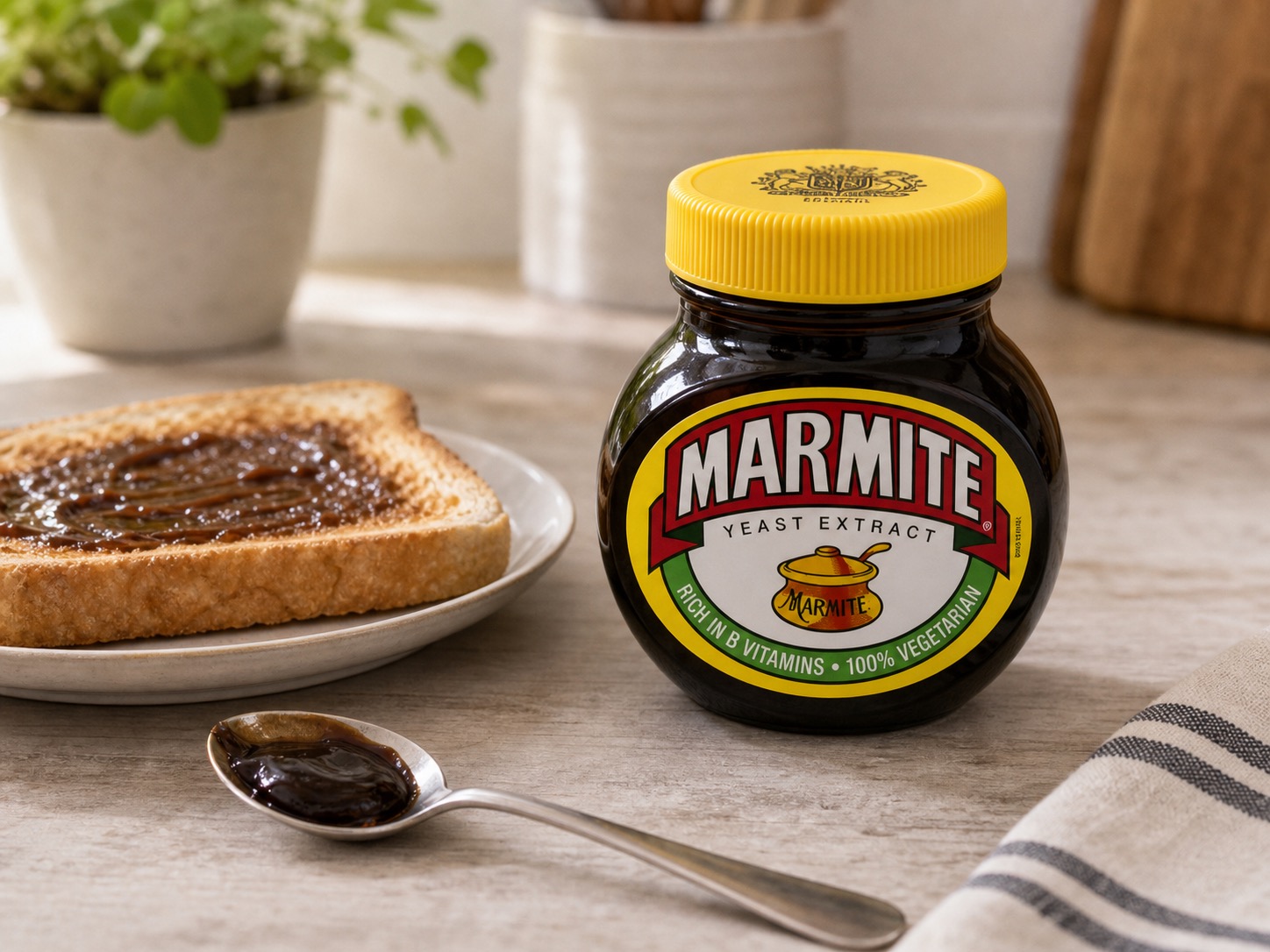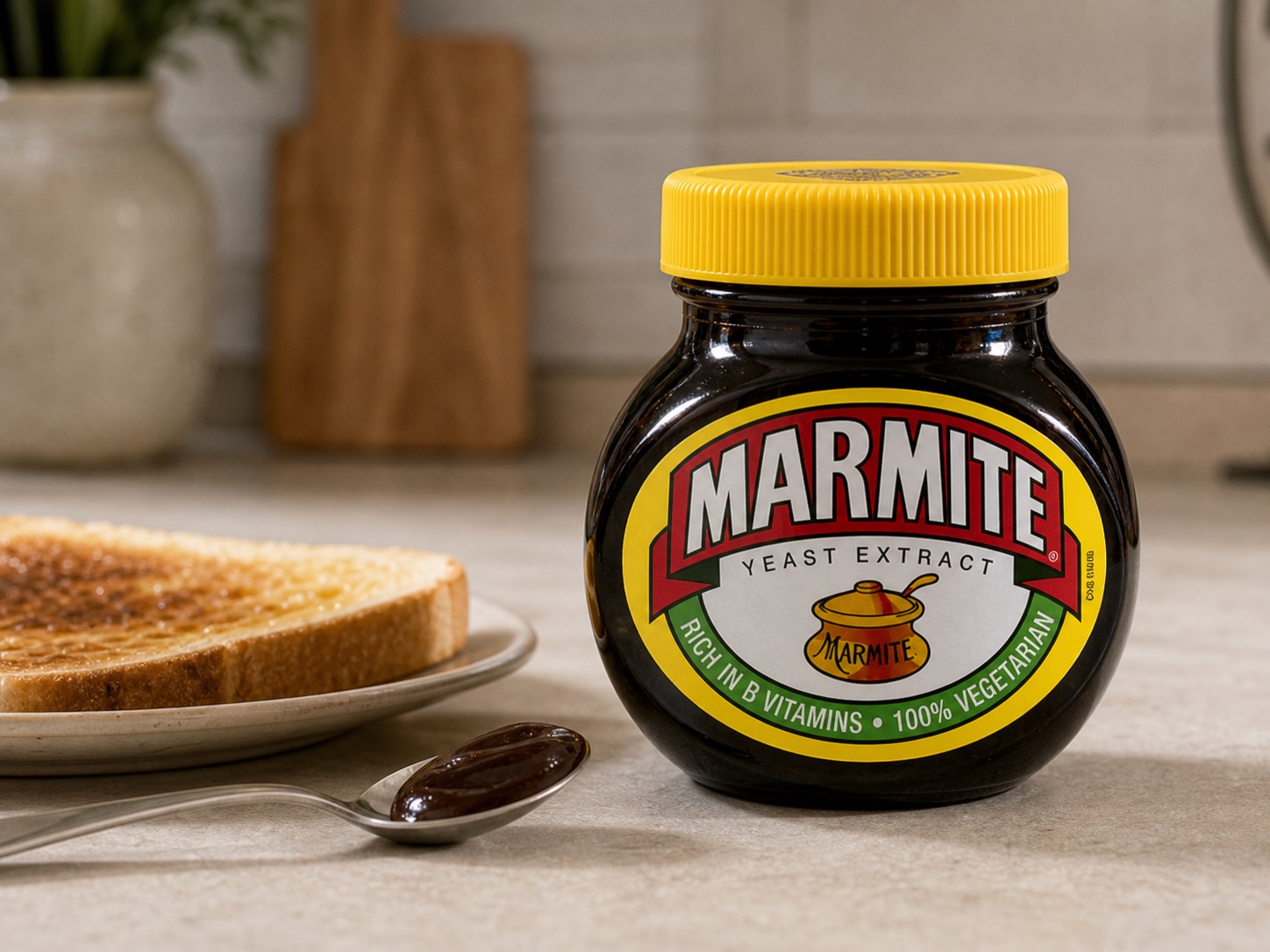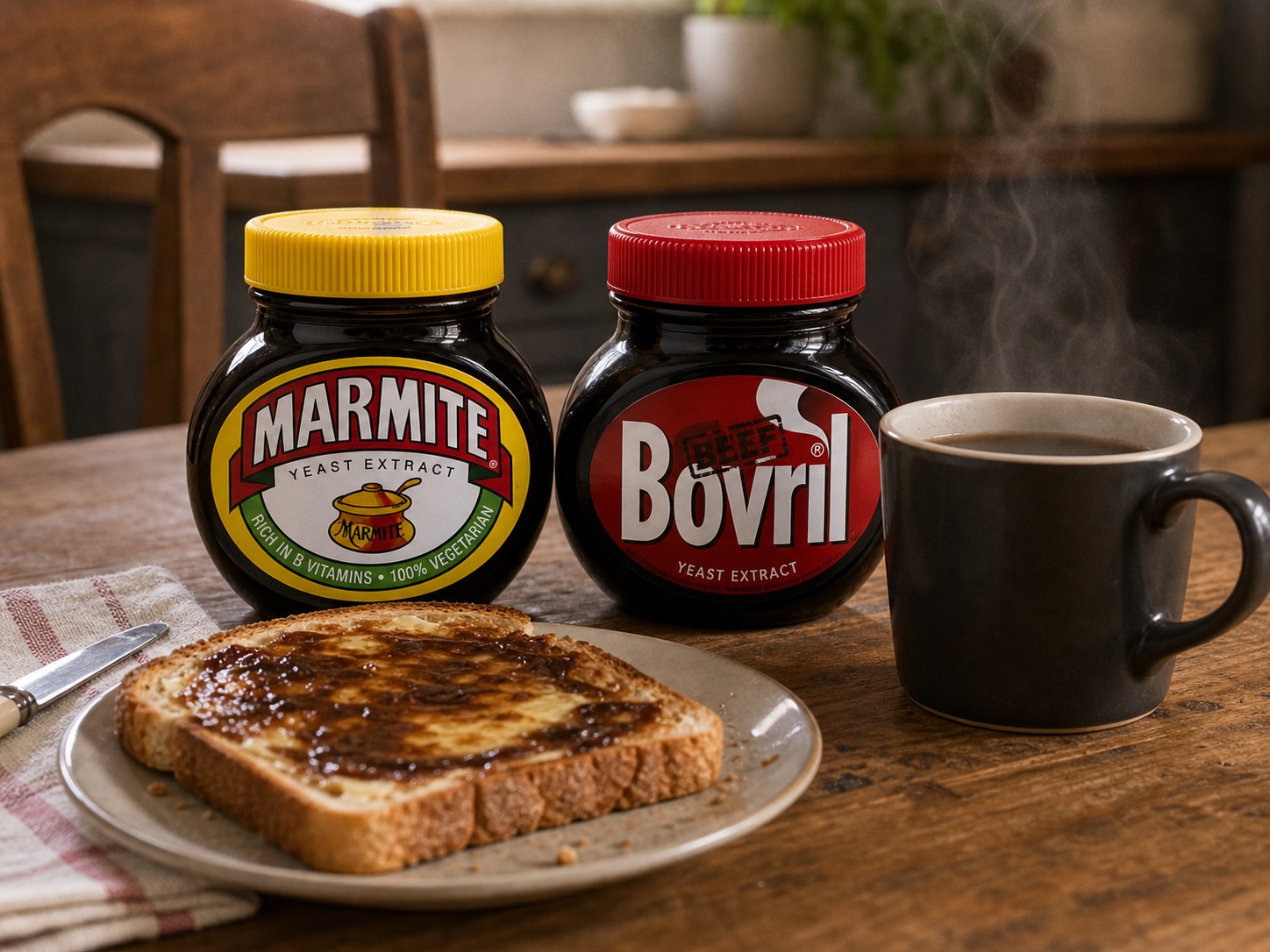

Marmite is one of those rare products where the dietary question has a different answer for almost every common diet. Here is the short, plain version, with the specifics that matter most if you genuinely need to check. The first thing to know is that there is no single Marmite-the-brand line on this. The answers depend on the variant (UK Marmite, NZ Marmite, Marmite Squeezy, Marmite XO and so on) and on which dietary framework you are using.
Is Marmite vegan?
Yes. UK Marmite is vegan and always has been. The yeast is grown on plant-derived media. The vitamins added during production are synthesised, not animal-sourced. The vegetable juice concentrate and the natural flavouring are both plant-derived.
The Vegan Society’s certification does not appear on the jar, because Unilever has chosen not to apply for the badge, but the ingredient list contains nothing of animal origin, and the Vegan Society itself confirms Marmite as suitable for vegans in its own product look-up tools. The certification gap is administrative, not a problem with the product.
The Squeezy bottle is the same recipe and the same vegan status. Marmite XO, when it was available, was also vegan. New Zealand Marmite (made by Sanitarium) is vegan too, with a slightly different recipe that adds sugar and caramel colouring. Both additions are plant-sourced.
Is Marmite vegetarian?
Yes. The vegan answer above also covers the vegetarian question. There are no eggs, no dairy, no honey, no fish, and no animal-derived rennet or gelatine in any version of Marmite. It is one of the safest fortified British savoury products for vegetarians to buy without reading the small print.
Is Marmite kosher?
Only some formats, and only when they carry the mark. The Kosher London Beth Din (KLBD) certifies the 8g portions and the 600g catering tubs as Parev (neither meat nor dairy, so eaten with either), when they bear the KLBD logo. The everyday retail jar, the Squeezy bottle and the limited editions are not kosher-certified. The certification has also lapsed and been reinstated over the years, so the safe rule is to check for the KLBD mark on the specific pack rather than assume. Full detail in the dedicated guide to whether Marmite is kosher.
Is Marmite gluten-free?
No. This is the dietary answer most likely to cause genuine harm if you get it wrong, and Marmite is not gluten-free.
The yeast extract that makes up the bulk of Marmite is grown on brewer’s-yeast media that includes barley, wheat, oats, and rye. The ingredients line on the jar declares this plainly: “yeast extract (contains barley, wheat, oats, rye)”. The processing reduces the gluten content well below the raw cereal levels, but residual gluten remains, and the product is not classified as gluten-free under the UK’s 20-ppm definition.
So for people with coeliac disease or a confirmed gluten intolerance, Marmite is not a safe choice. Coeliac UK lists Marmite as unsuitable for coeliacs. Some yeast-extract competitors are produced from corn-grown or rice-grown yeast and do meet the gluten-free threshold. Marmite is not one of them.
The gluten question is asked often enough that Unilever has, at times, considered a gluten-free reformulation. As of mid-2026 no such product has reached UK supermarket shelves. If a gluten-free Marmite ever does launch, it will be a separate SKU rather than a recipe change to the existing jar.
Is Marmite halal?
The short answer is “essentially yes, but without certification”. There is nothing in Marmite that would be considered haram on ingredient grounds: no pork, no alcohol-derived ingredients, no animal products at all. The yeast itself is permissible under most schools of Islamic jurisprudence, because it is not classed as an animal.
The one nuance worth flagging is that brewer’s yeast is, by its origin, a by-product of the alcohol-fermentation process. Some Muslim consumers and some scholars take a stricter view of yeast that has been involved in beer production, even when the yeast itself contains no alcohol in the finished product. The mainstream view is that Marmite is permissible because the finished product has no alcohol content, but individual judgement on this varies.
Marmite does not carry a halal certification mark in the UK. For consumers who require certified halal status on every product, the absence of the mark may be the deciding factor whatever the ingredient analysis says.
A summary table
| Diet | UK Marmite | Squeezy | NZ Marmite (Sanitarium) |
|---|---|---|---|
| Vegan | Yes | Yes | Yes |
| Vegetarian | Yes | Yes | Yes |
| Kosher | Yes (KLBD certified) | Yes (KLBD certified) | Check Sanitarium directly |
| Gluten-free | No | No | No (contains wheat-derived yeast extract) |
| Halal | Permissible, not certified | Permissible, not certified | Permissible, not certified |
| Suitable for low-sodium diets | Use sparingly | Use sparingly | Slightly lower salt than UK |
| Suitable in pregnancy | Yes, with usual salt caveat | Yes | Yes |
The certification question, in general
A pattern runs through this whole list: Marmite is suitable for many specific dietary needs, yet it is sparing with the formal certification marks on the jar. The vegetarian-society mark, the vegan-society mark, the kosher mark and the halal mark are all conspicuously absent from the UK retail label, even where the underlying product status would support them.
This is a deliberate choice by Unilever. Once a certification mark appears on a jar, the brand is committed to maintaining it across every batch and supply-chain change. Adding marks adds compliance work and risk. Removing them later, if a supply-chain change forced it, generates bad press. The brand prefers to keep the certification active behind the scenes (Marmite has held the KLBD kosher certification for many decades) without printing it on the jar.
For the consumer this means the label tells you less than the actual product status would justify. If you need to verify any of the answers above for your own diet, go to the certifying bodies directly: the Vegan Society’s product look-up, the KLBD’s kashrut database, and Coeliac UK’s list of unsuitable products are all freely searchable online.