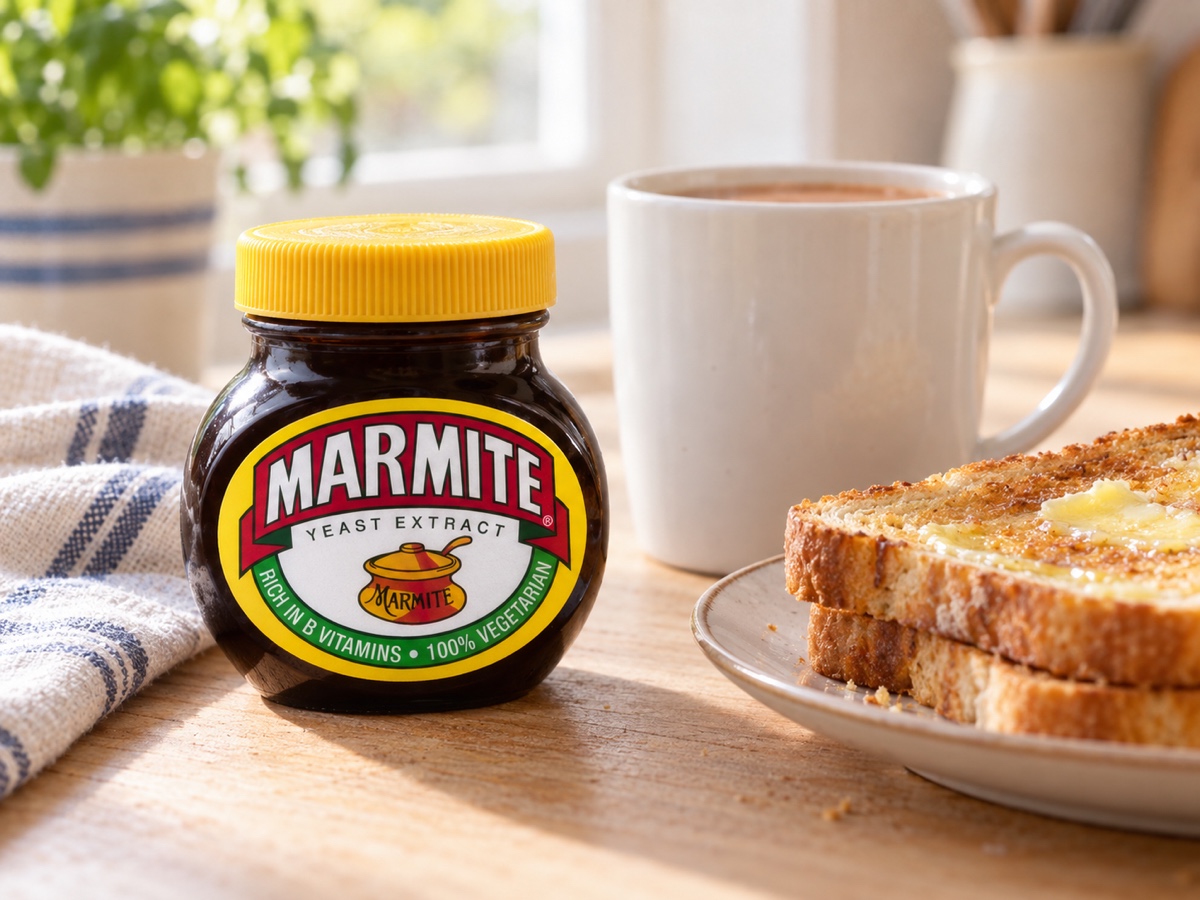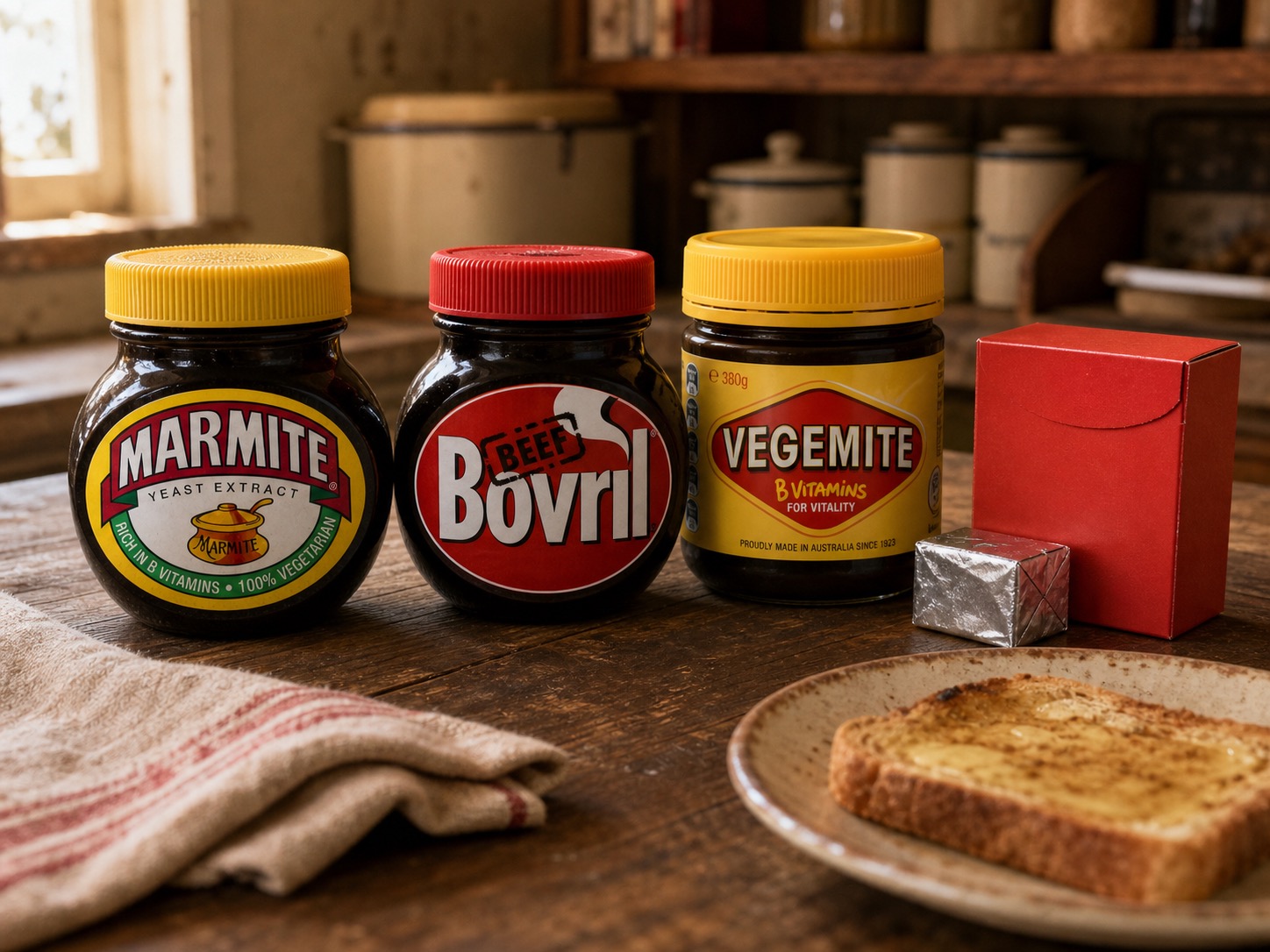

If you have ever been handed a migraine diet sheet, Marmite was on it.
It’s on almost all of them, filed under high-tyramine foods alongside mature cheddar, red wine, cured meat and anything that has been left to age. And on the chemistry, that placement is completely fair. Blackwell measured tyramine and histamine across five yeast extracts for the Journal of Food Science in 1969, and of the five, Marmite came out carrying the most of both. The range across the samples ran from 0.1 to 1.6 mg per gram.
So Marmite is a high-tyramine food. That part isn’t in dispute.
The thing that doesn’t add up
Aged cheese and Marmite both sit near the top of the tyramine tables. Aged cheese is about the most commonly self-reported migraine trigger going. Marmite, despite the numbers, barely comes up.
That gap has been noticed in the literature, and it’s a genuine problem for the simple version of the tyramine theory. If tyramine is the mechanism, and Marmite has plenty of tyramine, Marmite should be lighting people up. It largely isn’t.
I find this more interesting than a straight yes or no answer, because it points at the tyramine story being incomplete rather than wrong.
Five explanations, none of them settled
Dose, the most important. Tyramine per gram isn’t tyramine per sitting. A portion of aged cheddar is thirty to fifty grams and nobody thinks twice about it. The label serving for Marmite is eight grams and most people use rather less than that, because Marmite is not a food you can eat carelessly. So a substance that looks alarming in a concentration table can deliver a fairly ordinary absolute dose in practice. Cheese wins on portion size what it loses on concentration.
What it arrives with. Cheese is dense with fat. Marmite has essentially none. Fat slows gastric emptying, so a lump of cheddar and a scrape of yeast extract don’t present to the gut in the same way or on the same timescale. It’s argued that this changes tyramine absorption meaningfully, and it might. I’d treat it as plausible rather than established, because tyramine is water-soluble rather than fat-soluble, and the tidy version of that argument leans on a mechanism that suits fat-soluble compounds better than it suits this one.
You, specifically. This is the explanation I find most persuasive, and it is not the one the diet sheets imply.
Tyramine is broken down by monoamine oxidase A, an enzyme concentrated in the lining of your gut and in your liver. It does the overwhelming majority of the work: in a 2019 human study, close to seventy-seven per cent of an oral dose came back in urine as the metabolite that enzyme produces. So the amount reaching your bloodstream isn’t really a property of the food. It’s a property of what happened to it on the way through you.
And what happens varies wildly. That same study gave people identical doses under identical conditions and found plasma exposure differing roughly eightfold between individuals, with the time to peak concentration ranging from thirteen minutes to two hours. Same dose, same protocol, completely different experience.
I half believed the obvious explanation until I read the paper. That explanation is genetic: low-activity variants of the enzyme, which would neatly explain why the same cheeseboard floors one person and does nothing to another. The authors went looking for exactly that, and did not find it. Their conclusion was that the data “did not indicate the existence of common deficient, very low, or ultra-active MAO-A phenotypes”.
So the variation between people is real, large and measured. The tidy genetic story for it is not established. Something is making one person’s response to tyramine eight times another’s, and on current evidence it isn’t a common enzyme deficiency.
None of this is the same question as monoamine oxidase inhibitors, which comes up constantly and is worth separating. Those drugs shut the enzyme down deliberately and comprehensively, which is a genuine and dangerous interaction, and a different thing entirely from ordinary variation between healthy people.
How the lists were built. Migraine trigger lists mostly aren’t the output of blind oral challenge testing. They come from patient diaries, and diaries record what people already suspect.
Aged cheese and red wine have been famous triggers for forty years. A patient who gets a migraine after a cheeseboard writes down cheese, because cheese is on the list they were handed. The same patient, having eaten toast that morning, doesn’t write down Marmite, because nobody told them to look. That’s a feedback loop, not evidence, and it will keep a famous trigger famous and an unfamous one invisible more or less indefinitely.
The attack got there first. A migraine begins hours before the pain does. During that prodrome the hypothalamus starts driving cravings, and what people reach for is fat, salt and sugar. Cheese and chocolate are exactly the things people crave in that state, which raises the awkward possibility that they aren’t triggers at all but early symptoms, eaten because the attack had already started.
Marmite, being a taste half the population actively dislikes, is nobody’s comfort binge. A food you never reach for during the prodrome will never look like a trigger, whatever is in it.
I can’t tell you which of these is doing the work. Most likely all of them, in different proportions, in different people.
What this means if you get migraines
Not very much, honestly.
If you have identified Marmite as a trigger through your own experience, your experience beats a 1969 table and you should carry on avoiding it. Nothing here is an argument for testing that. If you’re on a monoamine oxidase inhibitor, the tyramine restriction is a real pharmacological interaction rather than a dietary theory, and that advice comes from your prescriber, not from a fan site.
But if Marmite is on your avoid list purely because it appeared on a printed sheet, and you have never actually noticed a connection, the evidence for that restriction is thinner than the confident formatting suggests.
Why it’s in there at all
Tyramine forms when proteins break down and amino acids get decarboxylated, which is what happens during ageing, fermenting and autolysis. Autolysis is precisely how Marmite is made: spent brewer’s yeast, encouraged to digest itself, then concentrated. High tyramine is an unavoidable consequence of the process and any product made this way will carry it. Which is why every yeast extract in Blackwell’s study registered.
This is the same reason it’s loaded with B vitamins, and the same reason it tastes the way it does. You don’t get the flavour without the chemistry.
Does Marmite trigger migraines?
Marmite is high in tyramine, a compound associated with migraine in some people, and it appears on most low-tyramine diet sheets. However, migraine sufferers rarely report it as an actual trigger, unlike aged cheese which has comparable tyramine levels. The evidence that Marmite specifically triggers attacks is weak. If you have personally identified it as a trigger, that observation is more reliable than the general data.
How much tyramine is in Marmite?
A 1969 study by Blackwell published in the Journal of Food Science measured tyramine and histamine across five yeast extracts and found Marmite contained the largest amounts of both. Tyramine content across the samples tested ranged from 0.1 to 1.6 mg per gram. Because the label serving is eight grams and most people spread rather less, the absolute dose per sitting is much smaller than the per-gram figure suggests.
Why is Marmite on low-tyramine diet sheets?
Because it is genuinely high in tyramine per gram. Tyramine forms when proteins break down during ageing, fermentation and autolysis, and autolysis is how Marmite is made. The listing reflects the chemistry accurately, even though the real-world evidence that Marmite triggers migraine attacks is much weaker than for other foods on the same lists.
Why do some people react to tyramine and others don’t?
Nobody has fully established why, though the variation itself is well documented. Tyramine is broken down mainly by monoamine oxidase A in the gut lining and liver, and a 2019 study by Rafehi and colleagues found that identical oral doses produced roughly eightfold differences in plasma exposure between individuals, with time to peak concentration ranging from thirteen minutes to two hours. The obvious explanation would be low-activity genetic variants of that enzyme, but the same study looked for them and concluded the data did not indicate common deficient or ultra-active MAO-A phenotypes. So individual response varies enormously; the reason is not settled.
Should I avoid Marmite if I take MAOIs?
Follow your prescriber’s advice. Tyramine restriction for people taking monoamine oxidase inhibitors is a genuine pharmacological interaction rather than a dietary theory, and it is a different question from whether Marmite triggers migraine in the general population.
Sources and further reading
- Blackwell B., Mabbitt L. A. and Marley E., “Histamine and Tyramine Content of Yeast Products”, Journal of Food Science 34(1), 1969, pages 47 to 51. doi.org/10.1111/j.1365-2621.1969.tb14359.x (paywalled). This is the source of the figure that Marmite carried the most tyramine and histamine of the five yeast extracts tested.
- Rafehi M. et al., “Highly Variable Pharmacokinetics of Tyramine in Humans and Polymorphisms in OCT1, CYP2D6, and MAO-A”, 2019, at PubMed Central. Source of the eightfold interindividual variation, the thirteen minute to two hour time to peak, the seventy-seven per cent recovery as the MAO-catalysed metabolite, and the finding that no common deficient or ultra-active MAO-A phenotypes were detected.
- “Biochemistry, Tyramine”, StatPearls, at NCBI Bookshelf. Background on tyramine metabolism and where monoamine oxidase A sits.
- American Migraine Foundation, “The Science Behind Migraine Triggers: Are Migraine Triggers Real or Part of the Prodrome Phase?” On food cravings as an early symptom rather than a cause.
- Karsan N. and Goadsby P. J., “The premonitory phase of migraine is due to hypothalamic dysfunction: revisiting the evidence”, at PubMed Central. The hypothalamic mechanism behind prodrome cravings.
- PubChem entry for tyramine, for its solubility, which is why I treat the dietary fat argument as plausible rather than settled.
- Marmite’s own nutrition and FAQ pages, for the eight gram label serving.
A note on what is not cited here. Several popular write-ups link a specific MAO-A variant, rs6323, to migraine susceptibility. I have left that out, because the association is documented for other conditions rather than for migraine, and at least one study found the related polymorphism was not confirmed as a migraine risk factor. The variant also appears to raise enzyme activity rather than lower it, which points the opposite way to the argument it usually gets used for.