
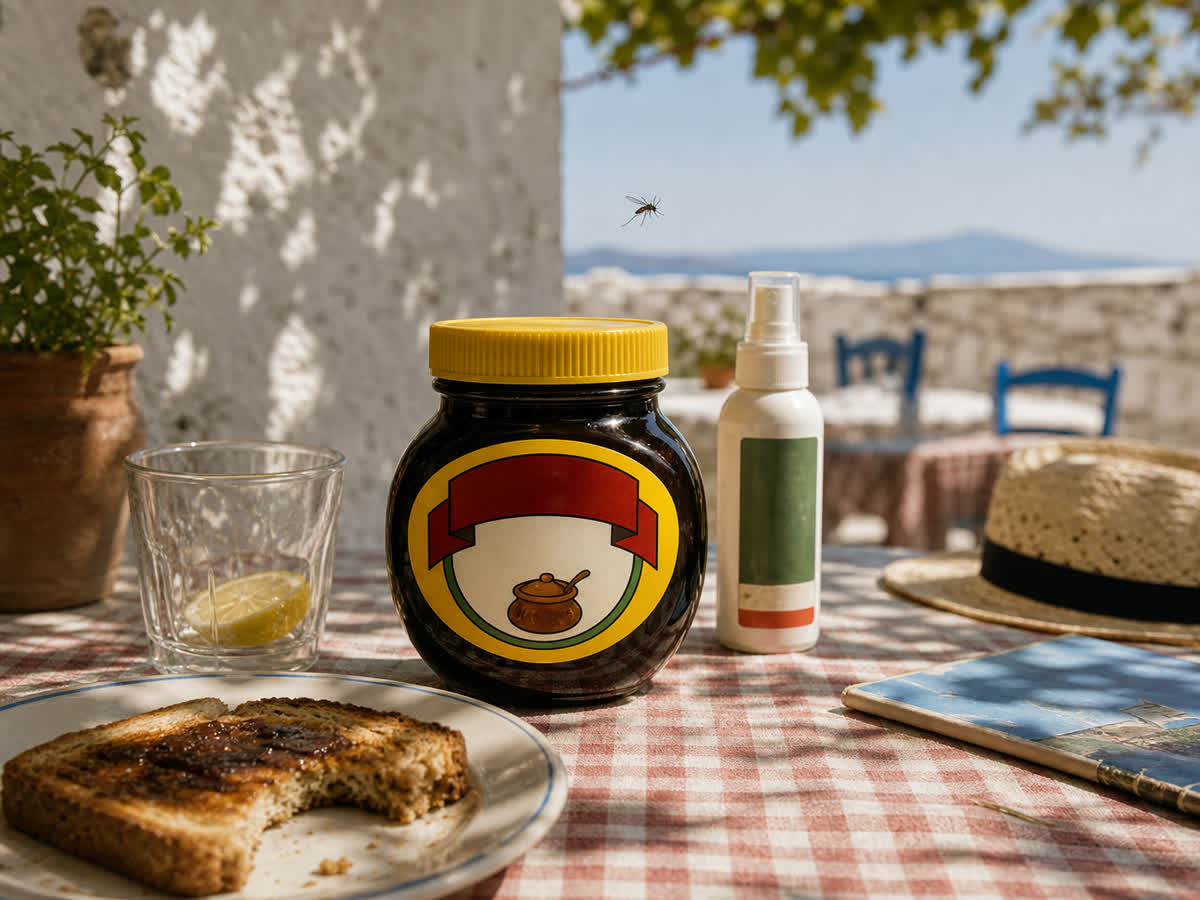
The folk theory
It goes like this. The B vitamins in Marmite, particularly thiamine (B1), are excreted through the skin in small amounts. Mosquitoes find the smell of thiamine unattractive. Therefore, eating Marmite makes you a less appealing target. Therefore, the British tourist on the Greek islands who has had Marmite on toast every morning of the trip will be relatively un-bitten compared to the tourist who has not.
It is a charming theory. People have believed it for generations. Travel guidebooks have repeated it. Mothers have packed jars of Marmite into the suitcases of children going abroad on the strength of it.
It is also, unfortunately, complete rubbish.
What the actual research says
The London School of Hygiene and Tropical Medicine has run the experiments. So has the broader entomological literature on B-vitamin supplementation and biting-insect attraction. The consistent finding across multiple properly-controlled studies is that eating Marmite, taking B-vitamin supplements, or in any other way loading your body with B1 has no measurable effect on how attractive you are to mosquitoes.
The things that do affect mosquito attraction (which the researchers also know about, because they keep being asked) include carbon dioxide output (which is more or less fixed), lactic acid in sweat (which varies with exercise), body temperature, certain skin bacteria, and, modestly, the colour of your clothing. None of these is affected by eating Marmite.
What actually works
Two things. First, DEET. The chemical N,N-diethyl-meta-toluamide, available in spray form, applied to the skin. It is the most effective broad-spectrum insect repellent ever developed and the WHO recommends it for travel in malaria zones. It is not lovely, but it works.
Second, lemon eucalyptus oil. The proper extract, marketed as a slightly more natural alternative, is the second-best-evidenced option after DEET. Less effective than DEET, but better than anything else in the natural-products category.
A jar of Marmite, alas, is in a separate category called “things that are very nice but not actually mosquito repellents”.
Why the myth persists
Two reasons. The first is that some people are genuinely less attractive to mosquitoes than others (the skin-bacteria thing, mostly), and if those people happen to also eat Marmite, they will cheerfully attribute their good fortune to the jar rather than to their personal microbiome.
The second is that Marmite is a delightfully British thing for a British traveller to take abroad, and the mosquito-repellent story is the kind of folk-belief that gives you a small extra reason to enjoy your morning toast in a hot country. Take the toast, take the joy of British-breakfast-while-on-holiday, just do not skip the DEET on the strength of it.
Eat the Marmite anyway
The B vitamins are still doing real work even if they are not deterring the bugs (see articles 200 and 173 for the proper nutritional case). The taste is still there. The morning ritual is still pleasant. Just put on the actual insect repellent before you go out for dinner.
Source: London School of Hygiene and Tropical Medicine field studies on B-vitamin and DEET efficacy; NHS Fit for Travel guidance.