
The headline that did the rounds
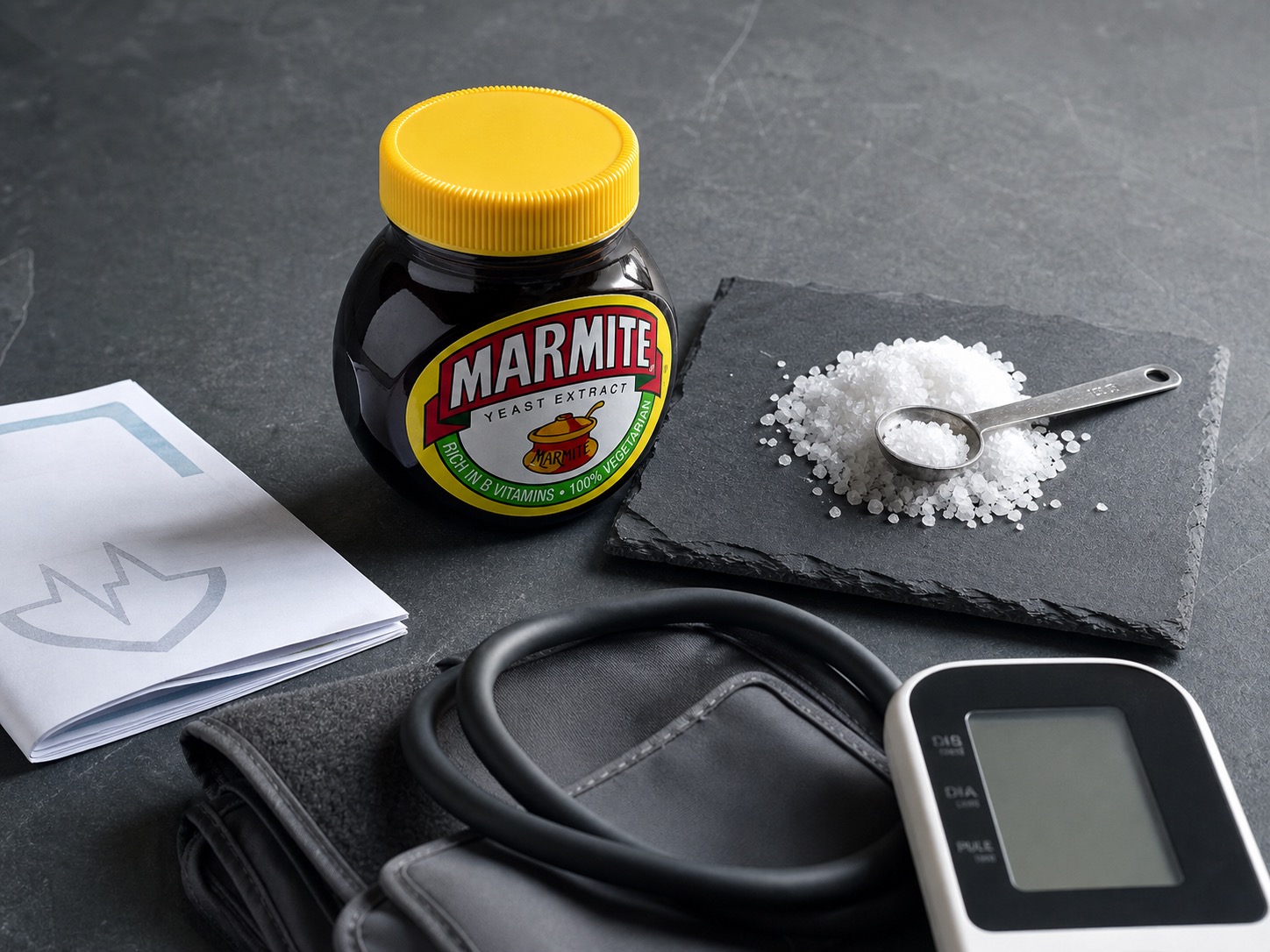
A health blogger spent the first week of May reporting that a single serving of Marmite caused a 26 per cent spike in their blood pressure. The piece travelled. Half the Marmite community panicked. The other half assumed it was nonsense. Both reactions were roughly half right.
Let me unpack it properly.
What is actually in a teaspoon
The label’s declared portion is 8g, one teaspoon spread thinly across a slice of toast, and the panel does not leave you to work out the rest. It prints the number: 0.86g of salt in that portion, 14 per cent of an adult’s reference intake. The same panel says a 250g jar holds 31 portions, which puts about 27g of salt in a whole jar.
Marmite is, factually, a high-salt food by concentration, at 10.8g per 100g, and nobody is going to argue with the chemistry. The argument is about whether 0.86g in a teaspoon-sized serving is a health issue or not.
For scale, the rest of that portion is modest to the point of comedy: 21 calories, 2.7g of protein, under half a gram of fat and under half a gram of sugar. The salt is doing nearly everything the panel has to report.
Two things get muddled here. Salt and sodium are not the same number, and the jar declares salt: divide by 2.5 for sodium, so 0.86g of salt is 0.35g of sodium. And 8g is the label’s portion, not necessarily yours. A genuinely thin scrape is nearer 4g, which halves every figure in this article.
For most healthy adults eating Marmite a couple of mornings a week as part of an otherwise normal diet: no, it is not. For people with elevated blood pressure, kidney issues, or who are salt-sensitive (a real and individual thing): yes, it can be, and worth being thoughtful about.
That, more or less, is the whole story. The 26 per cent spike is real and is also one data point in one salt-sensitive individual. It is not a population-level prediction.
Why the salt is there in the first place
Marmite is made by concentrating brewer’s yeast extract. The process pulls B vitamins, glutamates and proteins into a thick paste. Salt is added partly as flavour, partly as preservative, partly because the yeast-extract concentrate, on its own, would not have the savoury punch that defines Marmite. The salt is doing structural flavour work, not just seasoning.
You cannot, in other words, make low-salt Marmite without it being a noticeably different product. Which is why the existing Low Salt Marmite (yes, this exists, and yes, it has occasional supply problems) is genuinely a different recipe rather than just the regular product with the salt taken out.
Who should actually worry
Three categories of person should think about it carefully.
First, anyone with diagnosed hypertension or who is on blood pressure medication. Talk to your GP about how Marmite fits into the daily sodium budget. The dose is the answer, and the dose depends on what the rest of your diet looks like.
Second, anyone with kidney disease. The kidneys regulate sodium balance, and impaired kidneys are less good at it. Sodium-restricted diets are usually part of the management.
Third, anyone who, like the health blogger, has noticed they are particularly salt-sensitive. Some people’s blood pressure responds sharply to sodium. Some people’s barely registers it. If you are in the first group and you know it, you already know what to do.
For everyone else, a sensible attitude to Marmite is the same as a sensible attitude to anchovies, soy sauce, parmesan, or a piece of well-aged ham. Used in normal quantities as part of a varied diet, fine. Used as the basis of three meals a day, not fine.
The “spread thinly” instruction is genuine advice
There is a reason every Marmite jar has said “spread thinly” since the 1920s. It is not branding. It is the right amount. A thin scrape across hot buttered toast is what the product is calibrated for. A tablespoon-sized smear is too much, both flavour-wise and sodium-wise.
If you are routinely eating a tablespoon of Marmite at a time, you have either decided you really love it (fair), or you have lost calibration and should restart from a thinner scrape (also fair).
What the public health context actually is
It is also worth being honest about where most of the sodium in the average British diet comes from. It is not Marmite. It is sliced bread (yes, really, more salt than you would think), processed meats, ready meals, takeaways, restaurant cooking, crisps, and a long tail of own-brand sauces. The total daily sodium contribution of one teaspoon of Marmite on toast is a rounding error in most people’s daily intake.
That does not mean Marmite gets a free pass. It does mean that the productive conversation about reducing your sodium is mostly about everything else in your diet, with Marmite as a small consideration in a long list.
So what should you actually do
If you are healthy, blood pressure is fine, no kidney issues: eat your Marmite. A teaspoon on toast a few times a week is unremarkable.
If you are not sure about your blood pressure: get it checked. The NHS does this for free at most GPs and at many pharmacies. Once a year is enough for most adults.
If you are diagnosed with hypertension: keep eating Marmite if you want to, but factor it into the daily sodium budget your GP or dietitian has discussed with you.
If you are profoundly salt-sensitive and you have done the experiments and Marmite spikes your numbers: yes, eat less of it, or switch to Low Salt Marmite, which exists for exactly this reason.
The salt figure is only one column of the panel. The B vitamins on the other side of it are weighed up in the honest answer on whether Marmite is good for you.
Sources: the Marmite 250g nutrition panel as published by One Stop, cross-checked against the panel and ingredient list on a 125g jar read directly and against Open Food Facts; NHS sodium guidance; British Heart Foundation on blood pressure.