
The Squeezy bottle has been on UK supermarket shelves since 2006 and now accounts for a meaningful slice of Marmite’s volume. Long-time jar loyalists tend to eye it with suspicion, as if it were a betrayal of something. It is not a betrayal. It solves a small daily problem that the jar has always quietly created, and once you have spent a month with one, going back to the jar is a deliberate choice rather than a default.
What the bottle actually does differently
The jar has always needed two hands and a knife. You unscrew the lid, you set it down, you dip the knife in, you scrape the inside edge to dislodge a workable amount, you spread it on toast, and then comes the bit nobody talks about: you have to deal with the Marmite stuck to the knife and to the rim of the jar.
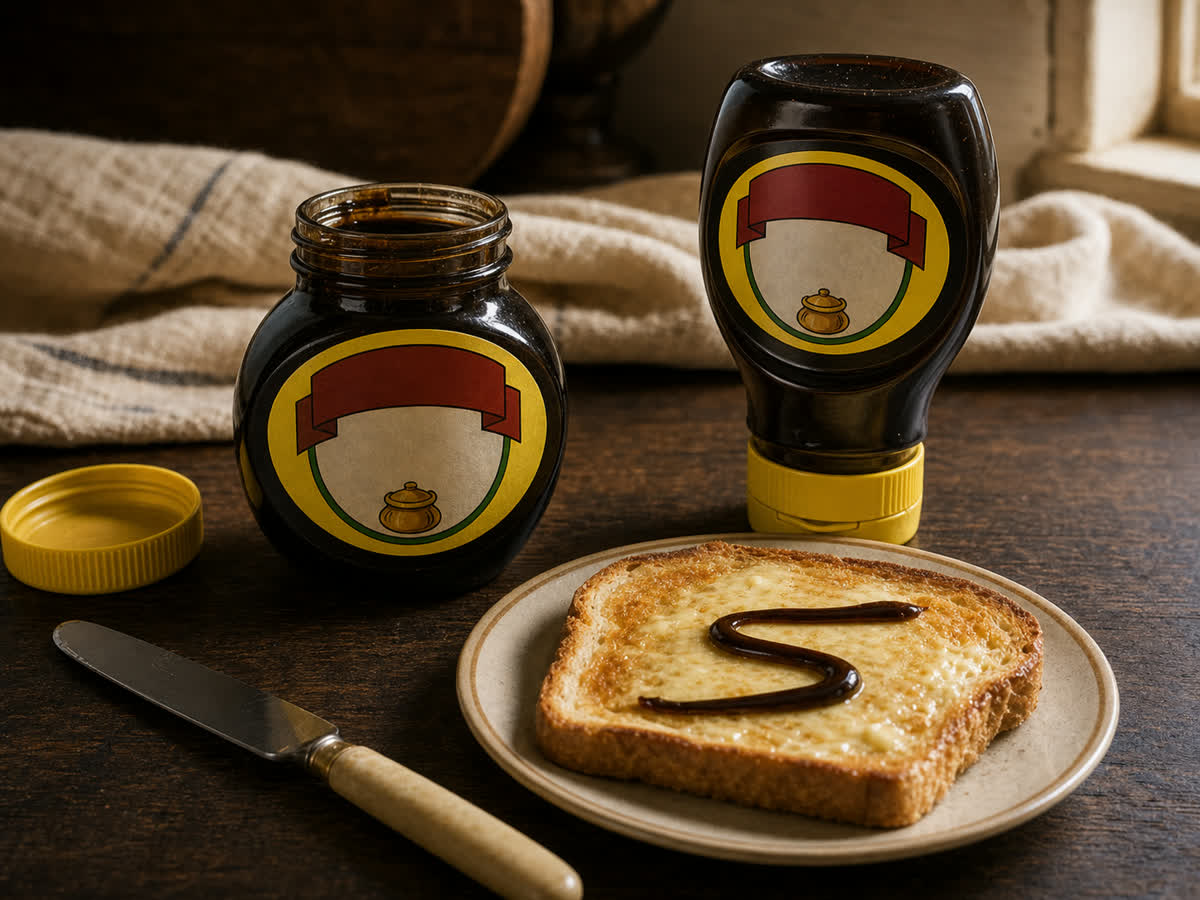
The Squeezy bottle is a thirty-second redesign of that whole sequence. You flip the cap. You squeeze a thin line straight onto the toast. You close the cap. No knife, and the rim of the bottle is clean.
On paper that is a small improvement. In practice, over a month of daily use, the small improvement adds up. You start using Marmite for things you would not otherwise have bothered with: drizzled into a stew on the hob, squeezed into a buttered baguette for lunch, run in a thin spiral across a fried egg. The bottle removes the friction that kept Marmite, in most households, as a once-a-day toast condiment.
This is what good packaging design does. It moves a product from being a thing you reach for in one specific context to a thing you reach for in several.
The technical bit: how the bottle works
The Squeezy bottle is upside-down. The cap sits at the bottom and the body widens upward. This is the bottle equivalent of a French’s-mustard or a Heinz-ketchup bottle, and it works the same way. Gravity keeps the product near the dispensing nozzle, so the first squeeze gives you product rather than an air burp. The cap is a self-closing silicone valve, which opens when you squeeze and closes when you release, so no air gets in to dry out the spread between uses.
The product inside the bottle is not the same recipe as the jar. It cannot be. Jar Marmite is too thick to flow through a valve. The Squeezy version has a slightly higher water content and a tuned viscosity that lets it move under squeeze pressure without becoming watery on the toast. Side by side, the taste is very close to the jar version but slightly less concentrated. Marmite enthusiasts can tell. Most casual users cannot.
What is lost
Three small things, honestly.
The ritual. Unscrewing a jar, picking up a knife, spreading the spread: these are tactile pleasures, and a long-time Marmite user has built habit around them. The bottle removes all that. You lose the small theatrical pause that a jar gives you.
The scrape control. With a knife on a jar, you control exactly how much spread you take, and the brown smear on the toast is shaped by you. With the bottle, the squeeze is a coarser tool. You can over-apply by mistake. Long-time jar users tend to over-apply for the first week, then calibrate.
The strongest hit. The thicker jar recipe gives a slightly more intense flavour per gram. If you like your Marmite as a concentrated bitter-savoury punch, the bottle’s tuned-down version will feel a touch diluted. If you like a smooth even savoury layer, the bottle is actually better.
None of those losses is large. The first is sentimental, the second is solved by practice, and the third is a matter of taste.
What is gained
Several practical things, and one unexpected one.
The kitchen drawer no longer needs a dedicated knife. The toast does not have to be rigid enough to take a knife load, so soft fresh bread works fine, because the squeeze line is supported by the bottle rather than transferred by knife pressure. The bottle does not leak if it falls over. Children can use it without supervision. Travel hand-luggage rules allow a small Squeezy bottle in a way the jar cannot match.
The unexpected gain is that cooking with Marmite becomes much more comfortable. A teaspoon in a stew is now a one-second squeeze rather than a knife-and-jar exercise that needs cleaning up. The umami-bomb cooking trend that took off in 2025 is, in some part, a Squeezy phenomenon. The bottle is what made adding Marmite to a Tuesday-night dinner a thing you would actually bother doing.
The format war: who is buying which
Internal Marmite-side data is not public, but supermarket sales patterns suggest the split is roughly two-thirds jar to one-third bottle, with the bottle skewing younger and the jar skewing older. The jar still owns the breakfast-toast use case. The bottle is winning the cooking and on-the-go use cases.
This fits how other dual-format condiments have evolved. Heinz ketchup glass bottles are still loved by a minority, but the squeezy bottle is the format most households actually buy. Marmite is several decades behind that curve, and Squeezy is the brand’s serious attempt to catch up.
The Squeezy bottle has quietly been through several design tweaks since 2006. The current nozzle is the third or fourth iteration, with a smaller aperture than the original to encourage thin elegant lines rather than dollops. The body has gone from clear plastic to a lightly translucent dark plastic that makes the contents look more like the contents of the jar. None of this was announced. It simply happened, the way good iterative packaging design tends to.
The other format question: the small jar
There is a separate, quieter format argument about the size of the standard jar. The 250g jar is the supermarket standard, but a 125g “small” jar exists, mostly bought as a gift item or a first-time-buyer purchase, and a 500g “large” jar turns up occasionally in larger supermarkets and online. There is no formal small-jar dispute, but the question of which size is correct is a real one for households of one or two people. A 250g jar opened in a single-person household can last well over a year, which is fine, because the spread keeps, but it feels excessive.
The Squeezy bottle, at 200g or 400g depending on the version, sidesteps this. The smaller bottle is the right size for a single household and the larger one is right for a family. The jar’s 250g compromise tries to serve both and ends up serving neither perfectly.
What this means for the brand
Squeezy is the cleanest piece of product-development work the brand has done in the post-Unilever-acquisition era. It expanded the use case without diluting the identity. It is the format that future Marmite product extensions are likeliest to copy. A Squeezy version of the rumoured “low-salt” Marmite would make practical sense, and a Squeezy version of Marmite XO (when it was still on sale) would have given that product a genuine cooking case rather than the toast-only positioning it ended up with.
The jar will not go away. It is the brand’s icon and a meaningful share of sales. But the bottle has earned its place, and the case for it is stronger than long-time jar loyalists give it credit for.