
The jar that came out of a brewery
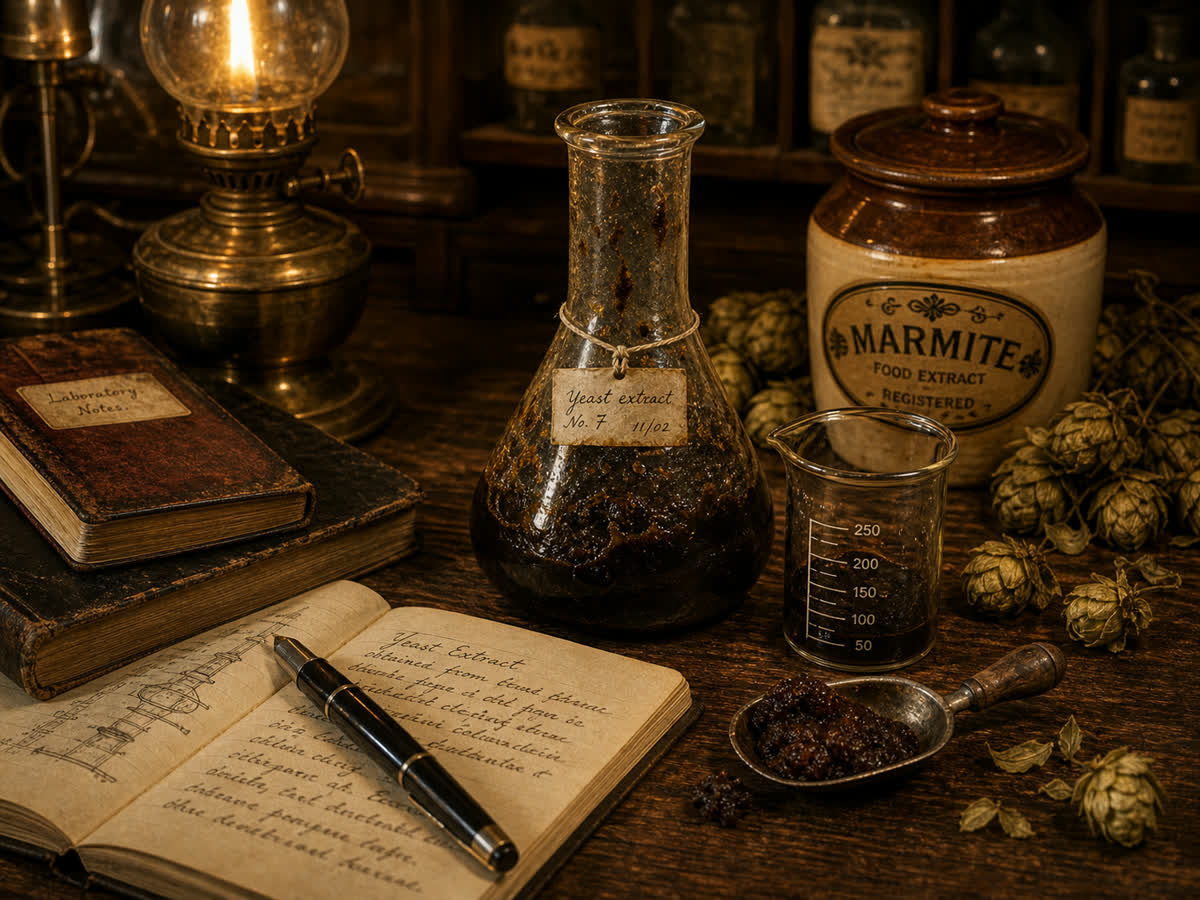
It begins, as a lot of British food does, with a by-product nobody wanted. In 1902, a small group of investors paid £100 a year to rent a disused malt house in Burton-on-Trent and started a company called the Marmite Food Company Limited. Burton was the centre of the British brewing industry. The breweries produced enormous quantities of spent yeast as a waste product and tipped it away. The investors had read the German chemist Justus von Liebig, who had worked out in the 1870s that you could autolyse spent brewers’ yeast into a concentrated, intensely savoury paste rich in B vitamins. They thought it was worth a punt.
It took them years to make it work. British brewing yeast behaves differently to continental yeast, and the machinery had to be redesigned. The British palate had to be talked into accepting an intensely salty dark spread it had never seen before. The early sales were modest. The company persevered. By the 1910s, Marmite was on enough breakfast tables to be a recognisable product, and by the time the vitamin discoveries of 1912 to 1929 established that the jar was a serious nutritional source of thiamine, riboflavin, niacin, folate and B12, the brand was secure enough to ride out the rest of the century.
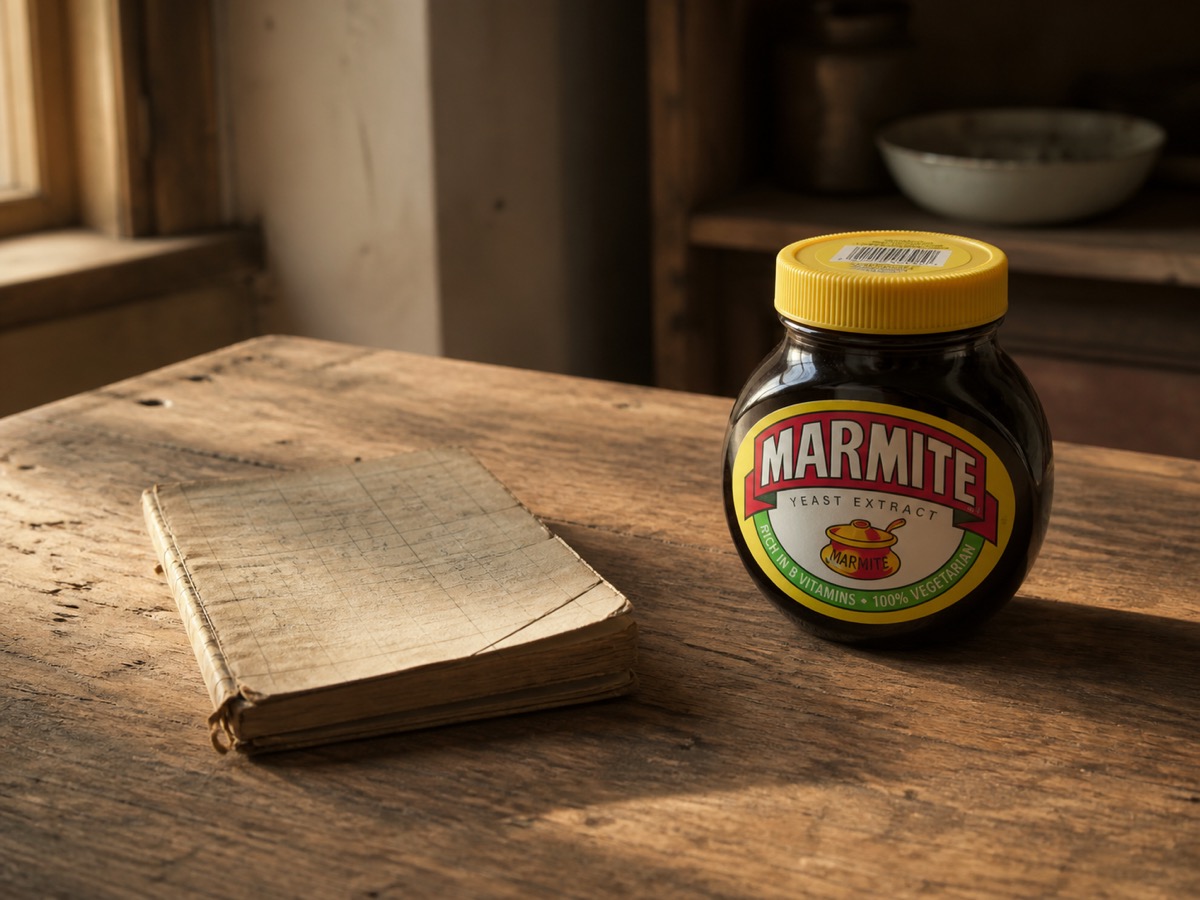
The name, incidentally, is the French word for a large covered earthenware cooking pot. The original Marmite was sold in actual pots, until the bulbous glass jar arrived in the 1920s. A small picture of the pot is still on the label today.
Two world wars
Both World Wars cemented Marmite into British life. From 1916 onwards the British Army Medical Corps put small portions of Marmite into ration packs as a public health measure against beriberi, the nerve disease caused by thiamine deficiency that was taking soldiers out of action in the trenches. The army quartermasters were not romantic about it. They were keeping young men upright on a diet of biscuit, tinned beef and tea. A teaspoon of yeast extract was the cheapest way to do that.
The Second World War repeated the trick at scale. Marmite went into rations across every theatre. The Ministry of Food at home promoted it heavily as a way of stretching restricted ingredients while maintaining vitamin intake. Wartime recipe pamphlets are full of Marmite-based dishes specifically for malnourished children and pregnant women. The brand was, in a quiet but real way, part of the public health infrastructure of mid-twentieth-century Britain.
There is a separate footnote here that the brand should shout about more. In the early 1930s, the English physician Lucy Wills cured a deadly form of anaemia in pregnant textile workers in Bombay using daily doses of Marmite. The active ingredient turned out to be folate (B9), and her work fed directly into the eventual discovery of folic acid and the modern recommendation that pregnant women supplement with it. The dictionary entry for “saved a lot of lives” should arguably have a picture of a Marmite jar next to it.
The Bovril years (1934 to 1990)
In 1934, the Marmite Food Company became a wholly-owned subsidiary of Bovril Limited. The same parent company, two of Britain’s most iconic savoury spreads under one roof, the original recipe untouched. For the next half-century Marmite stayed essentially the same product in essentially the same jar with essentially the same label. The 1984 lid change (metal to plastic) generated a small national correspondence in the Times letters page from outraged consumers, but otherwise the brand was a quiet, steady fixture.
Changing hands (1990 to 2000)
In 1990, the American consumer-goods giant CPC International acquired Bovril and Marmite together. Eight years later CPC renamed itself Bestfoods. And in 2000, Unilever (the Anglo-Dutch consumer-goods conglomerate) bought Bestfoods for £13.4 billion. Marmite, with the rest of the Bestfoods portfolio, went into Unilever’s hands. Unilever has owned the brand from 2000 right through to early 2026.
For Marmite, the Unilever years were the period of biggest marketing investment, the most product innovation, and the most cultural prominence the brand had ever had.
“Love it or hate it” (1996)
The campaign that defined the modern Marmite identity actually predates Unilever’s ownership by four years. In October 1996, the advertising agency BMP DDB launched a new tagline for the brand: “Love it or hate it”. The creative duo behind it, Richard Flintham and Andy McLeod, were genuine opposites on the question. Flintham loved Marmite. McLeod hated it. Their disagreement became the campaign.
The genius of the line was that it did not try to win anyone over. It accepted that the product was genuinely polarising and built the brand around that acceptance. People are rarely ambivalent about Marmite. The advertising chose not to fight that, and instead made it the central point.
The phrase escaped into the general language within a few years. “A bit Marmite” is now the standard British shorthand for anything that divides opinion, applied to politicians, films, footballers, sitcoms and prime ministers. It is one of the very few twentieth-century advertising lines that genuinely became a piece of public vocabulary. Bartle Bogle Hegarty took over the account later and continued the line for the next two decades.
Product innovation, 2006 to 2024
The 2000s and 2010s were the years of the limited editions and the brand collaborations.
The Squeezy bottle (2006). A thinner, soft-plastic version of Marmite in a yellow-topped squeezy bottle, designed for people who eat Marmite every day and want a cleaner delivery vehicle than the jar. Discontinued in 2020. Brought back in October 2024 by Sainsbury’s after a four-year campaign of complaints from devoted users.
Marmite XO (2010, then 2019). An extra-old, more intensely flavoured version aged for 28 days. Launched with the brilliant Marmarati fictional-secret-society campaign, where fans could apply to be inducted as founding members. Discontinued, then re-launched permanently in 2019 after fan pressure.
Marmite Peanut Butter (2019, then 2024 to 2025). The brand’s first permanent new product since 1902. A genuinely good combination of peanut butter and Marmite, particularly useful in cooking as a satay-sauce base. Discontinued in September 2024 after slow sales, brought back permanently in June 2025 after public outcry.
Marmite Dynamite (2021) and Marmite Truffle (2022). Chilli and truffle limited editions, both Sainsbury’s exclusives. Modest sales, devoted niche audiences.
Pride jar partnership with the Elton John AIDS Foundation (2023 to 2025). Four annual limited-edition jars, each referencing a landmark Elton John moment (Goodbye Yellow Brick Road, Rocketman, Dodger Stadium 1975, I’m Still Standing). Total donation to EJAF: £1 million, paid unconditionally, not tied to jar sales. Closed June 2025.
The crises
Marmageddon in New Zealand (2011 to 2013). The Sanitarium factory in Christchurch (which produces NZ Marmite, a different recipe under licence) was damaged in the February 2011 earthquake and production stopped for nearly two years. Jars commanded extraordinary eBay prices. Then-Prime Minister John Key commented publicly on the shortage. New Zealanders, fiercely loyal to their sweeter version, panic-bought what was left.
Marmitegate at Tesco (October 2016). Following the post-Brexit fall in the pound, Unilever asked Tesco for a ten per cent wholesale price rise across its product range. Tesco refused. Unilever stopped supplying. Marmite, along with Persil, PG Tips, Comfort and Hellmann’s, vanished from Tesco shelves for about a week. Marmite was the only one of those products to make the front pages, because it is the brand the press always reaches for as a stand-in for “ordinary British thing”. The row resolved quickly. Marmite sales went up sixty-one per cent the following week, generating £335,000 of extra revenue from pure free publicity.
The pandemic shortage (2020 to 2021). With pubs and breweries closed during lockdowns, the supply of spent brewers’ yeast dried up. Unilever was forced to halt production of all jar sizes except the standard 250g. Shortages continued into 2021 as the brewing industry slowly came back online.
The M&S cyber-attack (April to June 2025). When ransomware took down the M&S IT systems, Tesco’s wholesale arm Booker stepped in across competitive lines to keep M&S food halls stocked. Marmite was on the priority list. Two competing supermarket chains co-operating to keep jars of Marmite on shelves is, in its own quiet way, a small piece of British retail history.
2025: the year Marmite was suddenly everywhere
The twelve months from summer 2025 onwards were the most commercially active in the brand’s recent history. A short list:
- June 2025 — Marmite Popcorn Slab, a limited-edition caramelised-popcorn-meets-Marmite bar
- July 2025 — Marks & Spencer launched a three-cheese wood-fired Marmite pizza that outsold the Margherita in its first week, plus a Marmite mac and cheese ready-meal and Marmite mac bites
- September 2025 — M&S Christmas range added a Marmite Caramel Sauce and Marmite-pecan blondies (the savoury-sweet trick that everyone, with hindsight, agreed was obvious)
- October 2025 — Unilever and Joe & Seph’s launched the first officially licensed Marmite popcorn in a bag
- November 2025 — Reuters reported that Unilever had opened a formal sale process for Marmite, Bovril, Colman’s and a small group of other “Historic British Brands”. The press called the package non-core. The fans called the press something else
- December 2025 — The Magnum ice-cream company spin-off (MICC) was completed, the corporate rehearsal for the larger food-business sale
- December 2025 — Elton John “I’m Still Standing” Pride jar, the fourth and final in the EJAF series, with the campaign closing on £1 million donated
- December 2025 — The #MarmiteFirstTimer hashtag on TikTok passed half a billion views, marking the first proper Gen Z encounter with the jar
- January 2026 — Marmite Hummus launched as a permanent line in the chilled aisle
- February 2026 — Low Salt Marmite and the 500g jar disappeared from shelves for ten days during a brief supply-chain wobble
- February 2026 — New Zealand’s Health Star Rating system put Marmite at 1.5 stars out of 5, igniting a new chapter of the trans-Tasman Marmite-versus-Vegemite war
The McCormick deal (March 2026)
On 31 March 2026, McCormick, the American spice company founded in 1889 and based in Hunt Valley, Maryland, announced an agreement to combine with Unilever’s foods business. The combined company will keep the McCormick name, maintain its New York Stock Exchange listing, run a global headquarters in Hunt Valley and an international headquarters in the Netherlands, and have combined fiscal-year 2025 revenue of around $20 billion.
For Unilever shareholders, the transaction works out to a 65 per cent equity interest in the combined company. The breakdown: Unilever’s shareholders receive 55.1 per cent of the combined-company equity directly; Unilever the corporate parent retains a further 9.9 per cent, with a commitment to an orderly sell-down over time. McCormick’s existing shareholders end up with the remaining 35 per cent. On top of the equity, Unilever receives a one-time $15.7 billion cash payment, funded by a bridge loan from Citigroup, Goldman Sachs and Morgan Stanley.
The implied enterprise value for Unilever Foods is approximately $44.8 billion, or 13.8 times fiscal 2025 EBITDA. Total deal value is around £33.5 billion in sterling. The deal is structured as a Reverse Morris Trust, which means it is not expected to generate US federal income tax for Unilever or its shareholders, a structurally important detail that helps explain why the equity component is so large.
The financial profile of the combined company: $4.7 billion in 2025 adjusted EBITDA on a combined basis; operating margin moving from around 21 per cent today to a targeted 23 to 25 per cent by year three; $600 million in annual cost synergies by year three (two-thirds by year two); a further $100 million in revenue and cost synergies to be reinvested for growth; $300 million in one-time expenditures to capture all of the above; net leverage falling from 4.0 times at close to 3.0 times within two years; and a target organic growth rate of 3 to 5 per cent in year three. The deal is expected to close mid-2027, subject to McCormick shareholder approval, regulatory clearances and works-council consultation.
Leadership at the combined entity: Brendan Foley remains Chairman, President and Chief Executive Officer of McCormick. Marcos Gabriel remains Chief Financial Officer. Unilever will appoint four of the combined board’s twelve members, one of whom serves a two-year integration term. The Unilever Foods R&D centre in the Netherlands stays put as a core capability of the combined company.
A small but important caveat about which brands the release names
The official McCormick press release explicitly names exactly two Unilever Foods brands: Knorr (in 90 countries, with five billion consumers, sold “as a household name” worldwide) and Hellmann’s (one of the world’s leading mayonnaise brands, in 65 countries). Knorr and Hellmann’s together account for approximately 70 per cent of Unilever Foods’ sales. Everything else, including Marmite, Bovril, Colman’s, Pot Noodle and the British heritage brands the press has spent the most ink on, is bundled under the catch-all phrase “a wide array of local brands across EMEA, Latin America and APAC”.
So while every Reuters, FT and CNBC piece on this deal has named Marmite as part of the transaction, the official corporate statement does not. The brand is included via the Unilever Foods carve-out, but it is not, in McCormick’s own words, a strategic centrepiece. Whether that matters in the long run depends on how the new owners think about heritage British brands once the integration begins. The British heritage portfolio is, structurally, a long-tail piece of a deal whose headline rationale is mostly about Knorr and Hellmann’s.
Excluded businesses
The transaction does not include all of Unilever Foods. Excluded by name in the announcement: the Indian foods business (the largest single exclusion), the Nepalese and Portuguese foods operations, the Lifestyle & Nutrition arm (Horlicks and similar), the Buavita business in Indonesia, and the Lipton Ready-to-Drink joint venture. Those stay with what Unilever CEO Fernando Fernández described as “a €39 billion pureplay HPC company with a proven sector-leading growth profile” — the slimmed-down Unilever that emerges on the other side of the spin.
Burton, and the British response
For Marmite specifically, the immediate practical question is the Burton-on-Trent factory and the roughly 240 manufacturing jobs there. McCormick’s public language has been about long-term manufacturing agreements and respecting heritage brands, which sounds reassuring but is roughly the same language Mondelez used about Cadbury’s Bournville plant before they substantially scaled it back. The press release itself does not mention Burton, or any UK manufacturing commitment, by name. Burton is watching closely. So is everyone else.
The British public response was loud and immediate. The phrase “you can’t sell Marmite to the Americans” travelled through the press for a fortnight. The fact that Britain has sold off cars, banks, energy, water, ports, telecoms and football clubs without much fuss but drew a line at the yeast extract is itself a small piece of national psychology that deserves a sociologist’s attention.
The writer’s own view, for the record: Marmite will be more like me, British and American. We will see how this plays out.
What is next: the 125th anniversary (2027)
Marmite turns 125 in 2027. It will be the first proper Marmite anniversary under American ownership. Whether the new owners run a serious anniversary campaign, or whether the integration work absorbs all the attention, is the open question.
The 2002 centenary was a genuinely significant celebration with proper media presence, a fan-club tier, and a presence at the BBC Good Food Show. The 2027 milestone deserves the same.
In the meantime, Marmite is still made in Burton-on-Trent, still in the same bulbous glass jar with the same yellow-and-black label, still concentrated brewers’ yeast with the same secret seasoning blend the original company developed over a century ago. Whatever the corporate structure on the holding-company papers, the jar that arrives on your toast tomorrow morning is the jar your grandparents knew.
Whether you love it or hate it (and by now, you have surely decided which), Marmite has been one of the most enduring products in British food culture for nearly 125 years. There is no good reason to think the next 125 will be different.
References
- Marmite Museum: https://www.marmitemuseum.co.uk/
- Grace’s Guide to British Industrial History: https://www.gracesguide.co.uk/Marmite
- The Independent (2000) on Unilever’s Bestfoods acquisition: https://www.independent.co.uk/news/business/unilever-buys-bestfoods-for-13-4bn-722368.html
- Word Histories on the “Love it or hate it” campaign: https://wordhistories.net/2018/04/19/love-it-or-hate-it-marmite/
- The Guardian on the New Zealand shortage: https://www.theguardian.com/world/2012/mar/19/new-zealand-marmite-shortage
- Time Magazine on Brexit Marmitegate: https://time.com/4529101/marmite-tesco-unilever-brexit/
- The Guardian on Brexit and Marmite: https://www.theguardian.com/business/2016/oct/13/marmite-and-brexit-how-a-yeast-based-spread-explains-modern-britain
- Reuters on the November 2025 Unilever sale process
- SEC filings and CNBC coverage of the March 2026 McCormick acquisition
- Imperial War Museums on wartime rations
- BMJ obituary of Lucy Wills and the original 1931 paper on macrocytic anaemia