
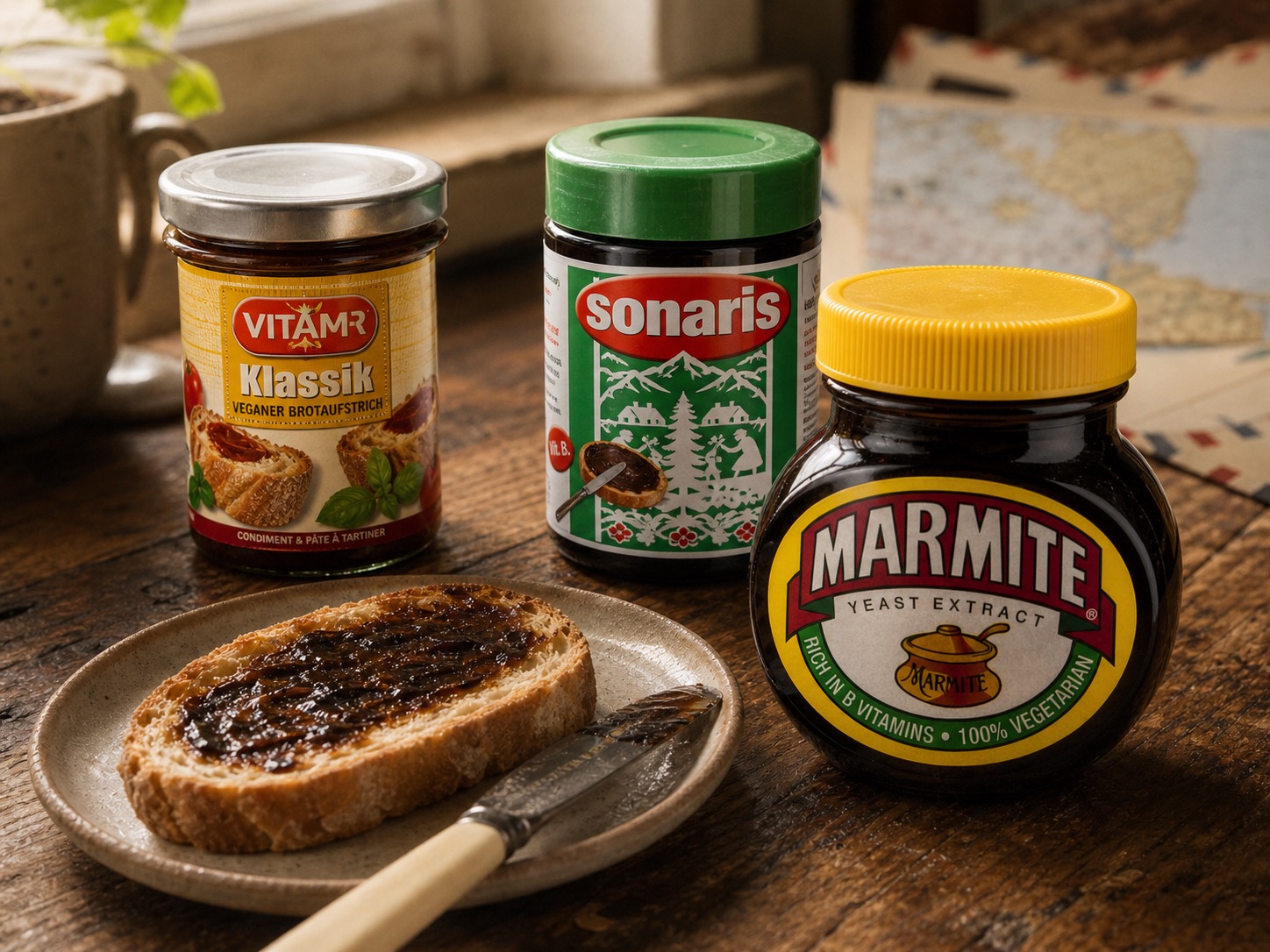
The short answer is Vitam-R. If you want the German equivalent of Marmite, it is a yeast extract spread called Vitam-R, made in Hameln and on sale in German health-food shops for the best part of a century. Switzerland has its own, older and more famous version called Cenovis. Neither is a national icon the way Marmite is in Britain, but both are close cousins of the same idea: take spent or whole yeast, concentrate it into a dark salty paste, and spread it thinly on bread.
Is there a German version of Marmite?
Yes. The closest German-made equivalent is Vitam-R, a savoury yeast extract spread (Hefeextrakt in German) produced by Vitam Hefe-Produkt GmbH in Hameln, Lower Saxony. It was first developed in 1925 by Rückforth AG in Stettin, then a German city and now Szczecin in Poland. The timing is no coincidence. It followed the same nineteenth-century discovery by the German chemist Justus von Liebig that made Marmite possible, namely that yeast could be broken down and concentrated into something edible and rich in flavour.
Marmite itself is also sold in Germany, mostly as an imported British product in larger supermarkets and online, so a German shopper has both options. But the home-grown one is Vitam-R.
What is Vitam-R?
Vitam-R is a dark, savoury, vegan spread built on yeast extract and a little sea salt. It is sold mainly through Reformhaus health-food shops rather than promoted as a mass-market breakfast staple, which is part of why it is far less famous abroad than Marmite or Vegemite. Germans who grew up with it tend to treat it as a wholesome store-cupboard item rather than a cultural talking point.
It still attracts the same split reaction as every other spread in this family. People either take to the concentrated savoury hit or they find it overwhelming, so the love-it-or-hate-it line applies just as well in German.
How is Vitam-R different from Marmite?
The main difference is the yeast. Marmite is built on spent brewer’s yeast, the leftover yeast from beer making, which is where its faint malty edge comes from. Vitam-R uses whole baker’s yeast cells instead, along with a little sea salt. The result is often described as smoother and slightly less sharp than Marmite, though the family resemblance is obvious to anyone who has eaten both.
Both are vegan, both are rich in B vitamins, and both are meant to be spread thinly rather than piled on.
How I came across Vitam
I should declare an interest. I came to Vitam long before I ever thought of writing about it. My Canadian cousin introduced me to it. Her mother had grown up in East Berlin and escaped to the West, and Germany stayed in the family long after she settled in Canada. Whenever she visited, the one thing she always brought back was a jar of Vitam. So it reached our table by way of Berlin and then Canada, rather than from any British shop.
For years that was the only way to get it, because Vitam was genuinely hard to find in Britain and a jar was something you stocked up on or had carried over. The internet changed that. The UK distributor is the Essential Trading Co-operative, which sells it under its own label as “formerly Vitam-R”, and you can also buy a jar on Amazon without much trouble.
My quiet confession, on a site called I Love Marmite: in a lot of situations I prefer Vitam. It is smoother than Marmite, and to my palate it tastes a little meatier and rounder, even though it is completely vegan. Marmite has the sharper, maltier edge. Vitam is the gentler, deeper one. I keep both in the cupboard, and which one I reach for depends on the mood and the meal.
What is the Swiss version of Marmite?
Switzerland’s version is Cenovis, a dark brown yeast extract paste that has been made there since 1931. Alongside the yeast extract it contains onions, carrots and spices, which puts it closer to Marmite’s actual recipe than Vitam-R is, since modern Marmite also carries a vegetable juice concentrate of carrot and onion. Cenovis is the one most often called “the Swiss Marmite”, and it has a small but devoted following.
Can you buy Marmite in Germany?
Yes. Marmite is widely available in Germany as an imported product, both online and in the international or British sections of larger supermarkets. So the practical answer for a Marmite fan in Germany is that you do not have to switch. You can buy the real thing, or you can try the local Vitam-R and Swiss Cenovis to see how the German-speaking world solved the same problem.
Why is yeast extract so common across Europe?
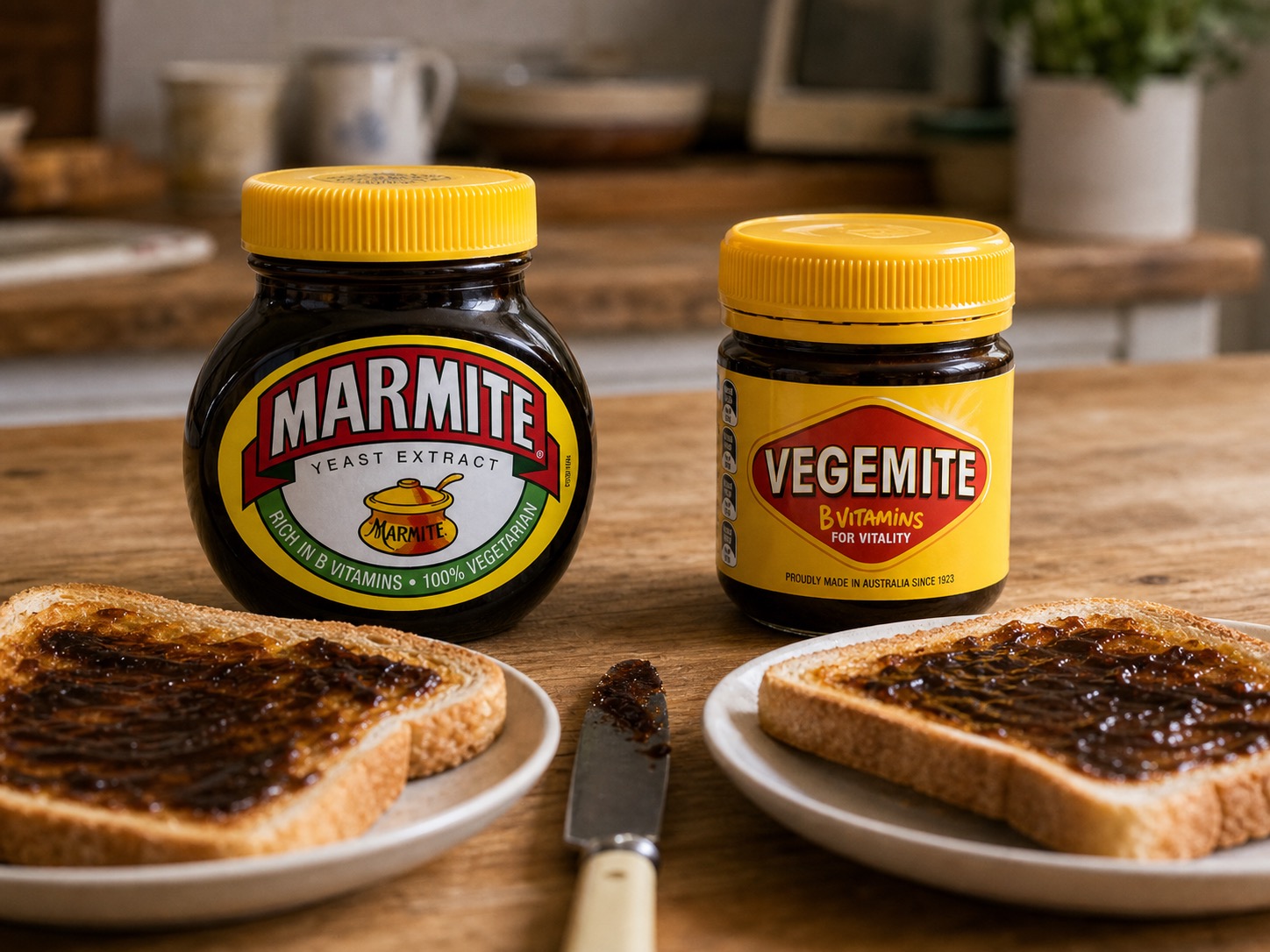
Because the underlying idea came from continental Europe in the first place. Liebig’s work in the 1800s showed that yeast, a by-product nobody had much use for, could be turned into a concentrated and nutritious paste. Britain turned that into Marmite in 1902, Switzerland into Cenovis in 1931, Germany into Vitam-R in 1925, and Australia into Vegemite in 1922. They are regional answers to the same starting point, which is why they all taste like variations on a theme.