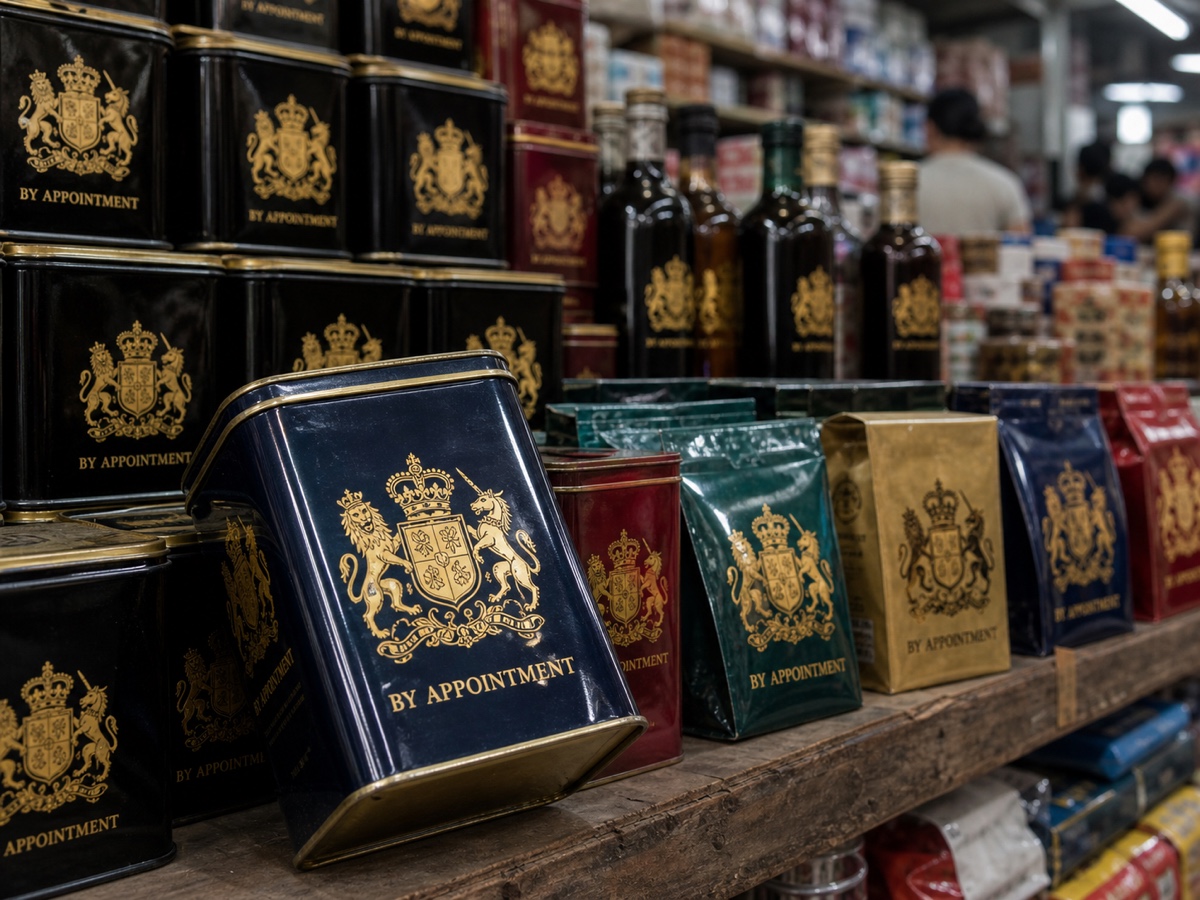

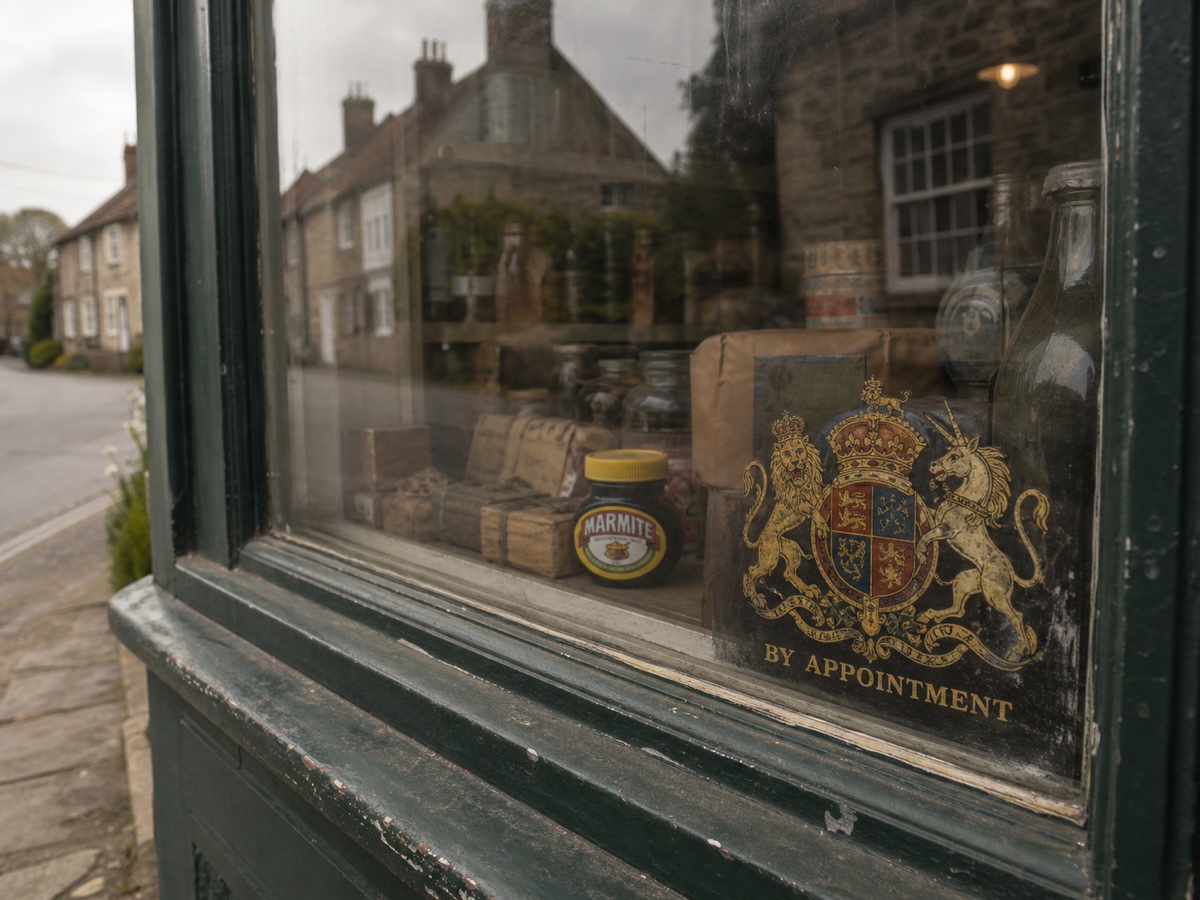
I grew up a walk from Sandringham, and the royal crests were just part of the furniture in my areas. A butcher, a garage, a fishmonger (Albert Balls in Kings Lynn, his crest was HUGE above his shop door), a nursery, all with the same small painted coat of arms in the window and the words “By Appointment” underneath. Nobody ever explained them. You absorbed that they meant something, that the shop was a cut above in some way to do with the big house up the road, and you left it there. It was years before I understood that the crest in the window is one of the oldest pieces of commercial recognition in the country, that it is fiercely policed, and that you can lose it.
Marmite is a neat way in, because Marmite is one of the few brands that won a royal warrant, kept it for a while, and has now had it taken away, all within about a decade. Warrant, Sandringham and Marmite together, then, starting with what the crest in the window actually means.
What a royal warrant is
A royal warrant is a formal mark of recognition granted to a company that has supplied goods or services to the Royal Household. It is not a prize for being good, and you cannot buy one or apply cold. You have to have actually supplied the household, for real, for a sustained period, before you are even allowed to put your name forward.
What the warrant gives you is the right to display the Royal Arms and the words “By Appointment to…” on your premises, your letterhead and your products, naming which member of the royal family granted it and saying, in the prescribed wording, what you supply. That is the crest in the local Norfolk shop windows. It is, in the old phrase, “a peerage for trade”, and it has been worth chasing for that reason since at least the eighteenth century, when the likes of Wedgwood pursued royal recognition for the prestige it carried.
There are roughly 750 warrant holders at any one time, holding around 800 warrants between them. Some are household names. Many are exactly the kind of local supplier I grew up seeing: the firm that does the estate’s fencing, the one that services the cars, the nursery that supplies the plants.
How you actually get one
The bar is supply, not flattery. Under the rules, a company has to have supplied goods or services to the Royal Household for at least five years before it can apply. Real trade, real invoices, an actual ongoing relationship.
After that, the path runs through the household itself. A buyer or department recommends the company. The application goes to the Royal Household Warrants Committee, which is chaired by the Lord Chamberlain, the most senior officer of the household. The committee reviews it, and the grantor, currently the King or the Queen, makes the final decision. A warrant is granted for up to five years at a time and is then reviewed again, so it is not a one-off honour but a relationship that has to be kept up.
The Lord Chamberlain’s office is the engine room of all this. It runs the committee, it interprets the rules, and it is the body that companies answer to on how the arms may be used. The phrase “the Lord Chamberlain’s Rules” is the everyday law of the warrant world.
The bit that surprises people: it dies with the monarch
A warrant belongs to the person who granted it, not to the Crown as an institution, and it does not pass automatically to the next monarch. When the grantor dies, the warrant becomes void. In practice the holder is given a wind-down period of about two years in which it may still display the arms while it sorts out whether it will be re-granted by the successor.
This is the single fact that explains most of what happened to Marmite, so hold on to it: warrants do not survive the monarch who gave them. Everyone has to reapply to the new reign, and not everyone gets back on the list.
Marmite’s warrant, won and lost
The Queen was, by repeated report, a Marmite person. That is the hook every “Ma’amite” jubilee jar leaned on, and I have written about those jars separately. But the warrant is a different and more formal thing than a known fondness, and Marmite’s own warrant arrived later than you might think.
Unilever, Marmite’s owner, has carried a corporate royal warrant going back to 1929, covering food and household products across its range. Marmite itself was added to that roll in 2016, when it was granted a warrant in its own right, reportedly the seventh Unilever product to hold one. The brand was pleased enough to say so out loud. “We’re especially pleased that Marmite’s ‘love it’ fan club now has Royal recognition,” its brand marketing manager said at the time. That is why the genuine “By Appointment” wording turned up on the neck tag of the commemorative jars: by then Marmite was entitled to it.
Then the rule about death did its work. Queen Elizabeth II died in September 2022, and every warrant she had granted, Marmite’s included, became void and entered the two-year wind-down. Companies had to reapply to King Charles III, whose own list opened in 2024.
In December 2024 the new list landed, and Marmite was not on it. King Charles dropped Unilever entirely, the parent company and its brands with it, in the same round that removed Cadbury after roughly 170 years of royal supply. Reporting at the time linked the Unilever decision to questions around the company rather than the spread, and the official line on losing a warrant is always carefully neutral: it is not necessarily a snub, since firms may not have reapplied, may have stopped supplying, or may have been deferred. But the plain outcome is that, as of the King’s list, Marmite no longer carries a royal warrant. It held one for about eight years, lost it the moment the reign that granted it ended, and did not make the cut for the next.
So the honest current answer to “does Marmite have a royal warrant” is no, not any more.
Why the system spends so much effort chasing fakes
What I never understood as a child squinting at shop windows is why the crest meant anything at all. It means something because an entire apparatus exists to stop people faking it.
The Royal Warrant Holders Association was founded in 1840, and a large part of its original purpose was precisely to prevent fraudulent claims of royal patronage. By the Victorian period the prestige of the arms had become valuable enough that traders were tempted to simply paint a crest over the door and imply a connection that did not exist. Putting royal arms on your business when you have no warrant, or falsely claiming to be “By Appointment”, is an offence, and has been since the nineteenth century. The Merchandise Marks Act 1887 sits behind that prohibition, and modern Trading Standards officers can act against a business that misuses the arms in the same way they act against other forms of false trade description.
In practice, the enforcement is mostly quiet. You do not find a steady stream of dramatic court cases about painted-on crests. What you find is a system that leans on cease-and-desist: the association and the Lord Chamberlain’s office notice the misuse, and the business is told to take the crest down, and it does, because the alternative is genuine legal trouble and the kind of publicity nobody wants. The official guidance on use of the Royal Arms spells out who may use them and how, and the threat behind it is real enough that it rarely has to be tested in front of a judge.
The more visible end of enforcement is not the fakes but the falls from grace, where a genuine holder loses a warrant it really had. Two cases tell the story. Harrods held royal warrants from 1910, and they were withdrawn in 2001 amid the long feud between its then owner Mohamed Al-Fayed and the royal family, with the store stripping the crests from its frontage. And Rigby and Peller, who had supplied the Queen with lingerie for decades, lost a warrant held for more than half a century in 2018 after its former owner published a memoir touching on her dealings with the household. A warrant can be withdrawn at any time, and bringing the royal family into disrepute is the surest way to lose one.
The fakes that live abroad
The painted-crest-over-a-Norfolk-door problem is the easy one to police, because the door is in Norfolk. The harder problem is the royal crest that turns up on a tin of biscuits in a market the other side of the world, on products that have never gone near a palace. The arms are protected almost everywhere on paper, through an old international treaty as well as British law, but a treaty is only as good as each country’s willingness to enforce it, and the Palace cannot be everywhere at once. That mismatch, between a right that exists globally and an enforcement that is concentrated wherever the Crown can actually reach, is why the fake “By Appointment” line keeps surviving in the grey markets. I have written about the overseas counterfeit crest, and how the household polices it, in a separate piece.
The Sandringham footnote
The local angle I grew up inside turns out to be a formal thing. The national association has regional branches, and one of them is the Sandringham Association of Royal Warrant Holders, founded in 1979, with over a hundred member firms that supply the household. It exists to keep up the relationship between the warrant holders and the Sandringham estate and to hold local business and social events for them.
So those crests in the shop windows around the estate and local area were never random. They were the visible edge of an organised body of local suppliers, the genuine article, the ones who had actually done the five years and more of real supply and earned the right to the arms over the door. Which, now that I know what the crest costs to win and how easily it is lost, makes me look at the empty hooks differently too. Somewhere out there is a Marmite neck tag with a “By Appointment” line on it that, as of 2024, the brand can no longer print.
For the wider Marmite ownership picture behind all this, including the McCormick deal now moving the brand out of Unilever’s hands entirely, see the companion piece on who owns Marmite. And for the jubilee jars that wore the warrant while it lasted, the Ma’amite story is its own small object lesson in how fast a royal seal can turn from a celebration into a full stop.