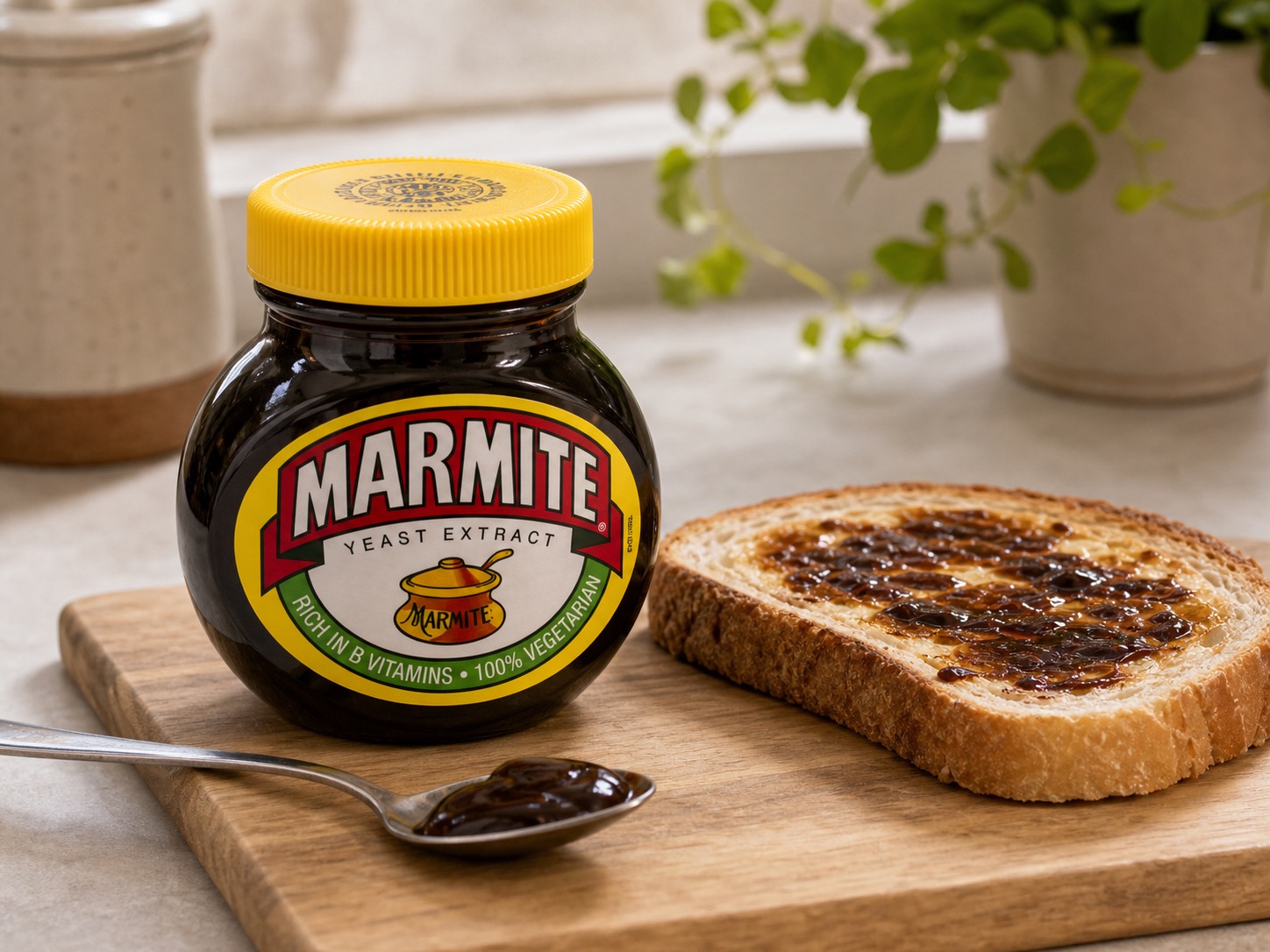

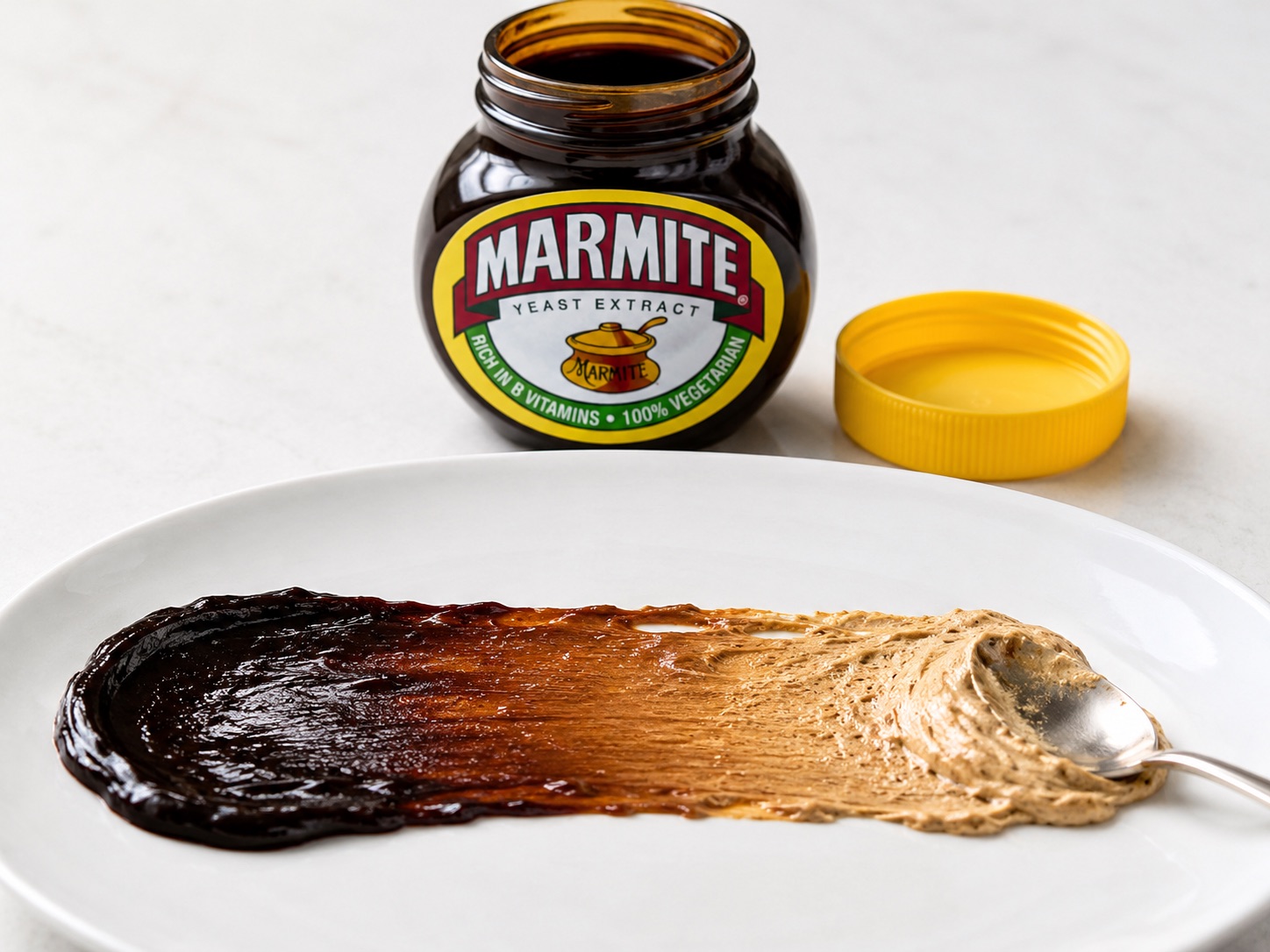
Most Marmite claims fall apart the moment you check them. This one survives, which is rare enough to be worth a whole piece. Take a blob of Marmite on a plate and whip it, hard, with the back of a spoon, for a minute or two. It lightens. Keep going and the famous near-black paste turns the colour of weak coffee, then milky beige, then something close to cream. I have tried it, and in the interest of honesty mine never went pure white. It went very pale, the colour of a milky coffee, which is exactly what the science says should happen. The “white” in the legend oversells it slightly. The transformation does not. People assume it is a trick. It is completely real, and the reason is quietly elegant.
It is physics, not chemistry
The instinct is to reach for a chemical explanation, some reaction with air that bleaches the stuff. That is not what is happening. The Marmite is not changing what it is made of at all. You could scrape the pale whipped version back together, leave it, and it would slowly darken again. Nothing has been created or destroyed. What has changed is what the Marmite is doing to light.
Marmite looks almost black for a simple reason: it is very good at absorbing light. Shine light at a smooth blob and most of it goes in and does not come back out, so your eye registers near-black. When you whip it, you beat thousands upon thousands of tiny air bubbles into the paste. Each bubble is a little boundary between air and Marmite, and at every one of those boundaries light gets bounced and bent rather than swallowed. The more you whip, the more bubbles you cram in, and the more the light is scattered back out towards your eye instead of being absorbed. Scatter enough light back and the surface stops looking dark and starts looking pale.
It is the same physics that makes other dark things go pale when you fill them with bubbles. Black coffee is nearly opaque, but the froth on top of it is fawn-coloured. Stout is famously dark, yet its head is creamy white. The liquid has not changed colour. The foam is just full of bubbles throwing the light around, and whipped Marmite is doing exactly that, only with a much stiffer paste that holds the bubbles in place so you can sit and admire the effect.
Why it feels like a myth
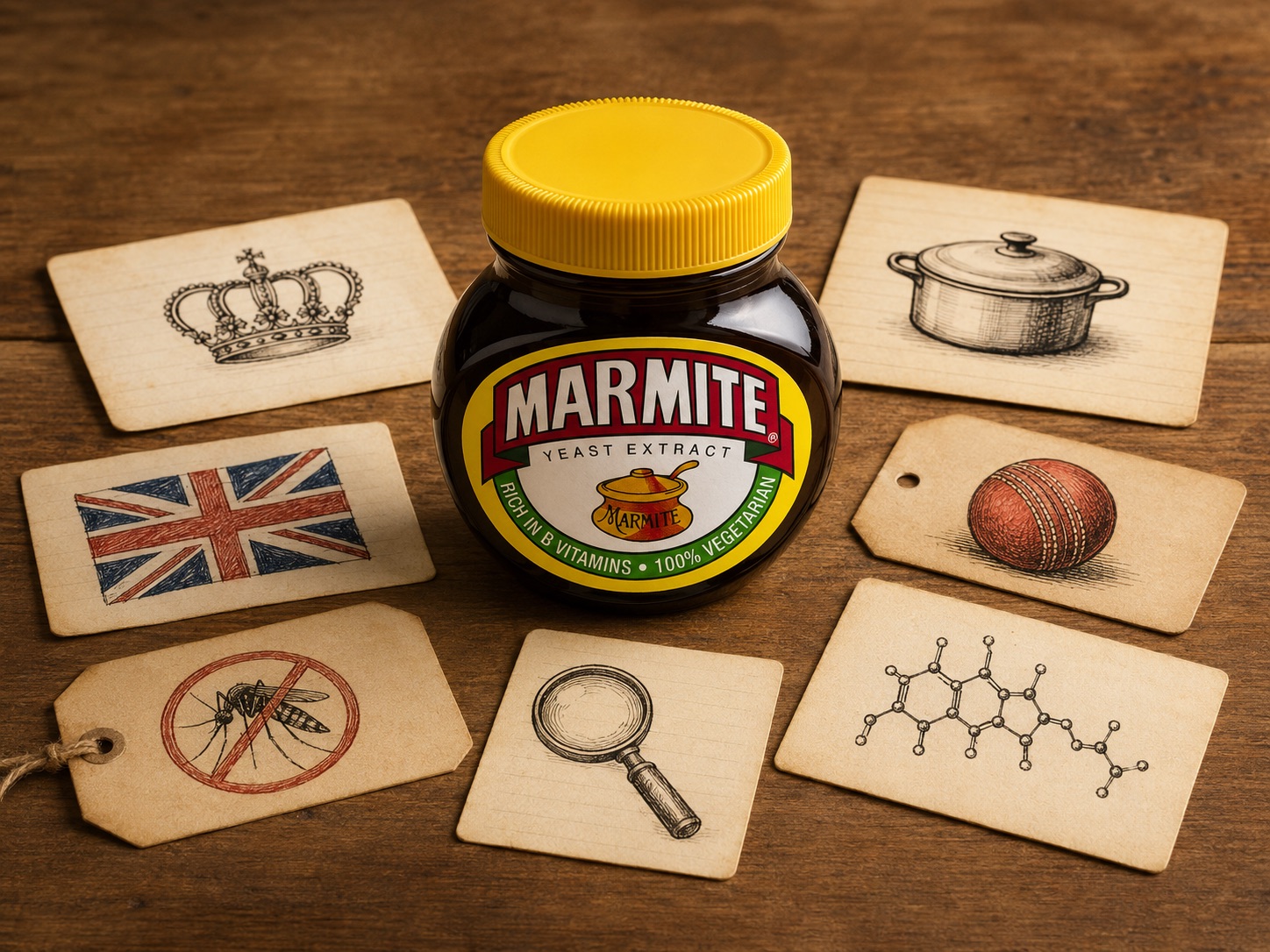
So why does “Marmite turns white if you stir it” get filed alongside the prison ban and the mosquito nonsense, as if it were another tall tale? Partly because it sounds like one. It has the same too-good-to-be-true ring as the fictions, and most things that sound like that about Marmite turn out to be wrong, so people reasonably assume this one is too. Partly because hardly anyone has a reason to whip Marmite for two solid minutes, so almost nobody has seen it happen, which keeps it in the realm of the rumoured rather than the witnessed.
But it has been a known piece of kitchen-table science for years, demonstrated in classrooms as a neat way to teach how colour and light and scattering work, written up by the popular science magazines, and it holds up every time. This is the rare Marmite “did you know” that you can settle yourself in the time it takes to make breakfast, with no equipment beyond a spoon, a plate and a bit of patience.
The one that is true
Every collection of myths needs one that turns out to be real, if only to keep the others honest, and this is it. Marmite is not banned in Denmark or British prisons, it will not keep the mosquitoes off you, and Margaret Thatcher almost certainly never ate it. But it really will go startlingly pale if you whip it long enough, for the most respectable of reasons. For more on why the unwhipped jar is so dark and so strong in the first place, there is a piece on why Marmite tastes the way it does.